Afraid to Write

I’m working on a story about parapsychology. Parapsychology includes paranormal phenomena such as telekinesis, telepathy, and clairvoyance. This is a huge stretch for me because I’ve never written anything remotely sci-fi or fantasy before. I’m scared.

Yes, I’m afraid to write.

I’m afraid that the story will tumble out horribly. That it won’t be realistic (ah duh, sci-fi is not), that it won’t be entertaining… that it simply won’t be good. I’ve got a ticker on the sidebar to keep track of my progress. Instead of writing this post, I should be writing in my novel.

But I think I’ll read instead.

Love Wins Analysis: Chapter 4: Does God Get What God Wants? (Part IV)

[This is part IX of a multi-part series on Rob Bell’s book, Love Wins. Note: Chapter 4 has been broken up into four parts. Chapter 4, part I can be found here, part II can be found here, and part III can be found here.]

Let’s work on closing out Chapter 4 of this book.

“Many people find Jesus compelling, but don’t follow him, because of the parts about ‘hell and torment and all that.’ Somewhere along the way they were taught that the only option when it comes to Christian faith is to clearly declare that a few, committed Christians will ‘go to heaven’ when they die and everyone else will not, the matter is settled at death, and that’s it. One place or the other, no looking back, no chance for a change of heart, make your bed now and lie in it . . . forever.

Not all Christians have believed this, and you don’t have to believe it to be a Christian. The Christian faith is big enough, wide enough, and generous enough to handle that vast a range of perspectives.

A Twitter friend of mine said this in her Goodreads review of this book:

“Speaking of Jesus, I don’t find many non-Christians that are hung up on the idea of hell. Most I know are hung up on the idea that Jesus is the only way. And that the Bible says seemingly contradictory things and you’d be stupid/silly to believe it. “

Doctrinally, I’d say that’s been my experience too. In general, I’d say non-Christians tend to be averse to Christianity because of the hypocrisy that runs rampant among many of its believers. (Side note: Tim Keller makes a great point in regard to why this behavior occurs among Christians in Chapter 4 of The Reason for God.)

As for the bolded part about not having to believe in eternal punishment/torment/hellfireandbrimstone to be a Christian, I start to get a little twitchy. Because even though the basic rule of being a Christian is being an obedient (“as best as you can”) follower of Jesus, there are all these doctrines and tenets that have kind of been hung around his neck as part of the package and it’s difficult to distinguish whether you can have Jesus without hell.

So can you? Continue reading “Love Wins Analysis: Chapter 4: Does God Get What God Wants? (Part IV)”

The emergent movement & postmodernism: Part V

Impact of the emergent movement

There’s a lot of criticism of the emergent stream. And much of it is valid. If taken too far, the emergent movement could possess the ability to completely deconstruct Christianity in an attempt to demolish it.

But on the flip side, the emergent movement can be used to challenge the missional arm of the church in a postmodern culture. I like the way Driscoll put it in a Desiring God video I recently watched. In essence, Driscoll asked what missions would look like if Christianity were foreign to the U.S.? How would foreigners assimilate American culture and adopt the tools to best reach those who do not know God or Jesus Christ in a mission field? Because Christianity has been so pervasive and long-standing in American culture, American Christians take their backyard missions field for granted and assume that current American culture will bow to its old way of doing things when in reality, American Christians would never expect that in traveling to any other nation. The emerging movement enables American Christians to see the United States with fresh eyes from a missional standpoint.

The Emergent Church has also served as a rubber band for those who have escaped from the sharp talons of legalistic Christianity. The movement has enabled many Christians to retain certain core truths but make their faith flexible and pliable—when exercised, this faith can be tested and stretched without breaking and completely falling apart. Bell, in Velvet Elvis, refers to legalistic faith as a brick wall: pull one brick out and the rest of the wall crumbles because its support hinges on that one brick.

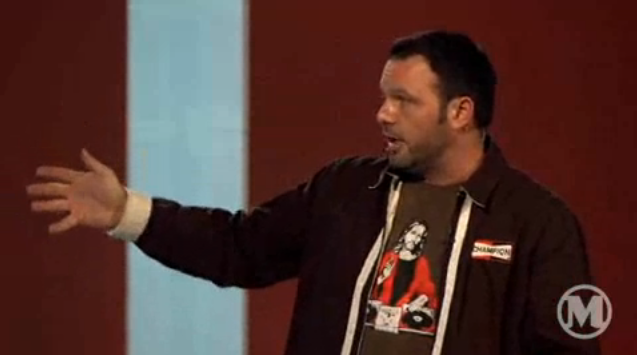
I’ve found emergent influence in dress. Older, more traditional Christians will complain that they can’t tell the difference between a young believer and a young non-believer because they simply look and act too much alike. Emergent influence in dress assists in blurring this distinction. Emerging Christians tend to dress down, and as some Christians complain, “look like the world.”  Emerging Christians will defend their choice of dress as part of cultural relevancy. Here’s a snapshot of Driscoll wearing a shirt of Jesus as a DJ while preaching.

There’s emergent influence in contemporary Christian art. Since I’m not an artist, I can’t define it very well but a look at the Mars Hill website (Rob Bell’s church in Grand Rapids, Michigan) will tell you all you need to know. I’ve provided a current snapshot of the website. (I don’t know if it changes.)

www.marshill.org

Is the emergent movement harmful to long-term Christianity?

Perhaps I’m an optimist in this area but I believe God is so much bigger than any one movement. If Judeo-Christianity has weathered all sorts of sects, migrations, movements, and off-shoots in the past 5,000+ years, it is likely to weather this one. God has promised to sustain and protect his church—not any one particular denomination but his “holy, catholic (universal) church.” The Emergent Church does not threaten or thwart God’s plans nor will it move God’s plans along any faster than He wants it to. The emergent movement can only be assessed in a Christian’s personal walk with God. How does that affect him or her? Has the emergent conversation added to or detracted from a person’s belief in the triune God? For some, the emergent movement has served to draw people closer to God in an effort to more fully “glorify Him and enjoy Him forever.” For others, the emergent movement is a distraction—a nuisance that must be eliminated in order to preserve the organized institution of Christianity. And there is yet another group who finds that while the emergent movement possesses many flaws, many of the questions and challenges it raises can prompt individuals to change their lives—and the lives of those around them—to better glorify, love, and serve God and others. This last group is the group I most identify with. To use another worn-out cliché, I am not willing to throw the baby out with the bathwater. (Even if the bathwater is very, very stinky and murky at times.) If that was the case, I would have walked away from Christianity the moment I left legalism.

The emergent movement & postmodernism: Part IV

Emergent and emerging

Some people, when speaking of the emergent movement, will use the words “emergent” and “emerging” interchangeably. However, Mark Driscoll takes good care to note that his Mars Hill church in Seattle is an emerging church (and part of an emerging conversation) rather than emergent. Driscoll’s distinction would be notable as he started out as part of the original emergent conversation and has since distanced himself from it. The reference to emerging is noted in Wikipedia as a “wider, informal, church-based, global movement” rather than the term emergent, which would specifically refer to those associated with the Emergent Village community (essentially the Emergent Church). Driscoll, in the following YouTube video, lists and defines four types of emerging voices:

  1. Emerging evangelicals: not trying to change Christianity, just trying to make it more applicable and more relevant
  2. House church evangelicals: Get rid of big church and meet in small groups like homes and coffee shops
  3. Emerging reformers: Believe in the reformed distinctives but try to make the church culturally relevant
  4. Emergent liberals: Calls everything into question including Christian orthodoxy without wanting to arrive at any answers

Note that Driscoll only uses the word emergent in connection the voices associated with the Emergent Village. This is the group Driscoll has publicly distanced himself from.

How does the emergent movement affect me?

The influence of the emergent church is pervasive in mainstream American Christianity. The main venue many of these emergent voices get their message out—apart from Internet-based distribution—is through their books. Don Miller is known for his New York Times bestseller Blue Like Jazz, Rob Bell has written a thought-provoking book titled Velvet Elvis, and Brian McLaren has recently released a book called A New Kind of Christianity that has unleashed a furor of criticism. While I find that many pastors eschew the emergent movement, many Christians are drawn to it. Perhaps it’s because the emergent movement has succeeded in making itself culturally relevant and practically applicable to those who do not hold theology degrees or work in Christian ministry for a living. Christians and non-Christians alike are taking notice of these works and this movement, even if they can’t quite define it.

Some time last year, my best friend [forever] (BFF) read Rob Bell’s book, Velvet Elvis, and insisted that I needed to read it. She promised it would help challenge my conventional notions and that it had helped her break some of the legalistic mindset she’d carried with her since graduating from a college that centered around a legalistic (and Pharisaical) lifestyle. I reluctantly borrowed her copy with a promise to read it only because she was my BFF. Here’s a short analysis I wrote last May:

When I was going through my “spiritual crisis” recently, my best friend handed me this book. She said, “You have to read it; it’ll change your outlook on Christianity.”I glanced down and read the title: Velvet Elvis. With a name like Velvet Elvis, how could this book be any good?

I opened the book up and began reading skeptically and with a critical eye. Bell starts out by discussing how he came a cross a paining of Velvet Elvis and then delves into this discussion of how there’s a big movement in history—something greater than ourselves happening. Standard fare from Rob Bell. After reading Bell’s response on Twittering the gospel, I was disillusioned with his outlook on Christianity. His answer seemed so vague… so unsatisfactory. His book couldn’t possibly offer anything better. Yet I made a promise to my friend and continued to push through the book.

To my surprise, Bell’s book isn’t as shallow as I’d thought.

While he repeats the rhetoric about a movement in history greater than ourselves, he explained Bible passages in a way that I’d never understood before. He draws heavily on Jewish culture to shed new light on Bible passages that once seemed so mundane. Never before had I known that the reference to “yoke” in Matthew 11:30 had deeper meaning than what oxen carry. And I never understood that the disciples functioned as Jesus’ talmidim. Bell’s writing style is clear but his message actually runs deep. …

Bell does seem to have a good grasp on the gospel but presents it in quite a different light. He acknowledges Jesus as the Son of God and “the way, the truth, and the life”–the only way to get to heaven. He also posits that truth can be found outside of the Bible. And since God is truth then anywhere truth is found, there God is. He uses Paul citing one of the Cretan prophets as an example of this.

He says that some Christians see their faith as a brick wall–pull out one brick and the structure of their faith begins to fall apart. He says that we need to be flexible. If something in our faith is wrong or proven as false, will we stray from the faith altogether?

A major problem I do have with this book is that nothing is absolute. He encourages Christians to question everything, including his book. Take nothing at face value. In fact, he asserts that God likes it when we ask questions. Turns out in Jewish culture, when rabbis ask students a question, students respond with… a question. According to Bell, straight answers are not standard. I don’t agree with this. There are absolutes in life and Bell doesn’t acknowledge or accept that.

While I’m not a fan of how Bell runs his church or the way he presents theology, Velvet Elvis is a book worth reading. I initially said I wouldn’t recommend it; I’ve since changed my mind. I’ve ordered my own copy and plan on rereading it, highlighting it, and marking it up. He makes some very many good points and I’m pleasantly surprised at how much I like this book. I’m afraid to pick up Sex God or his latest Jesus Wants to Save Christians but Velvet Elvis isn’t a bad read at all.

I have since returned my BFF’s copy to her and have my own copy with plans to re-read and highlight it. Velvet Elvis impacted me that much. And Velvet Elvis is indeed reflective of emergent conversation even if I wasn’t fully aware of it nearly a year ago.

The emergent movement & postmodernism: Part III

http://www.postmodern-art.com/postmodern_art_11.html

Postmodern background

From what I can gather, the emergent movement is part of a conversation that asks how Christians can minister in a postmodern (largely, secular) world.

Postmodernism developed as a reaction to the modernist movement. According to Wikipedia’s entry on the modernist movement, the term modernism “encompasses the activities and output of those who felt the ‘traditional’ forms of art, architecture, literature, religious faith, social organization and daily life were becoming outdated in the new economic, social and political conditions of an emerging fully industrialized world.” Interestingly, the wiki entry also notes that modernism rejected “the existence of a compassionate, all-powerful Creator.”

So postmodernism gets past all that modernist stuff, right? Not necessarily. In fact, some people see modernism and postmodernism as two sides of the same coin. Here are two definitions:

(1) A style and concept in the arts characterized by distrust of theories and ideologies and by the drawing of attention to conventions. (The Compact Oxford English Dictionary)

(2) Of, relating to, or being any of various movements in reaction to modernism that are typically characterized by a return to traditional materials and forms (as in architecture) or by ironic self-reference and absurdity (as in literature), or

of, relating to, or being a theory that involves a radical reappraisal of modern assumptions about culture, identity, history, or language. (Merriam-Webster)

Merriam-Webster’s latter definition (as opposed to its former) seems most appropriate to when referring to the Emergent Church.

At the risk of beating my readers over the head with more definitions, I’ll also refer to a Wikipedia entry that defines postmodern philosophy:

Postmodern philosophy is skeptical or nihilistic toward many of the values and assumptions of philosophy that derive from modernity, such as humanity having an essence which distinguishes humans from animals, or the assumption that one form of government is demonstrably better than another.

The wiki entry adds:

Postmodern philosophy has strong relations with the substantial literature of critical theory.

When you boil it down, the essence of postmodernism and its philosophy is rooted in criticism and critique. Question everything; take nothing at face value. Postmodern thought also moves away from superiority and toward equality (eg, humans aren’t superior to animals, capitalism isn’t better than communism). Postmodern thought has its place in society (eg, whites are not superior to blacks) but like all things, can be bad if taken too far.

So when I stumbled onto the Wikipedia entry about Postmodern Christianity, I found it interesting to read the following:

Many people eschew the label “postmodern Christianity” because the idea of postmodernity has almost no determinate meaning and, in the United States, serves largely to symbolize an emotionally charged battle of ideologies.

Today’s Emergent Church stresses a friendly conversation and an amiable exchange of ideas. But the identical foundations of secular postmodernism and the Emergent Church cannot be overlooked.

Criticism and critique. For example, consider how the Emergent Church began: by a group of friends who felt “disillusioned and disenfranchised” by 20th century Christianity. In other words, they became critical and sought to challenge the status quo. (Which I don’t have an issue with.) The critique of 20th century Christianity, however, never rose above just that—a critique. The critiques merely evolved into conversation, which leaders of the emergent stream want to keep amiable so as not to offend anybody within all sects and denominations of the Christian realm. My issue here is that constant talk doesn’t rectify wrongs or things that need to desperately be addressed in 21st century Christianity. There is a time for talk and a time for action. (Ecclesiastes 3:1-8)

No determinate meaning. Like postmodernism, the emergent movement also has “no determinate meaning.” As I mentioned earlier, its leaders want it kept that way. One will find varying definitions of the Emergent Church (aka the emergent movement aka the Emerging Church aka the emergent stream, etc.) all over the Internet. I can’t help but think of Challies’s earlier reference of trying to nail Jello to the wall when trying to define the Emergent Church. My attempt here is only as skewed as my personal view. Perhaps the Emergent Church leaders also intended that as well—a lack of objectivity to define the emergent movement only fuels further discussion and conversation.

Deconstructionism. Also very much like postmodernism, the Emergent Church seeks deconstruction. Where postmodernism was deconstructivist in the sense that it sought to undermine the foundations of the subjects it would challenge, the Emergent Church seeks to deconstruct the organized and institutionalized church. The three main areas of deconstruction the Emergent Church addresses are:

  1. modern Christian worship,
  2. modern evangelism, and
  3. the nature of modern Christian community

Followers of the emergent movement can be found worshiping with others in homes rather than a church building and talking openly about their faith with others in a non-traditional setting such as a bar.

(L-R) Rob Bell, Brian McLaren, and Donald Miller

Leading emergent voices also stress that Christianity is just one big story that’s unfolding. Bell spoke about this in his books Velvet Elvis and Jesus Wants to Save Christians and discussed it in an April 2009 Christianity Today interview. Brian McLaren, during the Washington National Cathedral’s Sunday Forum in February 2008, declared that “the Christian faith is [best] understood as a story by a postmodern generation that sees itself as part of the developing storyline,” according to the Christian Post. McLaren also went on to say that postmodern believers viewed Bible stories as part of a “bigger picture and larger story.” And finally, a close friend of mine has been challenged by Don Miller’s latest book, A Million Miles in a Thousand Years, to write a better story in her own life. A story, I can only assume, that is a small part of a bigger picture within the large framework of Christianity.

The emergent movement & postmodernism: Part II

Emergent history & definition (or lack thereof)

Now, to define the Emergent Church, as noted blogger Tim Challies says in reviewing the book Why We’re Not Emergent (By Two Guys Who Should Be):

“To borrow a tired cliche… is much like trying to nail Jello to the wall.”

Indeed. In a Google search for “emergent church” or “emerging church,” does not yield anything concrete. The terms “Emergent Church,” “emerging church,” “emergent movement,” and “emergent stream” are all used interchangeably by many people to refer to the same thing. (However, a distinction between “emergent” and “emerging” will be noted later.) One will likely stumble across someone’s attempts to define the Emergent Church, usually with a significant bias either for or against. Even the Emerging Church entry in wikipedia contains various citations for “weasel words,” vague phrasing, unverified claims, and lack of references. The Wikipedia entry complaints are actually ironic: the complaints actually perform a great job of describing the emergent movement. I don’t say that necessarily as a criticism. The founders of the emergent movement do not want it to be defined. So for the wiki entry to use weasel words and vague phrasing is the best that any writer of that wikipedia entry can do. There is no clear-cut, textbook definition.

When I speak of the Emergent Church, I refer only to the American aspect of it. (The emergent movement outside of the U.S. is long and varied.) A few core people at the foundation of this movement in the United States are Brian McLaren, Spencer Burke, Doug Pagitt, Rob Bell, Don Miller, and Mark Driscoll. (However, Driscoll has since disassociated himself and his ministry with this movement.) McLaren especially seems to be the driving figure of the Emergent Church and the community website Emergent Village, which loosely defines itself as “a growing, generative friendship among missional Christians seeking to love our world in the Spirit of Jesus Christ.”

Based on the Emergent Village About page, the emergent movement appears to have been born in the late 1990s by a group friends who felt “disillusioned and disenfranchised by the conventional ecclesial institutions of the late 20th century.” By 2001, this group of friends official declared themselves and their beliefs as “emergent.” Here’s a statement from the website explaining why the word emergent was chosen:

In English, the word “emergent” is normally an adjective meaning coming into view, arising from, occurring unexpectedly, requiring immediate action (hence its relation to “emergency”), characterized by evolutionary emergence, or crossing a boundary (as between water and air).

As intended, the Emergent Church is now a burgeoning movement within 21st century Christianity.

Unofficial buzzword: conversation

The Emergent Village site lists four buzzwords that are thrown around in its community: growing, generative, friendship, and missional. I believe it failed to list a very important fifth: conversation.

The word “conversation” is as foundational to the emergent movement as the word “triage” is to the business world. On various websites I’ve read, in an attempt to gain a better understanding of the Emergent Church, the word conversation is thrown around like water at a baptism. Leaders of the movement stress that it’s all about conversation. (Also note that the leaders of this movement do choose their words carefully.) Here’s Merriam-Webster’s definition of what a conversation is (as it relates to our current usage):

2 a (1) : oral exchange of sentiments, observations, opinions, or ideas
(2) : an instance of such exchange : talk <a quiet conversation>
b : an informal discussion of an issue by representatives of governments, institutions, or groups
c : an exchange similar to conversation

This is exactly what the leaders of the Emergent Church want: an exchange and an informal discussion.

Back in seventh grade, I used to participate in something called “rap sessions.” The point was to air our grievances and discuss any issues weighing on our minds. But nothing was ever resolved. It was simply an outlet for talking. The emergent movement (also referred to as the “emergent stream” to represent the continuous flow of conversation), in essence, is nothing more than just a Christian rap session on a grand scale. We all have our problems with Christianity but the emergent movement allows Christians to simply engage in conversation and air their observations without ever really rectifying any issues that might be plaguing them.

The American emergent movement and postmodernism: Introduction & Part I

http://www.smallfire.org/cota_ordo.html

I’ve written a series on the American emergent movement, its brief history, its lack of definition, its connection to postmodernism, and its effect on cultural Christianity in the United States. It’s possible to read up on the emergent movement and feel like you’re spinning your tires in a ditch. I’ve tried my best to avoid that in this series and provide some kind of clarity on the subject.

I tackle a multitude of things, which may or may not become clear through this series:

  1. My experience at a postmodern/emerging worship service
  2. The Emergent Church’s history & definition (or lack thereof)
  3. The unofficial buzzword of the movement: conversation
  4. The Emergent Church’s connection to postmodern philosophy
    • Definition of modernism
    • Definition of postmodernism
    • Definition and essence of postmodern philosophy
      • Rooted in criticism and critique
      • Rooted in a shift away from superiority and toward equality
    • Discarding the label “postmodern Christianity”
  5. The identical foundations between secular postmodernism and the emergent movement
    • Criticism and critique are at the heart of each movement
    • Neither movement has a clear, determinate meaning
    • Both movements seek deconstruction in some fashion
  6. The theme of Christianity as a running narrative or an unfolding story
  7. Distinguishing between emergent and emerging (according mainly to Mark Driscoll, pastor of Mars Hill Church in Seattle)
  8. How the emergent movement affects my life
    • My experience reading Rob Bell’s Velvet Elvis
  9. Impact of the emergent movement
    • Cultural relevancy in domestic missions
    • Expansion of faith post-legalism without it falling apart
    • Influence on Christian dress
    • Influence in Christian art
    • Its possible effect on long-term Christianity

This might as well become a Wikipedia entry in and of itself. My hopes are, however numerous or few of you, that you’ll be able to read through this series with some degree of ease in order to gain a fuller understanding of the emergent movement. My apologies in advance if I fall into emergent-speak that is at all unclear.

For the past day or two, I’ve been doing some research and reading on the Emergent Church and postmodernism. My husband, baffled by my sudden interest in the movement, asked why. I explained that the Emergent Church (which, by the way, isn’t really an institutional church, just a term assigned to the emergent movement) and its connection to postmodernism has become pervasive in Christian culture. I’ve seen it in the blogs and books I read, I see it in some cutting-edge, hip magazines, and I see it in some worship services. The emergent movement’s influence is one of those things that I’ve been able to see but have not been able to define. So, I’ve suddenly become filled with the desire to define it.

How is one able to “see” the emergent movement without being able to define it? Consider the following experience: Continue reading “The American emergent movement and postmodernism: Introduction & Part I”

NaNoWriMo: An excuse for writers to be totally insane for 30 days

www.nanowrimo.orgThis is my fourth year of participating in National Novel Writing Month, aptly shortened as NaNoWriMo (www.nanowrimo.org). (It’s also my third consecutive year.) The time I’m taking to write this is time I’m taking away from my novel. But that’s okay. As far as word counts go, I’m at least 9 days ahead (around 15,200 words). But I am also functioning on 7 hours of sleep for the past 48 hours so that’s not good. Call me crazy, call me an insomniac, but you can’t say I haven’t been productive.

So let’s break it down:

What is NaNoWriMo? Well, it’s a contest ambitious (and brave!) writers undertake during the month of November. The goal is to complete a work of fiction with a minimum of 50,000 words within 30 days. You start at midnight local time on November 1st and end by 11:59pm local time November 30th. You don’t start any earlier or finish any later.

What’s the prize for winning? Patting yourself on the back. The gratification of knowing you accomplished something that huge in one month. And a virtual certificate. Yeah… that’s pretty much it.

Why do people do this? NaNo is the cure for aspiring writers who say, “One day I’ll write a novel” but never actually get around to it. November is now a designated month to get that out of the way.

Why do YOU do this? Because I love it. And I love writing. NaNoWriMo gives me the freedom to simply write. It also challenges me to shut off my inner editor and just KEEP WRITING. It challenges me to reach a very difficult goal in a short period of time that would normally take me a long period of time. (I wrote my very first novel by hand in 6th grade and left it unfinished until 9th grade. And that was when I had more time on my hands [so to speak]!) When it’s not the month of November, I’m working on revising and polishing my 2007 NaNoWriMo novel for eventual publication.

I popped my NaNo cherry in 2005 and began writing a suspense novel. Due to various circumstances and hitting that annoying middle point of the novel where the creative muse runs dry, I never finished it. I skipped NaNo in 2006 due to poor health and re-emerged for a return in 2007. That year, I had a clear vision with a rough outline for what I wanted to write by October. I was dedicated and determined to pump out a complete novel and meet the minimum requirements. I did hit that dry spot that occurs in the middle of the novel (and the middle of the month) but trudged through it with gritted teeth to emerge victorious by November 30th. And why, yes, I did hold down a full-time job at the time, thanks for asking.

Working during train commuteHow was I crazy enough to do it? I worked on my novel every day:

  • morning and evening commutes on the train,
  • a full hour of typing for lunch (so technically I took an hour and a half—wouldn’t recommend that), and
  • slaved for hours over it during the weekends.

In 2008, I decided that I had a story dancing around in my head that I wanted to write but wouldn’t be for anyone else’s eyes. So I got to it and wrote it. The story came easily and quickly but finished 2K short a few hours before the deadline on Nov. 30th. So I continued the story by drafting an unnecessary 2,000+ words to meet the minimum requirement by the deadline.

Another successful NaNo year gone by, it’s now November 2009. And I intend to win yet again with my coming-of-age Young Adult novel that I’ll probably never see the light of day since it’s far-fetched and a broken off-portion of a series that I haven’t penned. Yet. However, you can feel free to read the “terrible, horrible, no good, very bad” excerpt here (click Novel Info and scroll to Excerpt).

I’ve created a writing-related account on Twitter, @kassiella, in which I follow a host of editors, literary agents, and published and aspiring authors. Reading about the publishing industry and getting tips on writing has really inspired and encouraged me to continue working and plugging away at my work-in-progress (WIP). So when I discovered Alexandra Sokoloff’s post, “Nanowrimo Day 1: Your First Draft is Always Going to Suck,” I nearly cheered at my computer desk. It’s a blog post bursting with truth that should encourage all NaNo writers to mentally banish their inner editor and JUST WRITE. Here’s an excerpt:

Your first draft always sucks.

I’ve been a professional writer for almost all of my adult life and I’ve never written anything that I didn’t hit the wall on, at one point or another. There is always a day, week, month, when I will lose all interest in the project I’m working on. I will realize it was insanity to think that I could ever write the fucking thing to begin with, or that anyone in their right mind would ever be interested in it, much less pay me for it. I will be sure that I would rather clean houses (not my own house, you understand, but other people’s) than ever have to look at the story again.

And that stage can last for a good long time. Even to the end of the book, and beyond, for months, in which I will torture my significant other for week after week with my daily rants about how I will never be able to make the thing make any sense at all and will simply have to give back the advance money.

manuscriptsEven though you will inevitably end up writing on projects that SHOULD be abandoned, you cannot afford to abandon ANY project. You must finish what you start, no matter how you feel about it. If that project never goes anywhere, that’s tough, I feel your pain. But it happens to all of us. You do not know if you are going to be able to pull it off or not. The only way you will ever be able to pull it off is to get in the unwavering, completely non-negotiable habit of JUST DOING IT.

Your only hope is to keep going. Sit your ass down in the chair and keep cranking out your non-negotiable minimum number of daily pages, or words, in order, until you get to the end.

This is the way writing gets done.

Some of those pages will be decent, some of them will be unendurable. All of them will be fixable, even if fixing them means throwing them away. But you must get to the end, even if what you’re writing seems to make no sense of all.

….

At some point you will come to hate what you’re writing. That’s normal. That pretty much describes the process of writing. It never gets better. But you MUST get over this and FINISH. Get to the end, and everything gets better from there, I promise. You will learn how to write in layers, and not care so much that your first draft sucks. Everyone’s first draft sucks. It’s what you do from there that counts.

Read Alexandra’s brilliant post in its entirety here. If you’re a writer, this should encourage you. If you’re not writing but want to, really, WHAT are you waiting for?

(typing photo from Elmine)

My messed-up imagination

Because I am doped up on cold and flu medicines, my equilibrium is off, and I’m feeling rather spacey, I’m going to use my blog here to just rant about nothing. Nothing that makes sense to anyone else anyway. And if it’s really bad, when I come to, I may take this down. I don’t know.

In any event, I’ve come to the conclusion that I’ve got a really messed-up imagination. By Christian and non-Christian standards, you wouldn’t believe some of the stuff that I’ve written. Some of it’s so far-fetched that it simply boggles the mind that I could have come up with it to begin with. Some of it’s incredulous. I need to go up to the loft, dig up some of the stuff I wrote (as in literally—wrote by hand) when I was a preteen, and type it all out. I’ve written 200-300 looseleaf pages of a novel. None of it will ever see the light of day because the stuff rivals L. Ron Hubbard’s books for believability. And they’re so embarrassingly bad. Want to blackmail me? Get your hands on some of that stuff. I’d turn darker than an a red delicious.

I have a storyline running through my mind. Different stories have been running through my mind at different times since I was 12. I may take every NaNoWriMo that comes along and actually put it on paper. Heaven knows I have the characters, plot, subplot, and conflict to keep it going to 50,000 words. Ending it may be the difficult part.

It’s October 22 and I’m not working steadily for the ad agency. Last year at this time I was so it’ll be interesting to see if I can crap out 50K words by November 15. (Although I doubt it.) Last year, I finished my novel just under 50K and had to keep writing nonsense to hit the 50K word mark. It’s a novel no one will probably ever see or read but it’s part of that running storyline I have in my head.

NaNoWriMo 2009 Participant BadgeSo I may just take some time off from revising my current novel to do NaNo. I’ll probably go it alone this year instead of attending write-ins like I’ve done in the past. But I’m rambling out of a head filled with DayQuil and Theraflu. Writing a chapter in my novel should prove to either be interesting or a challenge.

Now that I know what I want to write for NaNo, I can’t wait to get started. A coming-of-age story about a 14-year-old rich girl on Long Island. (Not autobiographical at all.)

November 1 can’t get here soon enough.