
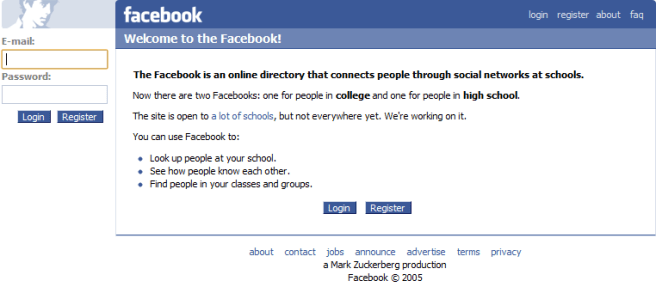
When I joined Facebook six years ago, it was a social networking site only open to college kids. When I joined, I had to have a .edu email address and join my college network. Networks were rather small and since I wasn’t really close to anyone at my school, I rarely used Facebook. Apart from status updates, the only other thing available was to join local groups such “I hate people who walk slowly over the Unispan!” or “I wish I had a girl’s superpowers so I could wear tight, revealing clothes in the middle of winter.” (Yes, these were real groups that existed.) Due to Facebook’s college students-only policy, MySpace was the dominating social network since it was available to nearly anyone with an email address (of any kind).
I never dreamed that by the end of the decade, I’d be forced to choose between my desire for keeping my information private or having it broadcast — not only to my 200-plus Facebook friends but also to advertisers who want to fine-tune the ads they target at me or sites that want to let you know that I “Like” their brand or product.
Today, Facebook is open to anyone and currently boasts more than 400 million users globally. In addition to group pages, it now has features such as applications (FarmVille, ZooWorld), Like (formerly Fan) pages, Share, and Facebook connect to connect your profile page with other sites on the Web. What used to be a small networking site among college students is now a social behemoth that can broadcast nearly anything almost anywhere in a matter of seconds.
Some people will argue that once you post your information out on the Internet, in any way, you can’t expect it to be private. These people view the Internet as the information “town square” — in other words, the public information areana. In the past, I would have agreed with that to the extent of the information not being excluded from public searches (Google, Bing, etc.).
But to give the impression that a person’s information can be kept private while finding subversive ways to keep it public is misleading. In the six years I’ve been using Facebook, I’ve watched the social network giant cross that line time and time again. There are enough stressors and things to worry about in this world — Facebook’s complicated privacy controls shouldn’t have to be one of them. Continue reading “Is the idea of privacy simply a long-lost memory?”
 This Journey Is My Own