Bible Verses of the Week

Image from alex-diaz.com

I “randomly” turned to Psalm 103 in my devotions yesterday, and it was full of quote-worthy verses. Here’s a passage that stood out to me:

The LORD is compassionate and gracious, slow to anger and abounding in lovingkindness. (v. 8)

Oddly enough, a few days ago, I read in Joel 2:

Now return to the LORD your God, For He is gracious and compassionate, slow to anger, abounding in lovingkindness and relenting of evil. (v. 13)

I like these verses because they are reminders of God’s attributes. In the midst of my pain, stress, and anxiety, I don’t feel a God who is any of these things. (Well, maybe the slow to anger part because I haven’t been smited yet.)

But God is gracious: I have three, going on four, part-time jobs in a down economy.

God is compassionate: I am earning money to pay bills and start a freelancing business.

God is slow to anger: In all the stupid ways I’ve disobeyed him and blasphemed, he still loves me.

God is abounding in lovingkindness: He has surrounded me with supportive friends and family.

God is relenting of evil: Oh, the punishment I deserve for being a rebellious child and having my heart set against him!

Satan has really set some attacks against me so that I destroy myself. But I am thankful that God’s truths are reiterated in different ways.


Self-Esteem and Self-Confidence: Shedding “Worm” Theology

Image from fatherthywillbedone.com

Before I became a born-again Christian at 16 years old, my problem at that time was that I didn’t have enough “self-esteem” and “self-confidence.” I didn’t believe in myself enough, and I didn’t try hard enough to believe in myself (which to be honest, I didn’t because I was an angsty, grungy teenager who thought it was cool to revel in my depression and suicidal bent).

Enter in born-again fundamentalist Christianity.

Fundamentalist Christianity says that one must not believe in self and only in Jesus Christ. Fundamentalist Christianity has no room for self-esteem, requiring a believer to place his or her trust solely in Jesus Christ.

Then I entered Protestantism and encountered a softer version of the same thing: Solo Christo! (This really refers to a theological belief of salvation, but this is the prescription of many orthodox Christians when it comes to problems with self-esteem.)

For a long time then, I believed self-esteem and self-confidence were wrong. I eschewed these things because my sole worth should be found in God and not in myself. I engaged in “worm” theology: Oh, I’m such an awful, terrible sinner. There is no righteousness in me. All righteousness is found in God, and I’m poor, pathetic, pitiful soul. I suck at life and I’m so lucky God saved me because I’m totally worthless otherwise.

Image from bn.com

Beginning last week, I started reading Jillian Michaels’s book, Unlimited: How to Live an Exceptional Life, and started seriously thinking, Maybe it’s time for me to walk away from Christianity because I like what Jillian’s saying about reclaiming and recapturing my life. I want to have self-esteem. I want to have self-confidence. I want to stop obsessing and feeling like a poor, pathetic little shit all the time.

But as I got further and further into Jillian’s book, I realized that a lot (not all) of what she says actually lines up with scripture. (Her chapter on Forgiveness and Accepting Responsibility was so solid, it blew me away.) And I realized that self-esteem and self-confidence do NOT need to contradict Christianity and God’s word. How?

In Mark 12, a scribe comes up to Jesus to test him. The scribe asks, “What is the greatest commandment?”

Jesus answered, “The most important is, ‘Hear, O Israel: The Lord our God, the Lord is one. And you shall love the Lord your God with all your heart and with all your soul and with all your mind and with all your strength.’ The second is this: ‘You shall love your neighbor as yourself.’ There is no other commandment greater than these.” —Mark 12:29-31

So Jesus lays it down: we are to love God with everything we have first. Then we are to love our neighbor as ourselves.

The assumption is we already love and esteem ourselves. If we do not, how are we able to love and esteem others better than ourselves (Philippians 2:3)? So one must tackle the challenge of learning to love and esteem oneself first before being able to truly love and esteem others better. Consistently treating others better than you treat yourself leads to an erosion of self-love and a path to possible codependency and people-pleasing (needing the approval of others).

An example: think of the mom who sacrifices herself on the altar of her children. This mother is constantly shuttling her kids to soccer practice, gymnastics, ballet class, and Boy Scouts but never takes any time for herself, investing her life in her children at great detriment to her health. She will likely be one stressed out and unhappy mommy. She may have high blood pressure,  feel dizzy, and tired all the time. Yet think of the other mom who shuttles her three kids to the exact same activities (still investing immensely in her kids) but once a month, goes to a spa to relax and get pampered. Three times a week, she jogs outdoors for 20 minutes simply to clear her head. Maybe she’ll even join a bi-monthly knitting group so she can engage in her own hobbies so she is invested in herself enough so that she can take care of her children. The latter mom is likely to be in an overall healthier position (mentally and physically) than the former.

A person who invests in herself first is better able to love and serve those around her. I do a better job helping people on 7 hours of sleep than I do 4 hours.

All this talk of self-love is probably making some Christians twitchy. It sounds odd and new age-y. But remember, Jesus assumed that we would already love ourselves and from that, commands us to love our neighbor. As Christians, if we don’t love ourselves, we are sinning. Continue reading “Self-Esteem and Self-Confidence: Shedding “Worm” Theology”

Love Wins Analysis: Chapter 8: The End Is Here

[This is the FINAL part of a multi-part series on Rob Bell’s book, Love Wins.]

Indeed, the end is here! And I know you and I are probably both glad for it.

Bell gives his testimony of how he came to know God’s love and invites his readers to trust God and that “the love we fear is too good to be true is actually good enough to be true.” Bell reminds his readers that the decisions they make today will impact the future, the hereafter.

This invitation to trust asks for nothing more than this moment, and yet it is infinitely urgent. Jesus told a number of stories about this urgency in which things did not turn out well for the people involved. One man buries the treasure he’s been entrusted with instead of doing something with it and as a result he’s “thrown outside into the darkness.” Five foolish wedding attendants are unprepared for the late arrival of the groom and then end up turned away from the wedding with the chilling words “Truly, I tell you, I don’t know you.” Goats are sent “away” to a different place than the sheep, tenants of a vineyard have it taken from them, and weeds that grew alongside wheat are eventually harvested and “tied in bundles to be burned.”

This paragraph begs for an explanation, begs for elaboration because of all the images and stories presented here. But Bell only offers this:

These are strong, shocking images of judgment and separation in which people miss out on rewards and celebrations and opportunities.

Bell glosses over the striking imagery presented in each of the parables he quickly presents, completely ignoring the deeper meaning and symbolism that lies in each because the explanation wouldn’t support his purpose in writing the book. It’s a shame because that large paragraph (not typical for Bell; I’ve done my best to adhere to his short line breaks) prompts more questions than Bell will ever be inclined to answer.

Love is why I’ve written this book, and
love is what I want to leave you with.

I walked away from this book with more frustration and unanswered questions rather than love and peace the fills the soul.

Love Wins Analysis: Chapter 7: The Good News Is Better Than That

[This is part XIII of a multi-part series on Rob Bell’s book, Love Wins.]

Image from covdevotions2010.blogspot.com

Heading into Chapter 7, the reader gets the sense that Bell is wrapping things up. He details the parable of the Prodigal Son very much in Tim Keller-like style, giving equal attention to the elder and young brothers. But then he also focuses on the attributes of the father in how he dealt with his sounds:

The father redefines fairness. … Grace and generosity aren’t fair; that’s their very essence. The father sees the young brother’s return as one more occasion to practice unfairness. The younger son doesn’t deserve a party—that’s the point of the party. That’s how things work in the father’s world. Profound unfairness.

The odd thing as I read that is that well, yes, I agree. God is unfair. And somehow I see this as evidence that bolsters a Reformed theologian’s argument rather than Bell’s idea of religious universalism.

People get what they don’t deserve.

Bell and I still agree.

Parties are thrown for younger brothers who squander their inheritance.

I put on brakes here not because I disagree with the statement as it’s written, but I worry that the implication is that it’s okay to “squander” an inheritance because a party gets thrown anyway. (Romans 6 warns against this.)

As Bell continues to develop his idea of this widely known parable (shifting away from Keller), Bell seems to redefine “hell” as a person living in the enslavement of his or her own selfish attitudes and vices in the presence of a loving and generous God.

Jesus puts the older brother right there at the party, but refusing to trust the father’s version of the story. Refusing to join in the celebration.

Hell is being at the party.
That’s what makes it so hellish.

… In this story, heaven and hell are within each other,
intertwined, interwoven, bumping up against each other.

If the older brother were off, alone in a distant field,
sulking and whining about how he’s been a slave all these years and never even had a goat to party with his friend with, he would be alone in his hell.
But in the story Jesus tells, he’s at the party, with the music in the background and the celebration going on right there in front of him.

Later on, Bell says:

We create hell whenever we fail to trust God’s retelling of the story.

The odd thing is, I see Bell’s connection. But I fear that his conclusion is simply just a leap. This idea is not easily pulled from the text, and when you frame the parable of the prodigal son in the context of a book on heaven, hell, and fate, sure, it somewhat makes sense. But out of the context of Love Wins (and in context of the rest of the Bible), I don’t know that Bell’s interpretation of the story holds up. And therefore, ultimately, I think it falls apart as a whole.

Bell later on admits that people who reject God do suffer punishment:

We’re at the party,
but we don’t have to join in.
Heaven or hell.
Both at the party.

… To reject God’s grace,
to turn from God’s love,
to resist God’s telling [of our story],
will lead to misery.
It is a form of punishment, all on its own.

This is an important distinction, because in talking about what God is like, we cannot avoid the realities of God’s very essence, which is love. It can be resisted and rejected and denied and avoided, and that will bring another reality. Now, and then.

We are that free.

This is the part where I imagine Reformed Christians chafing at the collar at that last statement. But Bell continues on to unequivocally state that yes, hell exists and people can create it. But I fear Bell is too equivocal in what that hell is (negative attitudes and vices).

When people say they’re tired of hearing about “sin” and “judgment” and “condemnation,” it’s often because those have been confused for them with the nature of God. God has no desire to inflict pain or agony on anyone.

God extends an invitation to us,
and we are free to do with it is [sic] as we please.

Saying yes will take us in one direction;
saying no will take us in another.

… We do ourselves great harm when we confuse the very essence of God, which is love, with the very real consequences of rejecting and resisting that love, which creates what we call hell.

I’ll end this chapter analysis with a quote I liked (in light of the parable of the two sons):

Our badness can separate us from God’s love,
that’s clear.
But our goodness can separate us from God’s love as well.

Neither son understands that the father’s love was never about any of that. The father’s love cannot be earned, and it cannot be taken away.

It just is.

Love Wins Analysis: Chapter 6: There Are Rocks Everywhere (Part II)

[This is part XII of a multi-part series on Rob Bell’s book, Love Wins. Note: Chapter 6 is two parts; read Chapter 6, part I here.]

Image from http://www.galacticbinder.com

After rambling on some random rabbit trail about “mystics” and the “Force,” Bell asserts that “Jesus is bigger than any one religion.”

Ah, durr. But then we get to Jesus’ claim in John 14 of being “the way and the truth and the life. No one comes to the Father except through me.”

Remember that acquaintance of mine I quoted from Goodreads who said that she encountered people more hung up on this statement than on hell? I said I agreed with her.

What he doesn’t say is how, or when, or in what manner the mechanism functions that gets people to God through him.

John 3, John 16.

He doesn’t even state that those coming to the Father through him will ever know that they are coming exclusively through him.

John 14:6-7; John 17.

He simply claims that whatever God is doing in the world to know and redeem and love and restore the world is happening through him.”

I agree with the overall idea of the statement but I’m not sure it’s as “simplistic” as Bell makes it sound. Jesus has consistently proven to be accessible to the multitudes in a simple manner with a highly complex undertone in his parables and teaching—so complex that even the disciples who were with him rarely “got” what he was speaking of without Jesus having to explain himself first. So let’s watch Bell tackle Jesus’ bold statement of being the only way to God using mental gymnastics (because really that’s what it feels like to me).

And so the passage is exclusive, deeply so, insisting on Jesus alone as the way to God. But it is an exclusivity on the other side of inclusivity.

Dude, what?!

After explaining that exclusivity defines the traditional view of hell (“in or out”) and inclusivity is universalism (all roads lead to the same God), Bell says:

And there is an exclusivity on the other side of inclusivity. This kind insists that Jesus is the way, but holds tightly to the assumption that the all-embracing, saving love of this particular Jesus the Christ will of course include all sorts of unexpected people from across the cultural spectrum.

As soon as the door is opened to Muslims, Hindus, Buddhists, and Baptists from Cleveland, many Christians become very uneasy, saying that then Jesus doesn’t matter anymore, the cross is irrelevant, it doesn’t matter what you believe, and so forth.

Not true.
Absolutely, unequivocally, unalterably not true.

What Jesus does is declare that he,
and he alone,
is saving everybody.

And then he leave the door way, way open. Creating all sorts of possibilities. He is as narrow as himself and as wide as the universe.

He is as exclusive as himself and as inclusive as containing every single particle of creation.

Bell is careful to write “Jesus is the way” omitting the oft-used word “only” or forgoing the italicization of “the.” (Just an observation. Jesus does not use the word “only” here although one could argue that it’s implied.) The problem here, which Bell raises by bringing in Buddhism, Hinduism, Islam, etc., is that Bell affirms Jesus is present in all of these different religions that claim to be salvation or divine attainment in some form. It’s like reverse religious universalism, in a way. Instead of all paths leading to the same God, Bell appears to be saying that Jesus is present in all of these paths.

So Jesus is the prophet Mohammad to Islam.

Jesus is nirvana—the place of Enlightenment.

Jesus is Vishnu, Brahma, Shiva, Shakti, or any of the number of Hindu gods.

For some reason, this idea seems really offensive to me. As if Jesus isn’t accessible in his own form, in his own way, he must materialize in different forms like a shape-shifter of the universe. I think I’d be just as offended if a Muslim told me that Mohammed was a shape-shifter who appears as Judeo-Christian Messiah to bring salvation to Jews and Western Gentiles. My mind can’t fully grasp the idea Bell is throwing out here.

Again, we’re back to religious universalism: yes, all paths do lead to the same God because as Bell seems to say since Jesus is present in all these religions, everyone in these religions reaches the same God.

It’s the most astounding mental gymnastics I’ve ever encountered.

Jehovah God, the Old Testament God was clear that many of the gods and idols that non-Israelites set up were not Him and that He was not present or blessing any of those rituals. (“Baal” is a notable god that Jehovah had a special holy hatred for.) Jehovah was pretty exclusive about that.

But the inclusivity on the side of exclusivity is that He was willing to draft Gentiles who were willing to believe in him (Rahab, Ruth, and Job being prominent examples).

There’s your mental gymnastics from me, but I think Bell wins the gold medal in this competition.

So how does any of this explanation of who Jesus is and what he’s doing connect with heaven, hell, and the fate of every single person who has ever lived?

Bell’s essential answer is that since Jesus is everywhere and in everything, believers in Christ need not worry about the eternal destination of others because “God’s got this.” (Not a Bell quote.)

We are not threatened by this,
surprised by this,
or offended by this.

Sometimes people use his name;
other times they don’t.

I agree that Jesus can be encountered in different ways by different people and perhaps he may not even be known to some people as Jesus or Yeshua. But we must also consider that Jesus warned his disciples about false prophets in Matthew 7 and Matthew 24 (speaking of exclusivity, one of those verses has Jesus mentioning “the elect” whoever and whatever that means).

So while “none of us have cornered the market on Jesus, and none of us ever will,” I don’t believe Jesus was as vague or confusing with his statements as Bell makes him out to be. I do, however, wholeheartedly agree with the following quote from Bell:

It is our responsibility to be extremely careful about making negative, decisive, lasting judgments about people’s eternal destines.

So is Gandhi in hell? Do we know this for certain? No, I don’t think we do. But we can all hazard guesses for now.


Additional note:

Bell goes on to say that Jesus says “he ‘did not come to judge the world, but to save the world’ (John 12)” but if you continue to read on in that same passage, Jesus speaks of an ultimate judge (the assumption from other Biblical texts is God the Father) who issues judgment or (as the NIV puts it) condemnation. Another way Bell is able to raise questions and ably dodge them because his readers are unable to ask all of the questions he raises by completely ignoring their existence.

Love Wins Analysis: Chapter 4: Does God Get What God Wants? (Part IV)

[This is part IX of a multi-part series on Rob Bell’s book, Love Wins. Note: Chapter 4 has been broken up into four parts. Chapter 4, part I can be found here, part II can be found here, and part III can be found here.]

Let’s work on closing out Chapter 4 of this book.

“Many people find Jesus compelling, but don’t follow him, because of the parts about ‘hell and torment and all that.’ Somewhere along the way they were taught that the only option when it comes to Christian faith is to clearly declare that a few, committed Christians will ‘go to heaven’ when they die and everyone else will not, the matter is settled at death, and that’s it. One place or the other, no looking back, no chance for a change of heart, make your bed now and lie in it . . . forever.

Not all Christians have believed this, and you don’t have to believe it to be a Christian. The Christian faith is big enough, wide enough, and generous enough to handle that vast a range of perspectives.

A Twitter friend of mine said this in her Goodreads review of this book:

“Speaking of Jesus, I don’t find many non-Christians that are hung up on the idea of hell. Most I know are hung up on the idea that Jesus is the only way. And that the Bible says seemingly contradictory things and you’d be stupid/silly to believe it. “

Doctrinally, I’d say that’s been my experience too. In general, I’d say non-Christians tend to be averse to Christianity because of the hypocrisy that runs rampant among many of its believers. (Side note: Tim Keller makes a great point in regard to why this behavior occurs among Christians in Chapter 4 of The Reason for God.)

As for the bolded part about not having to believe in eternal punishment/torment/hellfireandbrimstone to be a Christian, I start to get a little twitchy. Because even though the basic rule of being a Christian is being an obedient (“as best as you can”) follower of Jesus, there are all these doctrines and tenets that have kind of been hung around his neck as part of the package and it’s difficult to distinguish whether you can have Jesus without hell.

So can you? Continue reading “Love Wins Analysis: Chapter 4: Does God Get What God Wants? (Part IV)”

Love Wins Analysis: Chapter 4: Does God Get What God Wants? (Part III)

[This is part VIII of a multi-part series on Rob Bell’s book, Love Wins. Note: Chapter 4 has been broken up into four parts. Chapter 4, part I can be found here and part II can be found here.]

The other issue I have with Bell here about the talk of restoration, renewal, and if you will, “second chances,” is that gives people no real need to come to Jesus. If all things will be restored in the end anyway, what does it matter if I murder someone I don’t like? Even if I get fried in the electric chair, I still eventually go to heaven maybe after a brief punishment for my sins.

Although hell is an unlikable place to be or to think about (if you take it seriously), the purpose of it is for judgment. When a criminal is deemed guilty in a court of law and sentenced to life in prison, he is sent to jail until death. Hell is the jail that never ends.

But let’s take a step back. And we’ve got to follow Bell’s suppositions (maybe? he is careful to never outright say he believes these things) about what ultimately brings God glory in the end: restoration, reconciliation, and renewal.

Think of a terrible, gruesome time during the 20th century. I’ll give you a hint of where I’m going with this: think of a specific dictator who murdered tens of millions of people. There are at least three you can choose from.

1 . . .

2 . . .

This is kind of like an annoying email forward now, isn’t it?

3.

I’ll choose Hitler since Stalin and Tse-Tung (Zedong) don’t seem to strike the same kind of terror into Westerners’ hearts.

Adolf Hitler is estimated to be responsible for at least 12 million murders during World War II. When Hitler shot himself in the head on April 30, 1945, his soul plunged into eternity.

Now, tell me: do you think it brings God more glory to simply excuse such heinous and irresponsible actions and allow Hitler into heaven on the basis of restoration and reconciliation or does it bring God more glory to judge Hitler and punish him for the atrocities he committed while he was on this earth? Because remember, he was never tormented in the way that he tormented so many others (not just the Jewish and the Polish but anyone who either opposed him or didn’t fit his ideal Aryan race).

Maybe I’m a cold, heartless bitch, but I want God to make Hitler pay for the things that he never had to pay for on earth. It’s a little disappointing to think that Hitler could toy with the lives of 12 million people and after death still be reconciled to God after maybe a “season” in hell.

God is God, and yes, He could totally restore Adolf Hitler to himself in the era of restoration to come, but I just don’t see humans (who would have exacted the harshest sentences possible on Hitler before executing him) being more lenient than God.

Then Bell says things that make me wonder, Does this jive with scripture?

“To be clear, again, an untold number of serious disciples of Jesus across hundreds of years have assumed, affirmed, and trusted that no one can resist God’s pursuit forever, because God’s love will eventually melt even the hardest of hearts.”

Maybe. But again, it doesn’t necessarily mean that it remains that way forever. I think specifically of Pharaoh who had a rather hard heart against the people of Israel who wanted to be freed and even “repented” (!) of his temporarily “melted” heart (after a series of wearying plagues) and decided to go after them as they made their way out of Egypt. The Bible gives no indication that Pharaoh ever repented of his re-hardened heart.

“Could God say to someone truly humbled, broken, and desperate for reconciliation, ‘Sorry, too late’? Many have refused to accept the scenario in which somebody is pounding on the door, apologizing, repenting, and asking God to be let in, only to hear God say through the keyhole: ‘Door’s locked. Sorry. If you have been here earlier, I could have done something. But now, it’s too late.’

As it’s written in 2 Timothy 2, God ‘cannot disown himself.'”

These many who have refused need to reread the Parable of the Ten Virgins in Matthew 25:1-13. Not that I like the idea of a door being shut permanently, but if we’re going off of scripture, we have to seriously consider what it says.

“At the center of the Christian tradition since the first church have been a number who insist that history is not tragic, hell is not forever, and love, in the end, wins and all will be reconciled to God.”

And in Christianity, there are some people who choose not to directly align themselves with views they believe so that they may not be tied directly with these specific beliefs therefore they speak of themselves in generalities so that it is almost impossible to pin them down with what they believe.

Love Wins Analysis: Chapter 4: Does God Get What God Wants? (Part II)

[This is part VII of a multi-part series on Rob Bell’s book, Love Wins. Note: Chapter 4 has been broken up into four parts. Chapter 4, part I can be found here.]

Image by dan | FreeDigitalPhotos.net

Bell continues to expound on the concept that “In the Bible, God is not helpless . . . powerless . . . and [not impotent].” Then he goes through a series of his Socratic questions about God’s attributes and why people were created. And he frames the discussion in a way where it’s either God gets what God wants by all people being saved or God doesn’t get what God wants because some do not.

“God in the end doesn’t get what God wants, it’s declared, because some will turn, repent, and believe, and others won’t.  . . . Although we’re only scratching the surface of this perspective—the one that says we get this life and only this life to believe in Jesus—it is safe to say that this perspective is widely held and passionately defended by many in our world today.”

There’s your orthodox Christian view of hell.

“Others hold this perspective (that there is this lifetime and only this lifetime in which we all choose one of two possible futures), but they suggest a possibility involving the image of God in each of us.”

I have no idea what perspective this is. A Christian mystic perhaps?

“. . . And then there are others who can live with two destinations, two realities after death, but insist that there must be some kind of ‘second change’ for those who don’t believe in Jesus in this lifetime.  . . . At the heart of this perspective is the belief that, given enough time, everybody will turn to God and find themselves in the joy and peace of God’s presence. The love of God will melt every hard heart, and even the most ‘depraved sinners’ will eventually give up their resistance and turn to God.”

Bell never comes right out and says it but the reader gets the sense that this is the view Bell aligns with. And this view sounds a bit like purgatory in the sense that there’s judgment for wrongs committed in this lifetime but that eventually God will soften a person’s heart and allow him or her to turn to God’s presence. It’s a nice view but one that I don’t see supported by the Bible despite Bell’s support of Jesus saying in Matthew 19 that “there will be a ‘renewal of all things’ and Paul in Colossians 1 says that through Christ “God was pleased to . . . reconcile to himself all things, whether things on earth or things in heaven.” (The context of Colossians seems to actually make Bell’s argument weaker because Paul mentions a few verses later “if indeed you continue in the faith” giving me the impression that one needs to believe in Paul’s teachings.)

To add further support to his argument, Bell drops heavyweight names like church fathers Clement of Alexandria and Origen from the third century and Gregory of Nyssa and Eusebius in the fourth century. Clement of Alexandria appears to have been a gnostic Christian (a Christian form widely rejected by mainstream and orthodox Christianity), Origen was Clement’s student, and Eusebius seems to have been a student of Origen (although Eusebius seems to be considered well-respected church father). Bell pushes the idea that “the ultimate reconciliation of all people to God” was a common belief in early church history. (Hence, how Bell gets away with saying at the beginning of the book that he’s not saying anything new.)

Although Bell tries to shift the wording slightly to attribute it to these early church fathers, the reader can tell that Bell’s leanings are in this category:

“Central to their trust that all would be reconciled was the belief that untold masses of people suffering forever doesn’t bring God glory. Restoration brings God glory; eternal torment doesn’t. Reconciliation brings God glory; endless anguish doesn’t. Renewal and return cause God’s greatness to shine through the universe; never-ending punishment doesn’t.”

I am really, really resisting the urge to fire Socrates-like hypothetical questions after that quote because it haughtily assumes that Bell knows the mind of God and what brings Him glory in the end. Do I want suffering, torment, anguish, and punishment to be what brings God glory? No. And does it? From my perspective, I don’t think so either. But I can’t determine anything from God’s perspective. Since I am not God, I cannot definitely determine or define what brings Him glory.

Love Wins Analysis: Chapter 1: What About the Flat Tire?

[This is part II of a multi-part series on Rob Bell’s book, Love Wins.]

Here is a summary of Chapter 1 for you:

For real. When I began reading Chapter 1, I thought to myself, I’ve read this already. No, I hadn’t. But I’d heard it before through Bell’s video dramatization. (Most of his speech is derived from Chapter 1.)

And so I breeze through Chapter 1 because yes, some of it I’ve heard before but then there are parts that make me wince:

  • Renee Altson’s experience of being raped by her father while reciting the Lord’s Prayer and assorted Christian hymns
  • The Eastern European Muslim who refuses to set foot in a Christian Church in America because the Christians in his country rounded up all the Muslims and executed them
  • The Christians who stand on a busy street corner with signs, screaming into bullhorns about judgment and hell

Bell goes through a list of possible things on how one gets to heaven. Actions? Behaviors? He even picks apart the “personal relationship with Jesus” answer that many Christians offer.

“The problem, however, is that the phrase “personal relationship” is found nowhere in the Bible.”

Bell has me in agreement with him on this issue. So far. Then he has to go and ruin it by saying the following:

“Nowhere in the Hebrew scriptures, nowhere in the New Testament. Jesus never used the phrase. Paul didn’t use it. Nor did John, Peter, James, or the woman who wrote the Letter to the Hebrews.”

Did you see how he ruined it for me? Continue reading “Love Wins Analysis: Chapter 1: What About the Flat Tire?”

Ash Wednesday and the Beginning of Lent

Image from goldenspikelutheran.files.wordpress.com

Ash Wednesday, as the venerable Wikipedia describes it, “is a day of repentance and marks the beginning of Lent”:

Ashes were used in ancient times, according to the Bible, to express mourning. Dusting oneself with ashes was the penitent’s way of expressing sorrow for sins and faults.

I had planned on going to an Ash Wednesday service at a local Roman Catholic Church today but for various reasons, won’t be able to do so.

In 1998 when I became a born-again Christian in an independent fundamental Baptist (IFB) church, the pastor (a former Roman Catholic) bashed Catholicism in nearly every possible way. Even though I finished my schooling in a Roman Catholic school 2 years later, I walked away with a dismal view of Catholicism, its doctrines, and practices.

In 2007, I joined the Presbyterian Church of America (PCA). The PCA is a Christian denomination that still holds to Bible-based preaching but offers a liturgical structure similar to that of the Roman Catholic Church. After nearly a decade of being away from a liturgical service, my first experience back was a little jarring. After years of making the Bible as my only authority for Scriptural practices as an IFB, becoming a Presbyterian had me reconsidering church traditions as a supplement (not a replacement) to the Bible for Scriptural practices. (Let me state here that the Bible’s authority takes precedence over church traditions and church traditions clearly in conflict with Scripture should be modified or discarded.)

An acquaintance on a message board who went from born-again Protestant Christianity to Roman Catholicism once suggested that Catholicism may appeal to me again in the future. The likelihood of my becoming a Roman Catholic again is slim, but in a way, he was prophetic: the structure, reverence, and church traditions within Catholicism have reappealed to me and continue to do so the older I get (in age and in faith). Continue reading “Ash Wednesday and the Beginning of Lent”

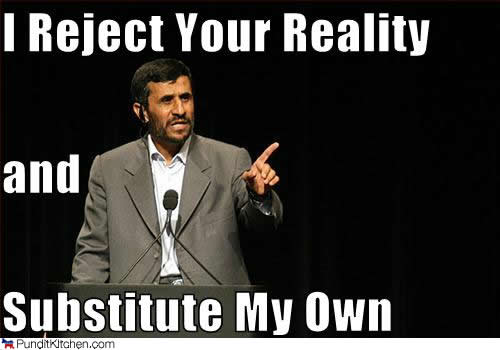
I’ve Been Rejecting God’s Reality and Substituting My Own

Because in Ahmadinejad’s anti-Semitic world, the Holocaust didn’t happen.

I’ve often thought of myself as being able to relate to the Biblical character Job, but lately I find myself falling in line with Jonah.

A (not very) brief synopsis of the Book of Jonah:

God commissions Jonah to preach repentance from sin to the town of Nineveh (or else God will bring calamity upon the town). Jonah, an Israelite, hates the Ninevites who are enemies of Israelites. Jonah’s not really happy about this commission from God because He knows God won’t act ruthlessly against these people so he runs.

He flees. He does all he can to get away from God and the mission he’s been sent to do.

After causing grief in the lives of some sea men who are caught in a tempest, they throw him into the water where he gets swallowed up by a whale for three days and three nights. Jonah repents of his attempt to escape God and his mission and the whale vomits him out on to land.

Jonah, eager to get his mission over with, completes a three-day journey to Nineveh in one day. He walks into the city crying, “Yet forty days and Nineveh will be overthrown.” From what readers can tell, Jonah does not elaborate on this statement; he only repeats that Nineveh’s doomed in 40 days.

And what Jonah expected to happen happens. The Ninevites repent and turn to the God of Israel, asking for forgiveness from their wicked ways.

How frustrating for Jonah. This turn of events makes God spare the lives of these people.

In the last chapter of the book, Jonah sits outside of the city waiting for what he knows will not happen: the destruction and complete annihilation of Nineveh. He rants at God angrily for having the following attributes:

  • Being gracious
  • Being merciful
  • Being slow to anger
  • Abounding in steadfast love
  • Relenting from disaster

Jonah hates the fact that God extends these attributes to people he can’t stand and begs for death. God answers him and challenges him:

“Do you have good reason to be angry?”

At first, Jonah doesn’t answer. God leaves it alone.

Then the sun and scorching heat bear down on Jonah and God allows a plant to grow over him to give him some relief. This makes Jonah happy.

Then God allows a worm to kill the plant overnight, leaving Jonah back in the sun and heat again. Again, Jonah puts his life back on the table, begging to die. God calmly asks:

“Do you have good reason to be angry about the plant?”

Jonah rages now: “Yeah, I got good reason to be angry. So angry I want to die!”

God declares checkmate against Jonah, challenging Jonah’s care of a dead plant that he did not labor to produce against God’s care for the people and animals of a big city that He created.

That’s the end of the chapter. No further response from Jonah. My supposition is that either Jonah was probably too pissed off to continue writing what occurred after or that Jonah was too embarrassed by his subsequent reaction that he didn’t record it. Perhaps God, in His loving compassion, didn’t require him to.

In the reading of this chapter, I discover that I am very much like Jonah. I run and flee from God. I don’t like the tasks He’s put before me and I’d rather do something else. And Tuesday night, I was angry—angry unto death.

Like Jonah, I need to accept what God’s mission is for me (job) rather than the mission I want to create for myself (motherhood). To quote Adam Savage from the hit TV show “Mythbusters,” I’ve been telling God:

“I reject your reality and substitute my own!”

It is clear in a variety of ways that God’s mission for me right now is to focus on my job. He is blessing in me in that realm through agent interest, independent contracting, further education, increased job responsibilities, and possibly a new position. I’ve been a complete fool to overlook the ways that God is blessing me in this area.

And while I’d love to become a mother, it’s clear that’s not what God wants for me right now. While it makes me sad and it’s okay for me to grieve over the death of this dream monthly, I need to press forward with the mission God has charged me with rather than trying to run away in an opposite direction, causing grief to those around me. Am as I happy about my mission as Jonah? Probably, since I’ve been hoping for my mission to come to fruition for a while. But I’ll try to accept where God has me and what He wants me to do before I become a mother (should that ever happen).

Okay, God, so here’s what I’ll try my best to do:

I reject my reality and substitute Your own.

The Armor of Pretentious Spirituality & the Shield of Piousness

A friend said this to me on Twitter today:

I do think people are dishonest in general about their ‘spirituality.’

I have to agree with him. And I can’t help wonder why that is.

This statement forced me to look at my own spirituality. I like to think that I’m rather “real” when it comes to my Christian life. Too often I’m frustrated by people who try to act like they have it all together just because they have Jesus in their lives and I’m always comparing myself mercilessly to people who seem particularly pious and pray and read their Bibles all the time.

On the contrary, I also look at the people who practice yoga religiously or listen to the teachings of Eckhart Tolle and wonder if they’ve discovered some inner peace that I still find myself seeking.

So I’ve come to the conclusion that we all put on a front to some extent. There are days (perhaps sometimes weeks!) when I’ve got this spiritual connection going, some amazing mountaintop relationship with God and I really am a prayer warrior and in touch with a power greater than myself.

Then there are days (and weeks!) that go by when I don’t pray, get angry with God, feel lost as though I’m stumbling through life just trying to life in the physical, and going through the motion of attending church because it’s what I do and not necessarily because I want to. (Is that right to do? No.)

So it’s time for me to strip off the armor of pretentious spirituality and put down the shield of piousness:

  • I do not go to church every Sunday. Catholic guilt plagues me afterward but it’s true. I like my sleep more than I like fellowshipping or worshipping with the saints.
  • I do not formally pray every day. If I pray at all, it might be a quick “Lord, please make this migraine go away” but I don’t get down on my knees every night regularly and pray for my family, your family, everyone’s needs, and world peace. I sometimes formally pray but more often than not, I don’t. And more often than not, I forget. And even more often than that, I just don’t want to.
  • I take the Lord’s name in vain occasionally. (Sorry for the following, God.) I’ve caught myself saying a “Lord have mercy” or “Oh my, God” when it’s not necessary or directed to God. It doesn’t happen often and I try to get around it by saying “Heaven, have mercy” but that just sounds silly afterward.
  • I do not like to fellowship with other believers on most days. Some Christians love nothing more than good Christian fellowship all the time. Great for them. I prefer to be alone or around unbelievers. For some reason, I feel the need to pretend like everything’s fine around other Christians. Going to Bible study this summer was heart-wrenching for me as I spent month after month discovering I was not pregnant and not feeling like I could really share that with a group of women who were pregnant or already had kids (for the most part). I always left Bible study feeling worse off than when I arrived so I stopped going or helped with childcare.
  • Reading tons of theological books does not make me a theological maven. I’m reading three books on theology, God’s love, and the Bible and I feel more filled with head knowledge and no closer to any heart knowledge. I wonder if a return to the basics of Jesus Christ and the removal of deep reformed theology from my brain would help but I don’t know how to go back.
  • I wonder if non-Christians have it better than I do. Hate on Deepak Chopra all you want but the man doesn’t complain about unhappiness. And Oprah seems to be doing all right…
  • I question my own beliefs:
    • Jesus ascended into heaven bodily? Um, wouldn’t he explode once he reached a certain altitude?
    • Jesus is returning and after that, no more sin and world peace? When? Will it ever happen? Is that just a fairy tale?
    • It’s wrong to romantically love someone who is of the same gender?
    • God created Ryan Seacrest? (Just kidding.)
  • I question God’s purpose for me. Constantly. Why am I here? I mean, me specifically. You have a different purpose than I do. What am I supposed to accomplish before I die? Is the afterlife really peaceful?
  • And the most basic question of all: Am I a person who really, truly loves Jesus and would sacrifice ALL to follow him?

The answer to that last question is no. And if you’re reading this, you’re probably answering similarly if you’re honest with yourself. By the way, if you still think you’d sacrifice all to follow Jesus then let me challenge you do to this right now:

Sell your house,
Sell your SUV,
Sell your stock,
Sell your security,
And give it to the poor.¹

Won’t do/haven’t done that? Yeah, your answer’s the same as mine.

Perhaps the way back to genuinely following Christ is to strip off the facades we wear. Maybe if I showed up at church and asked someone how he was doing and he responded honestly, “A tough week but I’m hanging in there” rather than the standard “Just fine,” perhaps we’d exhibit a bit more Christ-likeness.

I love Mark Driscoll’s ministry and I think he’s done a lot to reach others for Christ in the 21st century, but the machismo thing bothers me. Sorry, I can’t quite picture Jesus going to Monday Night RAW or cheering on guys beating each other senseless in the UFC. On the contrary (which is probably Driscoll’s real point), I don’t think Jesus would’ve been a pansy flower child flashing the peace sign and getting high in the middle of a muddy field.

Jesus is the sovereign Lord of the universe. During his time on earth, he exhibited emotion and didn’t pretend to be something he was not. When Lazarus died, the Lamb of God felt the real sting of death and wept for his friend (before resurrecting him!). When money changers were desecrating the temple of God, Jesus displayed righteous anger in preserving a sanctuary that was supposed to be kept holy. And right before Jesus faced the cruelest death anyone could face, fear flowed through his body as he pleaded three times with his heavenly Father to take the task at hand away from him (before submitting himself to God’s will).

Wow. Sadness, anger, and fear. All from the one whom Christians call their Savior. Jesus didn’t pretend to be okay. Jesus wasn’t all macho like, “Yo, dudes, I got this. No sweat.” Not even with the apostles, his closest friends, who he asked to stay up with him before Judas betrayed him. Jesus was real.

And if Jesus was real, why do believers in him keep acting so damn fake?

¹Quoted from Derek Webb’s “Rich Young Ruler”

Here, There, and Everywhere

“To lead a better life, I need my love to be here.”


I have a bunch of things I feel like writing about but they’re not topically related so here’s my mishmashed post.

Music.

I am enjoying listening to Danger Mouse’s new group, The Broken Bells. Hat tip to Derek Webb on that one.

Theology.

Up on The Resurgence blog this week:

Question 74 – Should infants, too, be baptized?
Answer – Yes. Infants as well as adults belong to God’s covenant and congregation. (Gen. 17:7; Matt. 19:14) Through Christ’s blood the redemption from sin and the Holy Spirit, who works faith, are promised to them no less than to adults. (Ps. 22:11; Is. 44:1-3; Acts 2:38, 39; 16:31) Therefore, by baptism, as sign of the covenant, they must be grafted into the Christian church and distinguished from the children of unbelievers. (Acts 10:47; I Cor. 7:14) This was done in the old covenant by circumcision (Gen. 17:9-14), in place of which baptism was instituted in the new covenant. (Col. 2: 11-13)

I seriously struggle with the idea of infant baptism also known as paedobaptism. I am a member of the Presbyterian Church in America (PCA) and appreciate that I do not need to agree with the concept of paedobaptism to be a member of the covenant community. I’m not even fully convinced that I hold to covenant theology but that’s too broad of a matter to tackle within the subject of paedobaptism.

The best case I’ve seen for infant baptism has been presented by Greg Bahnsen here. But again, it’s not that I’m not open to viewing infant baptism as scriptural or that I am adamantly opposed to it per se but I find that there is a clearer Biblical case for believer’s (or as some have called it, “professor’s”) baptism.

Perhaps, however, if I fully subscribed to covenant theology and saw baptism as a replacement for circumcision, then infant baptism would make logical sense. As a Christian who previously subscribed to dispensational theology, the jump to covenant theology is not easy. (Here’s a chart for a comparison between the two. However, I did stumble upon this, and from a quick glance, it would seem like I agree more with New Covenant Theology.)

Scripture.

Relevant Magazine had an article on the most misused verse in the Bible:

Jeremiah 29:11 that says, “‘For I know the plans that I have for you,’ declares the LORD, ‘plans for welfare and not for calamity to give you a future and a hope.”

I thought the article had great insight, especially given that as humans, we have a tendency to look at God as a vending machine: pop our prayer request in the coin slot and wait for our requested result. The author expounds on the context surrounding this oft-quoted verse which shows this verse is not telling readers that God will give us whatever we desire.

Stay-at-home dads.

Matthew Paul Turner at JesusNeedsNewPR tweeted a link to Nicole Wick’s post about Mark Driscoll who bashed stay-at-home dads.

The video is a little old but I was surprised to hear this view from Driscoll given the fact that I usually agree with him. The fact that he was only willing to make “rare exceptions” for men to stay at home to take care of the family was rather appalling to me. In this economic climate and culture, it’s possible for wives to have a better-paying and steadier job than their husbands. In that case, the right way for a husband and father to provide for his family is to let his wife bring in the necessary income for them so that he can be at home rearing the children. (We are assuming in this scenario that the parents have decided they will live off of one income so that one of the parents can be home to raise the children.) An ideal situation would be for a mom to be at home with her children (should she choose to do so) but that is not always the case and I don’t believe that it must always be the case. Driscoll is way off the mark here.

Miscellaneous.

I think there’s more a-brewin’ in my head but the words are all jumbled and I can’t get them out coherently. Some other things going on:

  • I’ll begin editing on my novel soon so that will be quite a challenge. (See hard copy mess in right photo.)
  • I’ll be leading the women’s weekday Bible study during the summer so that’s another exciting thing on the horizon.
  • I’ll also be part of a book club in which we’ll we reading Ed Welch’s When People Are Big and God Is Small. I read through it for the third time last year but highly enjoy the book and find that it’s chock full of wisdom to the point where I don’t mind reading through it again.
  • My husband and I may be going on a trip to Cancun during the summer with my paternal cousins, which I’m highly looking forward to so that I can establish solid relationships with them.

Perhaps you didn’t care to know all that but it made me feel better to type it out.

Food for Thought #4: A New Kind of Christianity

The Narrative Question

I’m particularly amused by McLaren’s quote about not taking the Bible literally but then he proceeds to take the Bible… literally. Here’s an example:

It is patently obvious to me that these stories aren’t intended to be taken literally, although it didn’t used to be so obvious, and I know it won’t be so now for some of my readers. It is also powerfully clear to me that these nonliteral stories are still to be taken seriously and mined for their rich meaning, because they distill time-tested, multilayered wisdom—through deep mythic language—about how our world came to be what it has become. They’re intended, as all sacred creation narratives are, to situate and orient us in a story, so we will know how to live. (p. 48)

Then:

Scene 1. God tells Adam and Eve they are free (this is a primary condition of their existence, 2:16) with one exception. If they eat of one specific tree, on the day they eat, they will die. Notice, the text does not say they will be condemned to hell, be “spiritually separated from God,” be pronounced “fallen” or “condemned,” or be tainted with something called “original sin” that will be passed on to their children. There is only one consequence indicated by the text: they will die—not spiritually die, not relationally die, not ontologically die, but simply die. And not die eventually, but on the day they eat. (p. 49)

McLaren argues that there is no literal fall—a term he argues we’ve been “brainwashed” into believing through our reading of the Bible from a Greco-Roman perspective. In fact, he asserts Genesis recounts a story initially of ascents:

It is a first stage of ascent as human beings progress from the life of hunter-gatherers to the life of agriculturalists and beyond. Their journey could be pictured like this:
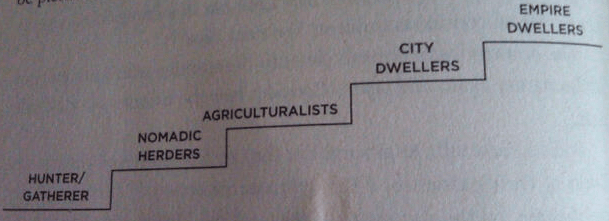
But also of a descent:

But the ascent is ironic, because with each gain, humans also descend into loss. They descent (or fall—there’s nothing wrong with the word itself, just the unrecognized baggage that may come with it) from the primal innocence of being naked without shame in one another’s presence.
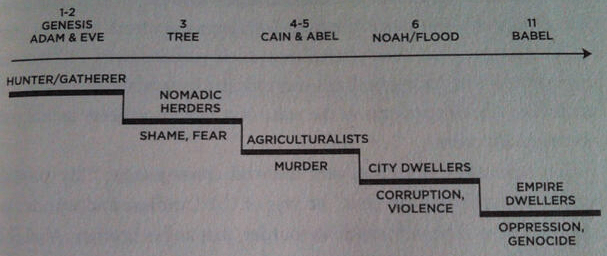
Each step of socioeconomic and technological ascent thus makes possible new depths of moral evil and social injustice. (p. 50-51)

As humans, with progress (implication of ascent) there is also loss (which in turn puts humans on a descent). Thereby, we now lose the vertical pattern of Platonic perfection-ideal as expressed through the Greco-Roman view of Eden but have a more progressive view of the Bible—a stepping stone, if you will.

If Genesis sets the stage for the biblical narrative, this much is unmistakably clear: God’s unfolding drama is not a narrative shaped by the six lines in the Greco-Roman scheme of perfection, fall, condemnation, salvation, and heavenly perfection or eternal perdition. It has a different story line entirely. It’s a story about the downside of “progress”—a story of human foolishness and God’s faithfulness, the human turn toward rebellion and God’s turn toward reconciliation, the human intention toward evil and God’s intention to overcome evil with good. It begins with God creating a good world, continues with human beings creating evil, and concludes with God creating good outcomes that overcome human evil. We might say it is the story of goodness being created and re-created: God creates a good world, which humans damage and savage, but though humans have evil intent, God still creates good, and God’s good prevails. Good has the first word, and good has the last. (p. 54)

If this view sets the stage for how to read the Bible, we are certainly in for a very interesting (and bumpy) ride.

In Chapter 6, McLaren argues that the beginning of his quest to view Christianity through a new lens was shaped by his liberal arts education and bolstered by a lack of formal theology training. I found this quote interesting:

Deconstruction is not destruction, as many erroneously assume, but rather careful and loving attention to the construction of ideas, beliefs, systems, values, and cultures.

Merriam-Webster defines deconstruction this way:

1 : a philosophical or critical method which asserts that meanings, metaphysical constructs, and hierarchical oppositions (as between key terms in a philosophical or literary work) are always rendered unstable by their dependence on ultimately arbitrary signifiers
2 : the analytic examination of something (as a theory) often in order to reveal its inadequacy

Deconstruction is not careful and loving attention to construction, no matter what McLaren says. Deconstruction is critical assessment performed in order to reveal inadequacies.

But McLaren is openly stating that he’s reading the Bible through a literary lens where he can identify protagonists, antagonists, plot, tension, conflict, resolution, and character development.

So as we head into Exodus, we read of a God who “sides with the oppressed, and God confronts oppressors with intensifying negative consequences until they change their ways, and in the end the oppressors are humbled and the oppressed are liberated.”

I can’t help but comment that McLaren is back to nonliteralism now as he says God sends a “firm but gentle” plague on the Nile River that “turns red like blood.” But let’s read what Exodus 7:14-21 says. In fact, let’s use The Message version, Eugene Peterson’s paraphrase of what the Bible says:

God said to Moses: “Pharaoh is a stubborn man. He refuses to release the people. First thing in the morning, go and meet Pharaoh as he goes down to the river. At the shore of the Nile take the staff that turned into a snake and say to him, ‘God, the God of the Hebrews, sent me to you with this message, “Release my people so that they can worship me in the wilderness.” So far you haven’t listened. This is how you’ll know that I am God. I am going to take this staff that I’m holding and strike this Nile River water: The water will turn to blood; the fish in the Nile will die; the Nile will stink; and the Egyptians won’t be able to drink the Nile water.'”

God said to Moses, “Tell Aaron, ‘Take your staff and wave it over the waters of Egypt—over its rivers, its canals, its ponds, all its bodies of water—so that they turn to blood.’ There’ll be blood everywhere in Egypt—even in the pots and pans.”

Moses and Aaron did exactly as God commanded them. Aaron raised his staff and hit the water in the Nile with Pharaoh and his servants watching. All the water in the Nile turned into blood. The fish in the Nile died; the Nile stank; and the Egyptians couldn’t drink the Nile water. The blood was everywhere in Egypt.

The quote above is simply a paraphrase—someone’s interpretation of what is occurring in the Bible. I’m amazed that McLaren is so intent on reading the Bible non-literally that he tries to explain away what’s happening in the Bible through literal means: “Ironically, perhaps through a red tide, the Nile turns red like blood.” As a result of McLaren’s literary reading of Biblical passages, he begins to make literal assumptions about these passages that aren’t there.

On page 58, McLaren says “God never works directly, only indirectly” and reduces the plagues often seen as something extraordinary and supernatural into nothing more than ordinary and natural. He diminishes the work of God.

McLaren argues the Bible presents three narratives:

  1. God as creator
  2. God as liberator from external and internal oppression
  3. God as reconciler

After reading beautiful literary passages from Hosea, Joel, and Isaiah, McLaren encourages his readers to see the future as something that “is not fatalistically predetermined” but rather see history as “live”—“unscripted, unrehearsed reality, happening now—really happening.” (p. 62-63) Here, McLaren rejects the premise of a predetermined, foreknown future by God (Jeremiah 29:11; Acts 2:22-23; Romans 8:28-30; I Corinthians 2:7; Ephesians 1:5,11).

Then McLaren attempts to literalize Scripture within a modern framework despite saying, “As this approach relieves of literalistic interpretations, it frees us to let the poetry work as poetry is supposed to”:

Swords into plowshares. Today that would mean dreaming about tanks being melted down into playground jungle gyms and machine guns being recast as swing sets. (p. 63)

That’s just one example. It’s a clever reading of the passage but the fact of the matter is, McLaren is trying to take the literal, make it literary, and then convert the literary as the literal he wants to see. To put it bluntly, McLaren is reading things in the Bible that simply aren’t there.

McLaren is very good at igniting passion and hope for a better tomorrow that seems as if it can occur today.

If the Genesis story sets the stage by giving us a sacred vision of the past, and if the Exodus story situates us in the sacred present on a pilgrimage toward external and internal liberation, then the story of the peace-making kingdom ignites our faith with a sacred vision of the future, a vision of hope, a vision of love. It represents a new creation, and a new exodus—a new promised land that isn’t one patch of ground held by one elite group, but that encompasses the whole earth. It acknowledges that whatever we have become or ruined, there is hope for a better tomorrow; whatever we have achieved or destroyed, new possibilities await us; no matter how far we have come or backslidden, there are new and more glorious adventures ahead. And, the prophets aver, this is not just a human pipe dream, wishful thinking, whistling in the dark; this hope is the very word of the lord, the firm promise of the living God.

Perhaps I’m not as optimistic or those darn Greco-Roman glasses keep getting in the way.

Again, I appreciate McLaren’s attempt to read the Bible with a new perspective but there needs to be a balance between the literal and literary interpretations. I understand that some people Bible see the Bible as purely a literal work of God; others see the Bible as nothing more than a beautiful piece of literature. McLaren looks as the Bible as a beautiful piece of literature and then tries to recast it into a literal work with explanations that are a stretch. Frankly, McLaren’s attempt at a new kind of Christianity appears headed extremely off-course as I go into reading Chapter 7.


Bible verse of the week

My husband and I visited a local church nearby and the verse the pastor preached on resonated me:

“Peace I leave with you, My peace I give to you; not as the world gives do I give to you. Do not let your heart be troubled, nor let it be fearful.” —John 14:27

The pastor went on to explain what kind of peace Jesus was talking about and how personal that peace had become to him, especially since the pastor’s mother had passed away at 5:45 this morning.

This resonated with me as well since peace has been something I have been praying about. The two non-sin issues I struggle with most in my Christian walk are joy and peace but especially peace. As a person who suffers from depression and anxiety, naturally joy and peace are what I would seek most.

It is comforting to know that there is peace in Jesus Christ: the peace of knowing him, and the peace of that final destination as a result of knowing him. It is not the peace that the world gives or hopes to give but that blessèd assurance that all is well with my soul.

I now know the peace Jesus speaks of and realized I’ve had it all along in my Christian walk but like the disciples, kept looking for the wrong kind of peace—the world’s peace. It’s possible to be a believer and never experience the peace that rests inside you because you are searching for the world’s peace and not the peace Jesus speaks of.

I can best describe this peace, not as a warm, fuzzy feeling or a moment of tranquility but rather an assurance that in the face of trials, tribulations, natural disasters, rampant disease, and death, I know what the end will be because I know Who I serve. It’s quite a different peace than the one I was seeking and not at all what I expected. And because I am a sinner, prone to being tossed to and fro in the waves of life, my peace will also be shaken—mainly because I will be seeking after that worldly peace. But if I keep my eyes on Jesus through this journey of life, my peace will remain sure and solid—moreso than the ground I stand on.

And that’s what I must remember: my faith is a journey. I will not be perfect all the time but if I challenge myself to tuck that verse away in my heart, perhaps I will remember a bit more often what true peace is.