
End-of-Year Update: 2024 Goals

2024

I failed at achieving most of these goals. Miserably. I contended with a difficult first half of 2024 with issues with my son and daughter at school, then getting laid off in June, then subsequently being rehired at another place within my company (along with a 30% salary reduction), and now here I am in December, trying to figure out what I did with all that time, what I plan to do in 2025, and paring my goals back significantly from even a Top 10.

2024 Goals

  1. Read 6 full books for the year. Needs improvement.
    a. Theologizin’ Bigger (reread)
    b. So You Want to Talk About Race
    c. Rising Strong
    d. The Councilman
    e. Unclobber
    f. Red, White & Royal Blue
    None of these. The last time I read an entire book was the advance copy of Theologizin’ Bigger at the end of last year. The Councilman has been delayed, which makes me hella sad because I absolutely love the story between Gillian & Gunner. Alas, we shall see what 2025 brings. I should follow up with the author.
  2. Read 2 chapters of the Bible 1 day per week. Accomplished.
    It’s not consistent, but it’s better than any Bible reading I’ve done in a while. I’ll give this one a W for the year.
  3. Pray in the morning for 5-10 minutes 1 day per week. In progress.
    This also has not been consistent. I pray for other people and I praise God a lot, but I need to pray for myself and my needs. It’s not an L but more in progress.
  4. Noom: Update at least 3x per week. Accomplished. Adjusted but accomplished.
    I’ve canceled Noom because it’s much too expensive, and I prefer the use of Cronometer. I’ve lost 50+ this year, thanks to getting COVID-19 in February and not having any sense of smell or taste for the 6 months following, but I’m finally at a manageable weight I’m happy with. I’m down from the “obese” BMI category to the “overweight” category, and honestly, I’m okay with that. 20 lbs away from the minimum ideal BMI, but I’m fine with where I am.
  5. Exercise 1x per week for at least 10 minutes. Needs improvement.
    I did okay for the first 2 months of the year, then I got COVID-19 in February, and it was downhill from there. We’re going to try to pick this back up in 2025 with a modest goal of 1x per week either BODi or walking outside with a 10-minute minimum.
  6. Attend church 2x per month. Needs improvement.
    I started out really well earlier this year, and I’ve just fallen off the wagon. Thankfully, I’ve got Brian to keep me accountable. We’re keeping this goal as-is for 2025.
  7. Visit Mom on Long Island 2x this year. Accomplished.
    I’ve visited my Mom more than twice this year. And she’s finally retired! Free of taking care of everyone but herself! So she’s been down here recently more than we’ve gone up there, but I’d like to keep this goal as-is so I can go back and visit friends and snag some Ciro’s tortellini pizza.
  8. Book a massage once per quarter. Accomplished.
    Success! Managed it all this year. Let’s continue to carry over to prioritize my self-care.
  9. Complete YA steampunk novel by year’s end. Needs improvement.
    I did not get this done. Sad with myself, but I need to refocus on this goal. Completing this by the end of 2025 is extremely doable (Lord willing) but will require some extra dedication and sessions with Ruth.
  10. Meditate 1x per week. Fail.
    I haven’t been interested in meditating. It’s been a goal but an unrealistic one. Prayer is more important to me. This is not getting carried over.
  11. Duolingo: 2x per week for 10-15 minutes. Fail.
    I’m always finding excuses not to do this or not in the mood for it. I’m not going to make it a goal (I’ve got enough already), but I will do it as I can (or feel like).
  12. Hand journal 2x per month. Needs improvement.
    I went several months not hand journaling on and off. I think this is a doable goal, but I’m not carrying it over. I will journal when I damn well please.
  13. Substack post 1x per month. Fail.
    I haven’t written a Substack post since March. I vacillate on whether to keep this or my WordPress blog updated, but either way, I don’t think I’ll carry this over.
  14. Blog on WordPress 1x per month. Fail.
    I haven’t updated this blog since June, which I suppose is better than anticipated. I need to choose between updating this blog or Substack—not both. Whether I’ll make either a goal, I’m not sure. I’d like to keep this on my radar, but along with completing my novel, I’m not sure this will be realistic.
  15. Take 3 LinkedIn Learning Courses by year’s end. Fail.
    I took 1 course and that was on “surviving a layoff.” (facepalm) I may make this a goal for 2025, but either reduce it to 1x per year or 1x per 6 months.
  16. Watch 3 TED/TEDx talks this year. Fail.
    I may have watched 1 TED talk this year? It might have even been at the end of 2023 and I’m imagining it occurred in early 2024. TED Talks are only 10-15 minutes so it’s not an unachievable goal. I may adjust this to 1x per 6 months, and if it gets done more than that, super hooray.

By the way, I really, really, really hate this WordPress block editor, it’s not user friendly or intuitive. I really, really hate it.
Reading 8 Books at One Time

For someone who reads as much as I do, I have a blank brain for writing my own story. I am reading 8 books at one time:

  1. The 7 Habits of Highly Effective People
  2. The Chronicles of Narnia: The Magician’s Nephew
  3. Wicked Girls
  4. Princess Elizabeth’s Spy
  5. I’d Like to Apologize to Every Teacher I Ever Had
  6. The Art of War for Writers
  7. The Essential Rumi
  8. Grace (Eventually): Thoughts on Faith

Continue reading “Reading 8 Books at One Time”

My Favorite Authors

Here’s a list of my favorite authors:

  1. Gail Carriger: Her books are clever and funny and don’t take themselves too seriously.
  2. John Grisham: If I want a good, fast-paced, suspenseful story, I always know where to turn.
  3. Anne Lamott: I’ve only read her nonfiction work, but I love her style of writing.
  4. Tess Gerritsen: The Rizzoli & Isles books have a voice that are all their own.
  5. Susan Elia MacNeal: Her mystery series on Maggie Hope is adventurous, quick-paced, and interspersed with real figures such as Winston Churchill and Princess Elizabeth.

5 Books I’m Looking Forward to Reading in 2013

The year 2013 promises some good books. Here’s a list of books I am looking forward to reading this year:

  1. His Majesty’s Hope: A continuation of the Maggie Hope mystery series that is filled with charm and cleverness.
  2. Untitled #3 (Divergent series): Yet another dystopian book that has action and romance.
  3. Shadow of Night (All Souls Trilogy #2): A hefty book with paranormal romance that details the story between a witch and a vampire.
  4. Untitled #3 (All Souls Trilogy): A likely hefty book, but it will be the final installment in the All Souls Trilogy.
  5. Etiquette & Espionage: A young adult book by one of my favorite paranormal/steampunk authors, Gail Carriger.

Reading Material for 2013

I’m a member of the social networking site Goodreads (I’d probably watch more movies if there were a site called Goodwatch or something) and each December, I plan the books I’m going to read for the next year. So for 2013, I currently have 58 books on my list. (This list will grow as books are published and I see must-read bestsellers at the library.) Thirty-six of those books are non-fiction books. I do not have them in order of books I plan to read, but here’s my goal for the year:

January
Wicked Girls (begun in December 2012)
The Art of War for Writers (begun in December 2012)
Princess Elizabeth’s Spy (begun in December 2012)
I’d Like to Apologize to Every Teacher I Ever Had (begun in December 2012)
The Darkest Minds
The Sacred Romance
A Year of Biblical Womanhood (begun in December 2012)

February
Shadow of Night
Generous Justice
Successful Women Think Differently
In the Garden of Beasts
Uglies
The Paris Wife

March
The Beautiful and the Damned
What Good Is God?
Matched (#1)
The Silent Girl
Paranormalcy
I’m Down

April
The Happiness Project
Crazy Love
Olive Kitteridge
Operating Instructions
The Girl Who Became a Beatle
Blame It on the Brain

May
His Majesty’s Hope (Maggie Hope #3)
Forgotten God
You Lost Me
The Tiger’s Wife
Porn Again Christian

June
The 7 Habits of Highly Effective People
Putting Amazing Back into Grace
The Selection (#1)
A Tale of Two Cities

July
Why Are All the Black Kids Sitting Together in the Cafeteria?
The Myth of Multitasking
Nickel and Dimed
Vienna Prelude (#1)
Jane Slayre

August
The Nazi Officer’s Wife
The Alchemist
CrossTalk
Running Scared

September
Untitled (Divergent #3)
Untitled (All Souls Trilogy #3)
The Paradox of Choice
Battle Hymn of the Tiger Mother

October
The Purpose Driven Life
The Artist’s Way
Having a Mary Heart in a Martha World
Time Management for Unmanageable People

November
Suffering and the Sovereignty of God
The Bluest Eye
Bittersweet
The Total Money Makeover
The Money Book for the Young, Fabulous & Broke

December
The Lion, the Witch, and the Wardrobe
Plot & Structure
Three Cups of Tea
When God Weeps
Ape House

I tend to read more at the beginning of the year and at the end of the year as I try to play catch up. It’s a lot to read, but I know I can do it as long as I pace myself! And Tim Keller will probably publish a book in 2013 so just add that to my list too.

What I’ve Learned from Working at the Library

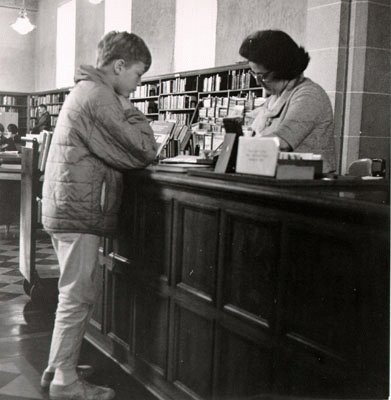
Image from usa.gov

I’ve been working in the library system for 2 years now, and as I move from one library to another, I want to take the time to reflect on what I’ve learned from working at the library.

1. Most people are nice.I can think of only once incident in which I’ve had a bad experience. That’s not bad for 2 years gone by.

2. Most people want a friendly face. Even if the patron just wants to get in and out very quickly, they usually appreciate a friendly face who is courteous and willing to help them. Often, they will return a smile.

3. Libraries are more than just books. Libraries are community centers where people can get access to the latest movies, music, and audiobooks along with the ability to use computers and take advantage of quality programming.

4. Libraries are the 411 of knowledge. Want to know whether the “a” in “at” in Sergeant-at-Arms is capitalized? (That’s a real question I’ve received.) We can answer that for you. Want to know whether Mrs. Jones still lives on 123 Main Street in King of Prussia, PA? If it’s public knowledge, we can tell you.

5. Libraries aren’t the quiet places they used to be. You can easily find children screaming or running around. In the children’s department at one library I’ve worked at, we were allowed to play music to showcase our musical selection. And with the population getting older and unfortunately getting hard of hearing, you can hear circulation clerks talking a bit loudly. In fact, circulation clerks are probably the loudest people in the library next to small children.

6. Gone are the days of no food or drink. One library I know of has a small cafe area that sells coffee, beverages, cookies, and fruit. Other libraries I know of don’t bat an eye if your drink is too close for comfort near a CPU (central processing unit). Didn’t finish your drink from Starbucks? Feel free to bring it on in!

7. It’s not necessary to know the Dewey decimal system as in the days of yore. The Dewey decimal system is still in use, and some knowledge of it is helpful, but if you want to find comic books, you likely can head straight for the graphic novels section instead of browsing through 741. Some libraries have even ventured to put subject classifications up, e.g., Art, Economics, World War II, Travel so you can browse for things yourself instead of needing to ask whether 917 is still U.S. travel or whether the 200s still house religion.

8. In the case of children’s series, it’s no longer necessary to know the author. Many libraries now have series sections for popular titles such as Magic Tree House, Diary of Wimpy Kid, or 39 Clues. This process simplifies things greatly, especially in the case of the 39 Clues books, which can be written by multiple authors and would be spread throughout.

9. Many libraries now offer a vast selection of e-books, e-audiobooks, and even music. Got an e-reader? It is most likely compatible with the library’s online lending service. Some libraries with large budgets can lend music online, and others with limited budgets simply offer e-books. This online lending service is at little to no cost and often incurs zero fines. Check with your local library if they offer e-books for download and how to take advantage of this valuable service.

10. Check out a magazine! Really want to read last week’s issue of People magazine? Wanted to flip through last month’s In Style but it’s already off the stands? You have the option of either leisurely flipping through a magazine at the library or checking it out for a minimum of one week.

11. Need information on local history? Your local library probably has a local history section with archives and niche publications.

12. Can’t find the latest release of a movie or album? Ask at the desk! Often, when movies or music are just released, you won’t see them on the shelves because they are out circulating with other patrons. The best way to ensure you get your hands on new material is to ask circulation assistants or reference librarians. They can either check the back office to see if it’s sitting on their shelves waiting to be put out or they can add your name to a waiting list. That way, you won’t have to walk into the library every week hoping you’ll finally see the new release you’ve been waiting for. (And you probably won’t see popular titles for months if you’re not on a list.)

Those are just some of the things I’ve learned from working at a library. What have you learned about the library that you didn’t know before?

Watching and Reading

Recently, I watched a documentary on President Bill Clinton called American Experience: Clinton that I found simply fascinating. It’s amazing how much Clinton’s legacy would have changed had he not gotten involved in the whole Monica Lewinsky affair. I found Clinton to be a fascinating president who, no matter how much experience he had, could have not possibly been prepared for the demands of the office, but still somehow found a way to make tough decisions that weren’t really popular with either party.

I have been reading Eat, Pray, Love and find the book to be dreadful. This isn’t the first memoir that I’ve read (Mennonite in a Little Black Dress was better) so I’m surprised by how much I dislike the author who left her husband, engaged in an extramarital affair during the divorce process, and proceeded to bribe a customs official during her stay in Bali, Indonesia. I’m surprised the book was as popular as it was given that the author seems to be self-absorbed (more so in the first third of the book rather than toward the end). Although reading Ms. Gilbert’s tripe make me want to write tripe of my own.

On the other hand, I just finished Man in the Music about Michael Jackson’s music and artistry and found that to be insightful and intriguing. I’d recommend that book for anyone who is interested in Michael Jackson and his work. It’s a five-star book.

Top 10 Favorite Books Read in 2011 So Far

Cover images from Goodreads.com

Here’s a list of my top 10 favorite books read in 2011 so far.

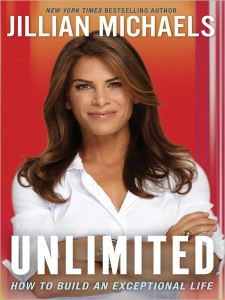
1. Unlimited by Jillian Michaels

2. Soulless by Gail Carriger

3. Changeless by Gail Carriger

4. Blameless by Gail Carriger

5. Heartless by Gail Carriger

6. Organized Simplicity by Tsh Oxenreider

7. Bonhoeffer by Eric Metaxas

8. Go the F**k to Sleep by Adam Mansbach

9. From the Mixed-Up Files of Mrs. Basil E. Frankweiler by E. L. Konigsburg

10. The Surgeon by Tess Gerritsen


“The Help”: In Defense of a White Woman Writing about Black Women

Apparently there was an uproar about Kathryn Stockett’s best-selling novel, The Help, about black maids oppressed by their white employees. Now that the movie’s out, the uproar is even louder. Tons of people (both white and black) have claimed the book is racist and historically inaccurate. Ms. Stockett isn’t doing too bad in spite of this—at a nearby speaking engagement, she was charging $65 for admission.

I pose the question, then, that my husband posed to me last night: why is it racist if a white woman writes about black women experiencing racism but not racist if a black woman writes about how white women treated black woman during a time of racism?

As a writer, I say Ms. Stockett is free to express her mind about her “fictionalized” book. (I’ve heard that The Help is really a fictionalized version of true stories from Mississippi.) It’s a novel which means that it’s fiction which means that it doesn’t need to be the most historically accurate book ever.

As a black woman, did The Help offend me? A little. I bristled during the first hundred pages of the book. Then I jumped to the end to see if the author had some kind of Afterword, which she did. I’m not sure I would have continued reading the book had I not read the Afterword. It makes me wonder whether Stockett was a little girl influenced by a black maid who just suddenly disappeared because her racist momma might have fired her and was atoning for her parents’ sins.

There is nothing Sambo-ish or overtly racist about this book. (Maybe the movie is different?) The main black women, Aibileen and Minny, are not idiots. I think Stockett happened to do a very good job of portraying black women who lived in the mundane: they were maids beholden to white employers who didn’t physically abuse them but still mistreated them. So these black women got back at them in a mundane way.

People complain that Skeeter is the white woman who “rescues” these black women. I see Skeeter as part of the majority ruling system that helped to make things right (again) in the a somewhat mundane way. She didn’t lobby Congress or hold hands with Minny and walk down the street in a march. She turned a racist institution upside down by publishing a book about black maids dishing on what it’s like to work in white households. Skeeter would have been nothing without the black maids who shared this information with her so no, they weren’t necessarily beholden to the “white woman” to “rescue” them.

America is a free country last I checked, and Stockett is free to write about black women as she imagines them just as Alice Walker is free to write about white women as she imagines them without being racist. Was there a lot about the civil rights movement that was left out? Heck yes! It’s very much (as Melissa Harris Perry argued against) Real Housewives of Jackson, Mississippi with a definite focus on the white women in the households. But there’s a lens that focuses in on the maids in those households too.

Black people are rarely (if ever) satisfied when white people write about racially sensitive times such as the early 1960s. White people don’t ever seem to get it right because they don’t seem to “understand” the plight of black people from those eras. But that’s what imaginations are for. And with the millions of black women in America during the 1960s, it leaves a world of possibilities.

Self-Esteem and Self-Confidence: Shedding “Worm” Theology

Image from fatherthywillbedone.com

Before I became a born-again Christian at 16 years old, my problem at that time was that I didn’t have enough “self-esteem” and “self-confidence.” I didn’t believe in myself enough, and I didn’t try hard enough to believe in myself (which to be honest, I didn’t because I was an angsty, grungy teenager who thought it was cool to revel in my depression and suicidal bent).

Enter in born-again fundamentalist Christianity.

Fundamentalist Christianity says that one must not believe in self and only in Jesus Christ. Fundamentalist Christianity has no room for self-esteem, requiring a believer to place his or her trust solely in Jesus Christ.

Then I entered Protestantism and encountered a softer version of the same thing: Solo Christo! (This really refers to a theological belief of salvation, but this is the prescription of many orthodox Christians when it comes to problems with self-esteem.)

For a long time then, I believed self-esteem and self-confidence were wrong. I eschewed these things because my sole worth should be found in God and not in myself. I engaged in “worm” theology: Oh, I’m such an awful, terrible sinner. There is no righteousness in me. All righteousness is found in God, and I’m poor, pathetic, pitiful soul. I suck at life and I’m so lucky God saved me because I’m totally worthless otherwise.

Image from bn.com

Beginning last week, I started reading Jillian Michaels’s book, Unlimited: How to Live an Exceptional Life, and started seriously thinking, Maybe it’s time for me to walk away from Christianity because I like what Jillian’s saying about reclaiming and recapturing my life. I want to have self-esteem. I want to have self-confidence. I want to stop obsessing and feeling like a poor, pathetic little shit all the time.

But as I got further and further into Jillian’s book, I realized that a lot (not all) of what she says actually lines up with scripture. (Her chapter on Forgiveness and Accepting Responsibility was so solid, it blew me away.) And I realized that self-esteem and self-confidence do NOT need to contradict Christianity and God’s word. How?

In Mark 12, a scribe comes up to Jesus to test him. The scribe asks, “What is the greatest commandment?”

Jesus answered, “The most important is, ‘Hear, O Israel: The Lord our God, the Lord is one. And you shall love the Lord your God with all your heart and with all your soul and with all your mind and with all your strength.’ The second is this: ‘You shall love your neighbor as yourself.’ There is no other commandment greater than these.” —Mark 12:29-31

So Jesus lays it down: we are to love God with everything we have first. Then we are to love our neighbor as ourselves.

The assumption is we already love and esteem ourselves. If we do not, how are we able to love and esteem others better than ourselves (Philippians 2:3)? So one must tackle the challenge of learning to love and esteem oneself first before being able to truly love and esteem others better. Consistently treating others better than you treat yourself leads to an erosion of self-love and a path to possible codependency and people-pleasing (needing the approval of others).

An example: think of the mom who sacrifices herself on the altar of her children. This mother is constantly shuttling her kids to soccer practice, gymnastics, ballet class, and Boy Scouts but never takes any time for herself, investing her life in her children at great detriment to her health. She will likely be one stressed out and unhappy mommy. She may have high blood pressure,  feel dizzy, and tired all the time. Yet think of the other mom who shuttles her three kids to the exact same activities (still investing immensely in her kids) but once a month, goes to a spa to relax and get pampered. Three times a week, she jogs outdoors for 20 minutes simply to clear her head. Maybe she’ll even join a bi-monthly knitting group so she can engage in her own hobbies so she is invested in herself enough so that she can take care of her children. The latter mom is likely to be in an overall healthier position (mentally and physically) than the former.

A person who invests in herself first is better able to love and serve those around her. I do a better job helping people on 7 hours of sleep than I do 4 hours.

All this talk of self-love is probably making some Christians twitchy. It sounds odd and new age-y. But remember, Jesus assumed that we would already love ourselves and from that, commands us to love our neighbor. As Christians, if we don’t love ourselves, we are sinning. Continue reading “Self-Esteem and Self-Confidence: Shedding “Worm” Theology”

Love Wins: Book Review (aka Cliff Notes Analysis)

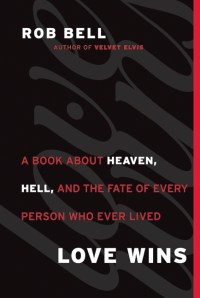
On Goodreads, I gave Rob Bell’s book Love Wins three stars. I might have given it 2.5 if I had the option.

I went through a detailed chapter-by-chapter analysis (but not as thorough as I would’ve liked to be!) outlining some of the issues I had in the book. Let’s see if it’s possible to recap:

Preface: Raises more questions than it answers, book has no notes, footnotes, endnotes, or bibliography. Further reading doesn’t cut it.

Chapter 1: Questions about heaven and hell that are set-up for the rest of the book.

Chapter 2: Heaven is a place on earth. God will eventually redeem and restore this broken world.

Chapter 3: Bell says Gehenna was really the city dump in Jesus’ day. Not a spiritual place of eternal torment. Bell says people can still reject God in the afterlife but leaves the door open for eventual repentance. He introduces an idea similar to purgatory in Catholicism. Then he says everyone will eventually be reconciled to God.

Chapter 4: Bell asks: Does God get what God wants?  What is it that God wants? “‘God wants all people to be saved and to come to a knowledge of the truth’ (1 Tim. 2).” Bell says contradicts himself in this chapter by saying that yes, some people believe God gets what He wants through eventual universal reconciliation and restoration but that God’s love allows for the freedom to reject him if someone wishes to do so. He adds that people don’t need to believe in the traditional doctrine of hell to be a Christian and that people can assume there’s a chance for repentance in the future.

Chapter 5: Bell tells his readers that Jesus dying on the cross and rising again the third day was a very beautiful thing. Don’t mar this beauty with nasty talk of eternal exclusivity via the traditional view of hell.

Chapter 6: Bell says that (since Paul says that) Jesus was present in the rock that Moses struck to give water to the Israelities, so Jesus is present in anywhere or anything. He also puts forward the odd idea of reverse universalism which posits that Jesus is present in all paths (ie, Jesus can be Mohammad for Muslims, Vishnu for Hindus, or nirvana for Buddhists).

Chapter 7: Using the template of the parable of the prodigal son (or the two sons), Bell says that we will all be at a party/celebration (heaven) and we can choose to exhibit negative attitudes and vices (hell) during the party if we want to. We can reject the Father’s love.

Chapter 8: Bell reminds his readers that people can miss out on rewards, celebrations, and opportunities and that love wins.

(And no, I would not have been able to do the summary above had I not done the analyses first.)

Love Wins Analysis: Chapter 8: The End Is Here

[This is the FINAL part of a multi-part series on Rob Bell’s book, Love Wins.]

Indeed, the end is here! And I know you and I are probably both glad for it.

Bell gives his testimony of how he came to know God’s love and invites his readers to trust God and that “the love we fear is too good to be true is actually good enough to be true.” Bell reminds his readers that the decisions they make today will impact the future, the hereafter.

This invitation to trust asks for nothing more than this moment, and yet it is infinitely urgent. Jesus told a number of stories about this urgency in which things did not turn out well for the people involved. One man buries the treasure he’s been entrusted with instead of doing something with it and as a result he’s “thrown outside into the darkness.” Five foolish wedding attendants are unprepared for the late arrival of the groom and then end up turned away from the wedding with the chilling words “Truly, I tell you, I don’t know you.” Goats are sent “away” to a different place than the sheep, tenants of a vineyard have it taken from them, and weeds that grew alongside wheat are eventually harvested and “tied in bundles to be burned.”

This paragraph begs for an explanation, begs for elaboration because of all the images and stories presented here. But Bell only offers this:

These are strong, shocking images of judgment and separation in which people miss out on rewards and celebrations and opportunities.

Bell glosses over the striking imagery presented in each of the parables he quickly presents, completely ignoring the deeper meaning and symbolism that lies in each because the explanation wouldn’t support his purpose in writing the book. It’s a shame because that large paragraph (not typical for Bell; I’ve done my best to adhere to his short line breaks) prompts more questions than Bell will ever be inclined to answer.

Love is why I’ve written this book, and
love is what I want to leave you with.

I walked away from this book with more frustration and unanswered questions rather than love and peace the fills the soul.

Love Wins Analysis: Chapter 7: The Good News Is Better Than That

[This is part XIII of a multi-part series on Rob Bell’s book, Love Wins.]

Image from covdevotions2010.blogspot.com

Heading into Chapter 7, the reader gets the sense that Bell is wrapping things up. He details the parable of the Prodigal Son very much in Tim Keller-like style, giving equal attention to the elder and young brothers. But then he also focuses on the attributes of the father in how he dealt with his sounds:

The father redefines fairness. … Grace and generosity aren’t fair; that’s their very essence. The father sees the young brother’s return as one more occasion to practice unfairness. The younger son doesn’t deserve a party—that’s the point of the party. That’s how things work in the father’s world. Profound unfairness.

The odd thing as I read that is that well, yes, I agree. God is unfair. And somehow I see this as evidence that bolsters a Reformed theologian’s argument rather than Bell’s idea of religious universalism.

People get what they don’t deserve.

Bell and I still agree.

Parties are thrown for younger brothers who squander their inheritance.

I put on brakes here not because I disagree with the statement as it’s written, but I worry that the implication is that it’s okay to “squander” an inheritance because a party gets thrown anyway. (Romans 6 warns against this.)

As Bell continues to develop his idea of this widely known parable (shifting away from Keller), Bell seems to redefine “hell” as a person living in the enslavement of his or her own selfish attitudes and vices in the presence of a loving and generous God.

Jesus puts the older brother right there at the party, but refusing to trust the father’s version of the story. Refusing to join in the celebration.

Hell is being at the party.
That’s what makes it so hellish.

… In this story, heaven and hell are within each other,
intertwined, interwoven, bumping up against each other.

If the older brother were off, alone in a distant field,
sulking and whining about how he’s been a slave all these years and never even had a goat to party with his friend with, he would be alone in his hell.
But in the story Jesus tells, he’s at the party, with the music in the background and the celebration going on right there in front of him.

Later on, Bell says:

We create hell whenever we fail to trust God’s retelling of the story.

The odd thing is, I see Bell’s connection. But I fear that his conclusion is simply just a leap. This idea is not easily pulled from the text, and when you frame the parable of the prodigal son in the context of a book on heaven, hell, and fate, sure, it somewhat makes sense. But out of the context of Love Wins (and in context of the rest of the Bible), I don’t know that Bell’s interpretation of the story holds up. And therefore, ultimately, I think it falls apart as a whole.

Bell later on admits that people who reject God do suffer punishment:

We’re at the party,
but we don’t have to join in.
Heaven or hell.
Both at the party.

… To reject God’s grace,
to turn from God’s love,
to resist God’s telling [of our story],
will lead to misery.
It is a form of punishment, all on its own.

This is an important distinction, because in talking about what God is like, we cannot avoid the realities of God’s very essence, which is love. It can be resisted and rejected and denied and avoided, and that will bring another reality. Now, and then.

We are that free.

This is the part where I imagine Reformed Christians chafing at the collar at that last statement. But Bell continues on to unequivocally state that yes, hell exists and people can create it. But I fear Bell is too equivocal in what that hell is (negative attitudes and vices).

When people say they’re tired of hearing about “sin” and “judgment” and “condemnation,” it’s often because those have been confused for them with the nature of God. God has no desire to inflict pain or agony on anyone.

God extends an invitation to us,
and we are free to do with it is [sic] as we please.

Saying yes will take us in one direction;
saying no will take us in another.

… We do ourselves great harm when we confuse the very essence of God, which is love, with the very real consequences of rejecting and resisting that love, which creates what we call hell.

I’ll end this chapter analysis with a quote I liked (in light of the parable of the two sons):

Our badness can separate us from God’s love,
that’s clear.
But our goodness can separate us from God’s love as well.

Neither son understands that the father’s love was never about any of that. The father’s love cannot be earned, and it cannot be taken away.

It just is.

Love Wins Analysis: Chapter 6: There Are Rocks Everywhere (Part II)

[This is part XII of a multi-part series on Rob Bell’s book, Love Wins. Note: Chapter 6 is two parts; read Chapter 6, part I here.]

Image from http://www.galacticbinder.com

After rambling on some random rabbit trail about “mystics” and the “Force,” Bell asserts that “Jesus is bigger than any one religion.”

Ah, durr. But then we get to Jesus’ claim in John 14 of being “the way and the truth and the life. No one comes to the Father except through me.”

Remember that acquaintance of mine I quoted from Goodreads who said that she encountered people more hung up on this statement than on hell? I said I agreed with her.

What he doesn’t say is how, or when, or in what manner the mechanism functions that gets people to God through him.

John 3, John 16.

He doesn’t even state that those coming to the Father through him will ever know that they are coming exclusively through him.

John 14:6-7; John 17.

He simply claims that whatever God is doing in the world to know and redeem and love and restore the world is happening through him.”

I agree with the overall idea of the statement but I’m not sure it’s as “simplistic” as Bell makes it sound. Jesus has consistently proven to be accessible to the multitudes in a simple manner with a highly complex undertone in his parables and teaching—so complex that even the disciples who were with him rarely “got” what he was speaking of without Jesus having to explain himself first. So let’s watch Bell tackle Jesus’ bold statement of being the only way to God using mental gymnastics (because really that’s what it feels like to me).

And so the passage is exclusive, deeply so, insisting on Jesus alone as the way to God. But it is an exclusivity on the other side of inclusivity.

Dude, what?!

After explaining that exclusivity defines the traditional view of hell (“in or out”) and inclusivity is universalism (all roads lead to the same God), Bell says:

And there is an exclusivity on the other side of inclusivity. This kind insists that Jesus is the way, but holds tightly to the assumption that the all-embracing, saving love of this particular Jesus the Christ will of course include all sorts of unexpected people from across the cultural spectrum.

As soon as the door is opened to Muslims, Hindus, Buddhists, and Baptists from Cleveland, many Christians become very uneasy, saying that then Jesus doesn’t matter anymore, the cross is irrelevant, it doesn’t matter what you believe, and so forth.

Not true.
Absolutely, unequivocally, unalterably not true.

What Jesus does is declare that he,
and he alone,
is saving everybody.

And then he leave the door way, way open. Creating all sorts of possibilities. He is as narrow as himself and as wide as the universe.

He is as exclusive as himself and as inclusive as containing every single particle of creation.

Bell is careful to write “Jesus is the way” omitting the oft-used word “only” or forgoing the italicization of “the.” (Just an observation. Jesus does not use the word “only” here although one could argue that it’s implied.) The problem here, which Bell raises by bringing in Buddhism, Hinduism, Islam, etc., is that Bell affirms Jesus is present in all of these different religions that claim to be salvation or divine attainment in some form. It’s like reverse religious universalism, in a way. Instead of all paths leading to the same God, Bell appears to be saying that Jesus is present in all of these paths.

So Jesus is the prophet Mohammad to Islam.

Jesus is nirvana—the place of Enlightenment.

Jesus is Vishnu, Brahma, Shiva, Shakti, or any of the number of Hindu gods.

For some reason, this idea seems really offensive to me. As if Jesus isn’t accessible in his own form, in his own way, he must materialize in different forms like a shape-shifter of the universe. I think I’d be just as offended if a Muslim told me that Mohammed was a shape-shifter who appears as Judeo-Christian Messiah to bring salvation to Jews and Western Gentiles. My mind can’t fully grasp the idea Bell is throwing out here.

Again, we’re back to religious universalism: yes, all paths do lead to the same God because as Bell seems to say since Jesus is present in all these religions, everyone in these religions reaches the same God.

It’s the most astounding mental gymnastics I’ve ever encountered.

Jehovah God, the Old Testament God was clear that many of the gods and idols that non-Israelites set up were not Him and that He was not present or blessing any of those rituals. (“Baal” is a notable god that Jehovah had a special holy hatred for.) Jehovah was pretty exclusive about that.

But the inclusivity on the side of exclusivity is that He was willing to draft Gentiles who were willing to believe in him (Rahab, Ruth, and Job being prominent examples).

There’s your mental gymnastics from me, but I think Bell wins the gold medal in this competition.

So how does any of this explanation of who Jesus is and what he’s doing connect with heaven, hell, and the fate of every single person who has ever lived?

Bell’s essential answer is that since Jesus is everywhere and in everything, believers in Christ need not worry about the eternal destination of others because “God’s got this.” (Not a Bell quote.)

We are not threatened by this,
surprised by this,
or offended by this.

Sometimes people use his name;
other times they don’t.

I agree that Jesus can be encountered in different ways by different people and perhaps he may not even be known to some people as Jesus or Yeshua. But we must also consider that Jesus warned his disciples about false prophets in Matthew 7 and Matthew 24 (speaking of exclusivity, one of those verses has Jesus mentioning “the elect” whoever and whatever that means).

So while “none of us have cornered the market on Jesus, and none of us ever will,” I don’t believe Jesus was as vague or confusing with his statements as Bell makes him out to be. I do, however, wholeheartedly agree with the following quote from Bell:

It is our responsibility to be extremely careful about making negative, decisive, lasting judgments about people’s eternal destines.

So is Gandhi in hell? Do we know this for certain? No, I don’t think we do. But we can all hazard guesses for now.


Additional note:

Bell goes on to say that Jesus says “he ‘did not come to judge the world, but to save the world’ (John 12)” but if you continue to read on in that same passage, Jesus speaks of an ultimate judge (the assumption from other Biblical texts is God the Father) who issues judgment or (as the NIV puts it) condemnation. Another way Bell is able to raise questions and ably dodge them because his readers are unable to ask all of the questions he raises by completely ignoring their existence.

Love Wins Analysis: Chapter 6: There Are Rocks Everywhere (Part I)

[This is part XI of a multi-part series on Rob Bell’s book, Love Wins. Note: Chapter 6 is two parts.]

Image from communities.canada.com

I really want to push through chapter 6 for fear I’ll dwell here for days on end like I did with chapters 3 and 4 (which were major chapters really), but I do have a few things I want to point out and we’ll see where things take us.

Bell is pretty straightforward in this chapter, and as the title says, Bell indeed talks about rocks. He details the story in Exodus 17 in which the Israelities are thirsty and can’t find water. God tells Moses to strike the rock and the rock produces water. Bell and his readers jump to I Corinthians 10 in which Paul explains to his audience that “those who traveled out of Egypt ‘drank from the spiritual rock that accompanies them, and that rock was Christ.'”

Paul, however, reads another story in the story, insisting that Christ was present in that moment, that Christ was providing the water they needed to survive—that Jesus was giving, quenching, sustaining.

Jesus was, he says, the rock.

According to Paul,
Jesus was there.
Without anybody using his name.
Without anybody saying that it was him.
Without anybody acknowledging just what—or, more precisely, who—it was.

… Paul finds Jesus there,
in that rock,
because Paul finds Jesus everywhere.

From this brief passage, one gets the sense that Bell is making two points here:

  1. The Israelites were saved in the wilderness by Christ who is the “living water” (John 4:10-15), which Bell really could’ve and, in order to strengthen his argument, should’ve mentioned here. Before the Israelites even knew who was saving them from physical death, the Messiah was already present providing them with the water of life.
  2. Christ can be present in nearly anything, anywhere; the implication being that the saving work of Christ can be present in almost any form. This starts to get loaded.

Here’s the deleted portion of the previous passage:

Paul’s interpretation that Christ was present in the Exodus raises the question:
Where else has Christ been present?
When else?
With who else?
How else?

This opens up a can of worms, in a way. In Velvet Elvis, Bell is careful to show that Paul finds secular truth in Greek philosophy and poetry and doesn’t hesitate to incorporate it into one of his sermons.

[Paul] is speaking at a place called Mars Hill (which would be a great name for a church) and trying to explain to a group of people who believe in hundreds of thousands of gods that there is really only one God who made everything and everybody. At one point he’s talking about how God made us all, and he says to them, “As some of your own poets have said, ‘We are his offering.'” (ENDNOTE!: Acts 17:28) He quotes their own poets. And their poets don’t even believe in the God he’s talking about. They were talking about some other god and how we are all the offspring of that god, and Paul takes their statement and makes it about his God. Amazing.

Paul doesn’t just affirm the truth here; he claims it for himself. He doesn’t care who said it or who they were even saying it about. What they said was true, and so he claims it as his own.” (Velvet Elvis, p. 079)

And I’m with Bell with the ability to affirm truth wherever it is because God exhibits truth and truth is an extension of God.

But I tread carefully on the ability to find Jesus’ saving work in anything because God can do anything and use anything He pleases for salvation. But the Bible is clear that God isn’t present in everything so Bell’s questions make me a bit iffy on the ways Christ has been present, can be present, and in what ways he can be present. I won’t make any definitive assertions except to say that while I don’t believe God is present in sin or evil, He can (and often does!) use the outcome for good that can lead to salvation.