Food for Thought #4: A New Kind of Christianity

The Narrative Question

I’m particularly amused by McLaren’s quote about not taking the Bible literally but then he proceeds to take the Bible… literally. Here’s an example:

It is patently obvious to me that these stories aren’t intended to be taken literally, although it didn’t used to be so obvious, and I know it won’t be so now for some of my readers. It is also powerfully clear to me that these nonliteral stories are still to be taken seriously and mined for their rich meaning, because they distill time-tested, multilayered wisdom—through deep mythic language—about how our world came to be what it has become. They’re intended, as all sacred creation narratives are, to situate and orient us in a story, so we will know how to live. (p. 48)

Then:

Scene 1. God tells Adam and Eve they are free (this is a primary condition of their existence, 2:16) with one exception. If they eat of one specific tree, on the day they eat, they will die. Notice, the text does not say they will be condemned to hell, be “spiritually separated from God,” be pronounced “fallen” or “condemned,” or be tainted with something called “original sin” that will be passed on to their children. There is only one consequence indicated by the text: they will die—not spiritually die, not relationally die, not ontologically die, but simply die. And not die eventually, but on the day they eat. (p. 49)

McLaren argues that there is no literal fall—a term he argues we’ve been “brainwashed” into believing through our reading of the Bible from a Greco-Roman perspective. In fact, he asserts Genesis recounts a story initially of ascents:

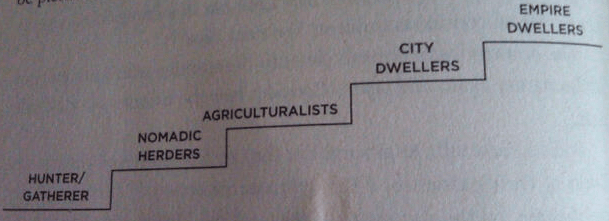
It is a first stage of ascent as human beings progress from the life of hunter-gatherers to the life of agriculturalists and beyond. Their journey could be pictured like this:
But also of a descent:

But the ascent is ironic, because with each gain, humans also descend into loss. They descent (or fall—there’s nothing wrong with the word itself, just the unrecognized baggage that may come with it) from the primal innocence of being naked without shame in one another’s presence.
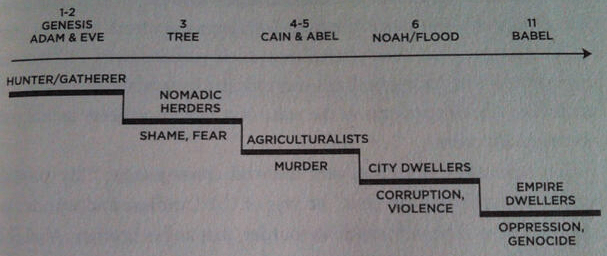
Each step of socioeconomic and technological ascent thus makes possible new depths of moral evil and social injustice. (p. 50-51)

As humans, with progress (implication of ascent) there is also loss (which in turn puts humans on a descent). Thereby, we now lose the vertical pattern of Platonic perfection-ideal as expressed through the Greco-Roman view of Eden but have a more progressive view of the Bible—a stepping stone, if you will.

If Genesis sets the stage for the biblical narrative, this much is unmistakably clear: God’s unfolding drama is not a narrative shaped by the six lines in the Greco-Roman scheme of perfection, fall, condemnation, salvation, and heavenly perfection or eternal perdition. It has a different story line entirely. It’s a story about the downside of “progress”—a story of human foolishness and God’s faithfulness, the human turn toward rebellion and God’s turn toward reconciliation, the human intention toward evil and God’s intention to overcome evil with good. It begins with God creating a good world, continues with human beings creating evil, and concludes with God creating good outcomes that overcome human evil. We might say it is the story of goodness being created and re-created: God creates a good world, which humans damage and savage, but though humans have evil intent, God still creates good, and God’s good prevails. Good has the first word, and good has the last. (p. 54)

If this view sets the stage for how to read the Bible, we are certainly in for a very interesting (and bumpy) ride.

In Chapter 6, McLaren argues that the beginning of his quest to view Christianity through a new lens was shaped by his liberal arts education and bolstered by a lack of formal theology training. I found this quote interesting:

Deconstruction is not destruction, as many erroneously assume, but rather careful and loving attention to the construction of ideas, beliefs, systems, values, and cultures.

Merriam-Webster defines deconstruction this way:

1 : a philosophical or critical method which asserts that meanings, metaphysical constructs, and hierarchical oppositions (as between key terms in a philosophical or literary work) are always rendered unstable by their dependence on ultimately arbitrary signifiers
2 : the analytic examination of something (as a theory) often in order to reveal its inadequacy

Deconstruction is not careful and loving attention to construction, no matter what McLaren says. Deconstruction is critical assessment performed in order to reveal inadequacies.

But McLaren is openly stating that he’s reading the Bible through a literary lens where he can identify protagonists, antagonists, plot, tension, conflict, resolution, and character development.

So as we head into Exodus, we read of a God who “sides with the oppressed, and God confronts oppressors with intensifying negative consequences until they change their ways, and in the end the oppressors are humbled and the oppressed are liberated.”

I can’t help but comment that McLaren is back to nonliteralism now as he says God sends a “firm but gentle” plague on the Nile River that “turns red like blood.” But let’s read what Exodus 7:14-21 says. In fact, let’s use The Message version, Eugene Peterson’s paraphrase of what the Bible says:

God said to Moses: “Pharaoh is a stubborn man. He refuses to release the people. First thing in the morning, go and meet Pharaoh as he goes down to the river. At the shore of the Nile take the staff that turned into a snake and say to him, ‘God, the God of the Hebrews, sent me to you with this message, “Release my people so that they can worship me in the wilderness.” So far you haven’t listened. This is how you’ll know that I am God. I am going to take this staff that I’m holding and strike this Nile River water: The water will turn to blood; the fish in the Nile will die; the Nile will stink; and the Egyptians won’t be able to drink the Nile water.'”

God said to Moses, “Tell Aaron, ‘Take your staff and wave it over the waters of Egypt—over its rivers, its canals, its ponds, all its bodies of water—so that they turn to blood.’ There’ll be blood everywhere in Egypt—even in the pots and pans.”

Moses and Aaron did exactly as God commanded them. Aaron raised his staff and hit the water in the Nile with Pharaoh and his servants watching. All the water in the Nile turned into blood. The fish in the Nile died; the Nile stank; and the Egyptians couldn’t drink the Nile water. The blood was everywhere in Egypt.

The quote above is simply a paraphrase—someone’s interpretation of what is occurring in the Bible. I’m amazed that McLaren is so intent on reading the Bible non-literally that he tries to explain away what’s happening in the Bible through literal means: “Ironically, perhaps through a red tide, the Nile turns red like blood.” As a result of McLaren’s literary reading of Biblical passages, he begins to make literal assumptions about these passages that aren’t there.

On page 58, McLaren says “God never works directly, only indirectly” and reduces the plagues often seen as something extraordinary and supernatural into nothing more than ordinary and natural. He diminishes the work of God.

McLaren argues the Bible presents three narratives:

  1. God as creator
  2. God as liberator from external and internal oppression
  3. God as reconciler

After reading beautiful literary passages from Hosea, Joel, and Isaiah, McLaren encourages his readers to see the future as something that “is not fatalistically predetermined” but rather see history as “live”—“unscripted, unrehearsed reality, happening now—really happening.” (p. 62-63) Here, McLaren rejects the premise of a predetermined, foreknown future by God (Jeremiah 29:11; Acts 2:22-23; Romans 8:28-30; I Corinthians 2:7; Ephesians 1:5,11).

Then McLaren attempts to literalize Scripture within a modern framework despite saying, “As this approach relieves of literalistic interpretations, it frees us to let the poetry work as poetry is supposed to”:

Swords into plowshares. Today that would mean dreaming about tanks being melted down into playground jungle gyms and machine guns being recast as swing sets. (p. 63)

That’s just one example. It’s a clever reading of the passage but the fact of the matter is, McLaren is trying to take the literal, make it literary, and then convert the literary as the literal he wants to see. To put it bluntly, McLaren is reading things in the Bible that simply aren’t there.

McLaren is very good at igniting passion and hope for a better tomorrow that seems as if it can occur today.

If the Genesis story sets the stage by giving us a sacred vision of the past, and if the Exodus story situates us in the sacred present on a pilgrimage toward external and internal liberation, then the story of the peace-making kingdom ignites our faith with a sacred vision of the future, a vision of hope, a vision of love. It represents a new creation, and a new exodus—a new promised land that isn’t one patch of ground held by one elite group, but that encompasses the whole earth. It acknowledges that whatever we have become or ruined, there is hope for a better tomorrow; whatever we have achieved or destroyed, new possibilities await us; no matter how far we have come or backslidden, there are new and more glorious adventures ahead. And, the prophets aver, this is not just a human pipe dream, wishful thinking, whistling in the dark; this hope is the very word of the lord, the firm promise of the living God.

Perhaps I’m not as optimistic or those darn Greco-Roman glasses keep getting in the way.

Again, I appreciate McLaren’s attempt to read the Bible with a new perspective but there needs to be a balance between the literal and literary interpretations. I understand that some people Bible see the Bible as purely a literal work of God; others see the Bible as nothing more than a beautiful piece of literature. McLaren looks as the Bible as a beautiful piece of literature and then tries to recast it into a literal work with explanations that are a stretch. Frankly, McLaren’s attempt at a new kind of Christianity appears headed extremely off-course as I go into reading Chapter 7.

Food for thought #2: Brian McLaren’s A New Kind of Christianity

I have a slight problem with Brian McLaren’s graph from p. 34 of A New Kind of Christianity. His graph is shown above in the picture; my revised version is shown below.

McLaren places Eden on the level of Heaven which basically equals perfection. That might bother some but it doesn’t bother me. The only difference between my graph and his is the direction of the “Hell/Damnation” arrow. While nitpicky, I have a fundamental disagreement with McLaren on this one.

From a theological perspective, what bothers me is the downward direction of the arrow. Perhaps he drew it that way because we always think of heaven as existing above and hell existing below. I redrew it to make it a continuous straight line not only because I have semi-OCD tendencies but also because the destination as a result of condemnation is hell/damnation. It’s not a downward trajectory from condemnation but rather, a continuous path that is not separate from it. According to the Bible, this is the spiritual path that all souls are on as a result of the fall (Romans 5:17-19).

I’d also like to add that I’m interested in reading McLaren’s response to the pluralism question: “How should followers of Jesus relate to people of other religions?” On page 21, he briefly summarizes what he’ll try to address:

So we ask: Is Jesus the only way? The only way to what? How can a belief in the uniqueness and universality of Christ be held without implying the religious supremacy and exclusivity of the Christian religion?

I think it’s an interesting question to posit and answer, oops, I mean “respond to.” (There are no answers according to McLaren, only responses in an effort to stimulate and continue conversation. For a great Biblical counseling perspective on this conversation, check out Bob Kellermen’s series in which he provides responses to McLaren’s questions.)

So here are my initial responses before reading the chapter in which McLaren expounds on the pluralism question:

  • Is Jesus the only way? “I am the way, and the truth, and the life; no one comes to the Father but through Me.” — John 14:6
  • The only way to what? God the Father and His house. Thomas specifically asks about this. See all of John 14.
  • How can a belief in the uniqueness and universality of Christ be held without implying the religious supremacy and exclusivity of the Christian religion? While I appreciate McLaren’s question here, I’d rather “lob back” in response, as he’d say, that there’s a supremacy and exclusivity that’s inherent in Christ rather than the Christian religion. I don’t think any system of belief is foolproof. I believe only Christ is. Religion muddies waters (how many Christian denominations are there?); Jesus Christ is crystal clear. That being said, I believe there is a uniqueness and universality of Christ that transcends all beliefs and religions but there is a supremacy and exclusivity that is inherent in the God/man rather than the religion. (I’m sure this is something I will clarify and elaborate on as I progress within McLaren’s book.)

I’m excited about reading through A New Kind of Christianity. I have an open mind about this and am totally willing to transform my Christian faith and live it in a new way with only one caveat: it must remain true to the Bible. If McLaren argues something that goes against what the Bible says, I’ll point it out. We know very little about Jesus apart from the Bible. And we would know nothing about Jesus’ teachings without the Bible. So holding McLaren and his questions and responses to a Biblical standard is neither unreasonable nor unfair since he is talking about the the Christian faith.

I hope you’ll join me in my journey through this book. If you don’t know who Brian McLaren is or what a little bit of background on what part of the Christian faith he comes from, please check out my series on the emergent movement.

    Final thoughts in the emergent movement series

    People not directly involved in the emergent movement likely think that it’s something that doesn’t affect them. Not true.

    The emergent movement and its connection to postmodern philosophy is having a vital effect on the way Christians and non-Christians alike think.

    I, for one, find myself constantly questioning things in Christianity. I’m very open and honest about my struggles in this respect. I used to live under the veil of pretending to have it all together. I’d rather err on the side of being too broken than being too pretentious. (“A broken and a contrite heart, O God, thou will not despise.” —Psalm 51:17)

    Questioning one’s faith is typical within emerging Christianity. Question and reasoning can be helpful to the health of someone’s Christian life. It challenges a person’s faith and forces them to understand, reconcile, and know what he or she believes.

    Where emergent Christianity takes things too far is that it can get too deconstructivist and undermine things that, as a believer, should not be undermined (eg, the deity of Christ, the necessity of his finished work on the cross). Those things should not persist as constant questions but rather, should be resolved and the topic should move on.

    Emergent Christianity also tends to go in circles on questions. Those in the “conversation” contend that questions are healthy. Yes, to a point. Questions should be asked in the quest for answers. To simply throw questions out for the sake of engaging in constant conversation is ultimately fruitless because it accomplishes nothing.

    Rob Bell, in Velvet Elvis, offers the Jewish culture of answering a question with a question as proof that it’s okay to go around and around with questions. I counter that answering a question with a question in Jewish culture is meant to be an end within itself. The answer (in the form of a question) is not meant to lead to endless conversation but as a way of stating a point of finality while leading the inquisitor to muse further on the answer in his or her own mind.

    So when it comes to questioning things within Christianity, I have accepted this as part of postmodern and emerging thought. Where I stop, however, is that I seek answers and definitions to my questions.

    Along with postmodern thought is the idea that everything is relative. This idea of relativity can be found in the emergent movement. However, within the framework of Biblical Christianity, there are absolutes. (I believe absolutes exist outside of the Bible but I’ll stick to my topic of Christianity.) Since Jesus was absolute and authoritative with many of this statements (“I am the way, the truth, and the life, no man comes to the Father except by me” —John 14:6), there is no room for relativity. Again, believers of the Bible should not be questioning whether Jesus really meant what he said. While Jesus was figurative with many of his statements, he was also very literal. To take his literal meanings, distort them, and teach those distortions as valid Christian thought is dangerous.

    Please don’t misunderstand me. Most believers go through times in their lives when they questions the basics and fundamentals of Christianity. The problem is when people in leadership begin teaching these doubts, assisting in undermining Christianity in their own congregations. If a person chooses not to believe in Christianity, questions it, and tries to point out its weaknesses, that’s one thing. To do the same while claiming to be a believer and teach others to do the same is wrong.

    So while I understand there are many areas in life that are full of grey, Christians should not deny that some things are plainly black and white (figuratively speaking). Emergent Christians can seek to blur the lines, giving the illusion that black and white is or can be grey.

    Emerging church excels, however, in taking Christianity to the 21st century. I get frustrated when I hear Christians knocking other Christians’ choice of worship. A common complaint I’ve heard is that churches have become a type of theater: things are done with video, multimedia slides, and lighting effects. These things are dismissed as unnecessary and purposeless. I view these things as a valid and appropriate means of reaching postmodern American society. While some people may enjoy that “old time religion,” for others, it does not reach them. I am with Paul when he says “I became all things to all men that I might by all means save some.” (I Corinthians 9:22) There is nothing sinful in using video, slides, overhead projectors, and the like. Simply because it’s not a person’s style of worship doesn’t mean it’s wrong.

    The argument along with that is that good gospel preaching can stand on its own and there is no need for visual anything. While that may be true, visuals are a supplement, not a replacement. I am baffled by Christians who are willing to embrace technology in every other aspect of their lives but insist on keeping it out of the church. To reach a 21st century generation, Christianity cannot continue to function in 19th century mode. It is possible to adapt to the culture without sinning in order to evangelize. This is the area where the emerging church has challenged the ecclesial institution and can help make it better. Some Christians call it becoming “worldly,” however, I see it as taking Christ’s message and making it practical and relevant.

    And that’s how the emerging church challenges me: how do I make 1st century concepts and teachings from a Middle Eastern culture practical and relevant 20 centuries later in a postmodern American society? It’s a question I don’t have an answer to but hope to discover that answer someday. (Even if the answer comes in the form of a question.)

    —-
    Note: I typed this entire post on my BlackBerry so please excuse any spelling or grammatical errors.

    Exploring my meaning and purpose in life

    Who am I?

    As a product of the instant gratification generation, I want to know the answer to who I am and why I’m here NOW. The two basic questions I grapple with on a daily basis are:

    1. What is my meaning in life?
    2. What is my purpose?

    And when I say daily basis, I mean, daily as in every single day. Usually the standard answer I give myself is the first Q&A from the Westminster Shorter Catechism:

    What is the chief end of man? To glorify God and to enjoy Him forever.

    I’m not sure how those in the Reformed faith applied that practically in 1646 but I’m trying to figure out what that looks like in 2010.

    Does that result in a list of do’s and don’ts? There’s a call to holiness: how do I live that out? I’m called to be a Christian witness 24/7 but often feel like a practical atheist—speak of God, am interested in the things of theology but do not really talk about my faith outside of… my faith. Quite the impractical faith. But I’m not trying to get into a discussion of evangelism and witnessing right now. I’m trying to figure out how to accomplish my meaning and purpose in life by glorifying God and enjoying Him forever.

    Glorifying God and enjoying Him look different for each person. We are not all the same and we are not called to be alike. While we all have the same chief end, how that plays out looks different in an individual’s life.

    So in my life, what does glorifying God look like? Well, to be quite honest, I’m not so sure. As a Christian though, there are certain things I am called to:

    • Being a good wife
    • Seeking after God through prayer, Bible reading, worship with His community, and the preaching of His word
    • Exercising my spiritual gift of mercy (and supposedly encouragement) to those who need it (in and out of the body of Christ)

    And how do I enjoy Him? You’ve got me. I know how to enjoy His creation but enjoying Him is an entirely different matter.

    Another open letter to God re: Haiti

    Dear God,

    I come before You now humbly repenting. I was foolish to think I knew better and that my human ways are wiser than Your divine ways. I echo David’s prayer of Psalm 51:

    Be gracious to me, O God, according to Your lovingkindness;
    According to the greatness of Your compassion blot out my transgressions.
    Wash me thoroughly from my iniquity
    And cleanse me from my sin.
    For I know my transgressions,
    And my sin is ever before me.
    Against You, You only, I have sinned
    And done what is evil in Your sight,
    So that You are justified when You speak
    And blameless when You judge.
    Behold, I was brought forth in iniquity,
    And in sin my mother conceived me.
    Behold, You desire truth in the innermost being,
    And in the hidden part You will make me know wisdom.
    Purify me with hyssop, and I shall be clean;
    Wash me, and I shall be whiter than snow.
    Make me to hear joy and gladness,
    Let the bones which You have broken rejoice.
    Hide Your face from my sins
    And blot out all my iniquities.
    Create in me a clean heart, O God,
    And renew a steadfast spirit within me.
    Do not cast me away from Your presence
    And do not take Your Holy Spirit from me.
    Restore to me the joy of Your salvation
    And sustain me with a willing spirit.
    Then I will teach transgressors Your ways,
    And sinners will be converted to You.
    Deliver me from bloodguiltiness, O God, the God of my salvation;
    Then my tongue will joyfully sing of Your righteousness.
    O Lord, open my lips,
    That my mouth may declare Your praise.
    For You do not delight in sacrifice, otherwise I would give it;
    You are not pleased with burnt offering.
    The sacrifices of God are a broken spirit;
    A broken and a contrite heart, O God, You will not despise.
    By Your favor do good to Zion;
    Build the walls of Jerusalem.
    Then You will delight in righteous sacrifices,
    In burnt offering and whole burnt offering;
    Then young bulls will be offered on Your altar.

    Since I wrote an open letter to You, publicly asking questions, again I repent publicly expressing my sorrow and seeing how my limited judgment stilted my view of the work that you’re doing in Haiti.

    God, You’ve inspired me. Pastor Mark Driscoll of Mars Hill Church and director of Churches Helping Churches has no idea who I am and probably will never know who I am. But his 32 hours on the ground in Haiti has touched my heart and given me a better perspective. A perspective I should have had but was hasty instead to rush to judgment.

    I watched his special sermon to his congregation called 32 Hours: The Church in Haiti and was spiritually brought to my knees. In anger, I accused You of not caring, of not being loving, of not being fair, just, or kind when in fact, You are being more merciful that I could have possibly imagined.

    I don’t know how many people watched Driscoll’s sermon; in some ways, I don’t care. But at the beginning of his sermon, he spoke of how he barely knew of Haiti and its people. I then realized that fact was true for many people around the world.

    And it is through this tragedy, Lord, that people on a mass scale are FINALLY noticing, caring about, and loving Haiti. It is through this tragedy that You have forced people to come to grips with a country in the Western Hemisphere that is in impoverished in almost every single way. Haiti has received more attention in the past two weeks than it ever has before. I’m still not happy that hundreds of thousands of people had to die but I see now their deaths were not in vain. Though we know not their names, they served a purpose—they gave their lives so others might know about their country. They gave their lives so Brazil, Peru, Spain, France, and China to name a few countries, could lend medical care, provide basic needs, and help rebuild a country that has been broken for too long.

    Though they may not all have known You, the hundreds of thousands of people who died gave their lives for Your gospel. Through Driscoll’s video, I realized that churches who overlooked Haiti as a mission field before are now extremely burdened for the souls of those people. Pastors who never knew Haiti existed are now begging their congregations to give generously to a country that can never give back.

    And I am forced to say nothing other than “thank You.”

    People wiser than I encouraged me to read the Book of Habakkuk and see how Your servant asked You questions then awaited an answer and the judgment to come. You have given me an answer, Lord. And I thank You. Because that answer has shown me what I really knew all along but couldn’t really see—that You are being glorified and magnified.

    In a week or so from now, the images of Haiti will fade from most people’s minds, we’ll return to our normal lives, and the burden we feel for the country now may lessen. But you have imprinted Haiti on certain people’s hearts as a result of this and now many people from all sects of Christianity will flood into the country and witness the love of Christ in word and in deed. Some may give their lives as the country is still unstable. But the Haitian people will know of Your love and will know that Your people around the world care for them.

    Thank You, Lord, for the forgiveness that You provide through Jesus Christ; thank You that You have been gracious and merciful to me to answer my prayers; and thank You for drawing me closer to You and for reigniting a flame in my heart that was slowly beginning to die and lose hope. Show me how I can be of help to a hurting country and a hurting people. Please, God, never ever let me lose sight of the work that You’ve done in my heart and the work that You’re doing in Haiti.

    And, while I’m at it, thanks for making me Haitian.

    Merci pour tout bagai ou b’am mwen, bon Dieu.

    Love,
    Me

    I don’t know if this will work but I’ve embedded Pastor Driscoll’s video on Haiti below. If it doesn’t work, feel free to see it Embedding doesn’t work. See it here. It’s on YouTube now so I’m able to embed it. It’s over an hour long but it’s the best hour I’ve spent in a long time. I’d encourage anyone—Christian or not—to watch it.

    Three Lessons I Learned Today

    1. I am prideful. My husband pointed out that it’s a trait I get from my mother, attempting to look like I have it all together. “Well, when you put it that way…” I said with a shiver running down my spine. My mother’s need to look like she had it all together kept my father from getting treatment for his paranoia/schizophrenia and kept his sisters out of the dark for too many years. Knowing that quality exists in me is a rather scary thought.

    I went to a prayer retreat today and again, tried to act like I had it all together. Truth be told, I’ve been going through a spiritual drought. My prayers have consisted of nothing but “why” questions and I earnestly began to pray that I would seek to “know God more than my need to understand Him.” Through the guidance and counseling of two wonderful Christian friends, they prayed with me and reminded me of God’s promises through Scripture. My faith began to see the beginnings of restoration. Continue reading “Three Lessons I Learned Today”

    An open letter to God, re: Haiti

    WARNING: Objectionable photos below the cut. Viewer discretion is advised.

    Dear God,

    I know I’m supposed to pray in a private place with the door shut and stuff but I hope you won’t excuse me writing this and making it public. I think some people feel the same way I do. I can’t officially speak for them but I know I’m not alone when I ask you the following:

    Do you hate the Haitian people?

    No, I mean, seriously? Like, do you hate them? Did Satan make a deal with you that he’d pick this one country in the Western Hemisphere and beat it down and allow all others to look comfortable in comparison? Is Pat Robertson right? Did you curse this country because some idiot slaves wanted to be free from French rule?

    I am conflicted, Lord. I was born in New York. I am a first-born American. Yet, Haitian blood flows through my veins. I am more related to a country that was reigned by terror and plagued with fear than a country that gave people of my skin color the right to attend any school of their choosing only 45 years ago. I have never known the fear of Papa Doc and Baby Doc but then again, I have never known the fear of the Ku Klux Klan or other white supremacy organizations. I feel straddled between two countries.

    I have never been to Haiti. Out of concern for my safety and protection, my mother and father would never take me there. “It’s not the country it used to be,” they lament.

    Lord, were there ever glory days in Haiti? What was it like when my parents were growing up? They speak of it fondly as though those were the good ol’ days. But you allowed my grandfather to be gunned down in cold blood during those good ol’ days. Political strife was still present even back then.

    Even though I have never been to Haiti, it is a country my parents grew up in. I am first-generation. I guess I don’t need to tell you that; you ordained it. As a result, when I see the images of bodies strewn everywhere, buried under rubble, piled up on one another–I am cut to the quick. Continue reading “An open letter to God, re: Haiti”

    Personal thoughts on Tim Keller’s book, Counterfeit Gods

    I recently published a book review on Tim Keller’s book, Counterfeit Gods, but wanted to write a post that is a bit more personal in nature. I left off with this:

    To dethrone any and all other idols apart from God, Jesus’ sacrificial death on the cross must be real. The heart of the matter can be summed up in this question:

    What is operating in place of Jesus Christ as your real, functional salvation and Savior?

    It is a question that Christians should not neglect to ask themselves every single day.

    The cynic in me struggles with this. God knows how much I am very much a doubting Thomas, plagued with questions like:

    • “Jesus, were you real?”
    • “Are you really coming back?”
    • “How come you haven’t done anything for so long?”
    • “Can the compilation of what people claim to be Your word (the Bible) really be trusted?”

    I’ve come to the realization that I am the very least, a Jew. (Yeah, go ahead and make a Sammy Davis, Jr. joke now.) I believe wholeheartedly in the Old Testament. But the more I think about it, the more the Old Testament constantly points back to Jesus. (The Book of Matthew is a great book for discovering how the Old Testament continuously points to Jesus.)

    Now while the Pharisees were gathered together, Jesus asked them a question: “What do you think about the Christ, whose son is He?”
    They said to Him, “The son of David.”
    He said to them, “Then how does David in the Spirit call Him ‘Lord,’ saying,

    ‘THE LORD SAID TO MY LORD,
    “SIT AT MY RIGHT HAND,
    UNTIL I PUT YOUR ENEMIES BENEATH YOUR FEET”‘?”

    If David then calls Him ‘Lord,’ how is He his son?”
    No one was able to answer Him a word, nor did anyone dare from that day on to ask Him another question. ~ Matthew 22:41-46

    A puzzling question to me as well.

    So the basic hurdle that I am confronted with is whether I believe fully in Jesus Christ, who he is, and his purpose for being born on earth–his existence as fully human and fully God; that he is the Son of God, born to a virgin, lived, died on a cross bearing God’s wrath for the sins of humankind, was buried, and rose again three days later. If I accept this (and I do), then I also accept that the triune God alone is worthy of worship, leading me to adhere to the following commandment:

    You shall love the Lord your God with all your heart, and with all your soul, and with all your mind. ~Matthew 22:37

    This is not in conflict with the first commandment God issues (located in Exodus and Deuteronomy):

    I am the LORD your God, who brought you out of the land of Egypt, out of the house of slavery. You shall have no other gods before Me.  ~Exodus 20:2-3 & Deuteronomy 5:6-7

    Jesus reiterates that God must take the primary place in our heart, soul, and mind. He is to be the only One people worship. He must constantly occupy our daydreams and imaginations even. I quoted this passage from Keller’s book in my previous post but it strikes and convicts me so that I feel compelled to repost it:

    Archbishop William Temple once said, “Your religion is what you do with your solitude.” In other words, the true god of your heart is what your thoughts effortlessly go to when there is nothing else demanding your attention. What do you enjoy daydreaming about? What occupies your mind when you have nothing else to think about? Do you develop potential scenarios about career advancement? Or material goods such as a dream home? Or a relationship with a particular person? One or two daydreams are no [sic] an indication of idolatry. Ask, rather, what do you habitually think about to get joy and comfort in the privacy of your heart?

    If I’m honest, I must admit God does not constantly occupy my thoughts as He should. I also frequently fail to follow this directive from the apostle Paul as listed in Philippians 4:8:

    Finally, brethren, whatever is true, whatever is honorable, whatever is right, whatever is pure, whatever is lovely, whatever is of good repute, if there is any excellence and if anything worthy of praise, dwell on these things.

    How often do I dwell on the things that are false, dishonorable, wrong, impure, ugly, and bad repute, full of mediocrity and worthy of condemnation!

    As a result, I’ve instantly created an idol. Keller writes:

    Idolatry is not just a failure to obey God, it is a setting of the whole heart on something besides God.

    In my previous post, I listed all the idols Keller identifies. While I’ve struggled with many of those idols at one time or another, these are the main idols that currently dethrone God in my life: Continue reading “Personal thoughts on Tim Keller’s book, Counterfeit Gods”

    Tim Keller’s Counterfeit Gods (Book Review)

    My church recently distributed Tim Keller’s book, Counterfeit Gods, for Christmas to whomever wanted it. I’ve heard people sing Tim Keller’s praises but have never read his books or visited his church or church plants. Therefore, I decided to pick this book up first before picking up Keller’s other bestsellers that have piqued my interest: The Reason for God and The Prodigal God. And besides, it was FREE. How can you beat a FREE book?

    I made a goal to finish reading the book before the clock struck midnight for 2010 and achieved that goal. The hardcover book, barely larger than 5 x 7 inches, is just under a 200-page read (including the Introduction but not including Notes, Bibliography, or Acknowledgments). I’m a bit of a slow reader so I was able to complete the book in about three days (of dedicated reading). A fast reader could easily complete this book in a day–it’s that small.

    Upon completion of the book, I was pleasantly surprised to discover how much I enjoyed it. And it stood in marked contrast to a book I most recently finished, It’s Your Time by Joel Osteen, that touts health and wealth as proof of God’s favor upon an individual. Usually, I take a couple of days and allow my mind to fully absorb the contents from the book before making a full judgment, however, Counterfeit Gods impacted me so much, I view it as a life-changing book.

    Perhaps life-changing seems like an exaggeration but for me it is not. I operate on a five-star rating scale, basically using the Amazon system:

    * (one star) – I hated it
    ** (two stars) – I didn’t like it
    *** (three stars) – It’s OK
    **** (four stars) – I liked it
    ***** (five stars) – I loved it

    Counterfeit Gods gets FIVE stars from me. It’s not easy for a book to garner that high a rating from me but I personally can’t find any fault with it. (Perhaps a pastor or some high-falutin’ theologian would.) Keller is clear, concise, uses modern-day and Biblical examples to support his points, and instructs readers on how to identify and replace any idols in their lives.

    Keller leaves no graven image unturned in this book. This book, aptly titled Counterfeit Gods, could also have been titled If You’re Breathing, You’re Probably Breaking the First Commandment. Keller posits that anything that dethrones Jesus Christ as the sole object of worship in our lives is an idol. He also asserts that the remaining nine commandments are basically elaborations on the first:

    I am the LORD your God, who brought you out of the land of Egypt, out of the house of slavery. You shall have no other gods before Me.  ~Exodus 20:2-3 & Deuteronomy 5:6-7

    Since Counterfeit Gods is a relatively recent book, he begins by addressing the economic fallout of 2008-2009 that led the United States into a recession. He refers to wealthy investors who made money their sole god. So when the bottom dropped out of the economy and those investors lost millions upon millions of dollars, they had nothing left to turn to. As a result, many of them committed suicide. Except for one bright shining hope in an investor named Bill who gave his life to Christ in 2005. Bill testifies:

    If this economic meltdown had happened more than three years ago, well, I don’t know how I could have faced it, how I would have even kept going. Today, I can tell you honestly, I’ve never been happier in my life.

    Don’t get the idea that Keller is saying becoming a follower of Jesus Christ leads to a life of butterflies and sunshine. Quite the contrary, he implies Christians have a tougher road ahead of them because they are called to a higher standard. As a result, Keller points out that today’s (mainly Western) Christians often don’t look much different from non-Christians.

    Contemporary observers have often noted that modern Christians are just as materialistic as everyone else in our culture. Could this be because our preaching of the gospel does not, like Saint Paul’s, include the exposure of our culture’s counterfeit gods?

    Harsh words. It certainly convicted me.

    For starters, it would be good to define what an idol is. Here is the basic definition Keller provides:

    It is anything more important to you than God, anything that absorbs your heart and imagination more than God, anything you seek to give you what only God can give.

    Despite the book’s subtitle, The Empty Promises of Money, Sex, and Power, and the Only Hope That Matters, Keller does not limit his discussion of idols to money, sex, and power. Not at all. Here’s a full list of the idols he identifies (located in the Notes section) with brief descriptions: Continue reading “Tim Keller’s Counterfeit Gods (Book Review)”

    It’s Your Time Book Review: Dump this book, Discard much of what you learn, Desist reading

    Inspired by this post from Matthew Paul Turner, basically making fun of Pastor Joel Osteen’s (NOT OLsteen, maybe LOLsteen) new book, It’s Your Time and a one-star review on Amazon in which the “reviewer” essentially wrote that Osteen was a fraud, he hadn’t read the book, and never intended to read the book (the review’s since been taken down), I felt prompted to go where most Biblical evangelical Christians choose not to go.

    I decided to read Joel Osteen’s latest book to see if dollar signs would really begin flashing right before my eyes. However, I need to add a disclaimer of a sort:

    Last page with text in "It's Your Time"I am a little sensitive to Joel Osteen and his ministry and likely not as hard as I should be. Thank my mother. I believe that God used Pastor Osteen’s ministry to bring my mother to a saving knowledge of Jesus Christ. She was hesitant for many, many years but after watching Pastor Osteen regularly, softened up, accepted Jesus as her Lord and Savior, and now regularly attends a local Bible-believing church. I have seen Osteen’s telecast and at the end, he does give an invitation (though many Biblical evangelicals would consider it a weak one) to accept Jesus. Although the criticism is that Jesus is secondary to his preaching of the “health and wealth” gospel,” which we’ll get to later on in the review. (Click on the photo on the left to enlarge it and essentially read the “invitation” Joel Osteen provides.)

    I wrote an unfinished review of It’s Your Time and was probably more favorable to it than most Biblical Christians would have been. So now that I’ve completed this book, how would I rate it overall?

    Two stars.

    What were the issues then that led me to give this book a rating comparable to “poor”? Quite a bit. Sit back and have a nice cup of coffee or tea as you review this list with sometimes lengthy explanations. Continue reading “It’s Your Time Book Review: Dump this book, Discard much of what you learn, Desist reading”

    Still searching for an identity… part 4

    Faith, religion, God.

    I’m currently reading Joel Osteen‘s latest book, “It’s Your Time” and annoying the Twitter world with my #ItsYourTime-related tweets. I subscribe to a brand of Christianity that does not subscribe to Osteen’s brand of Christianity. So why am I reading this book if I don’t agree with him? Several reasons actually:

    1. Curiosity. It’s fun to make fun of what we know of the guy but has the message changed?
    2. Legitimate criticism. I tire of Christians panning books they’ve never read and never intend to read. I want to legitimately pan–or extol (unlikely, though)–Osteen’s book.
    3. Amusement. His optimism amuses me. He’s easy to make fun of and his anecdotes are sometimes hilarious.
    4. Thought-provoking. In a twisted mode of thought, I enjoy finding verses and passages that are distorted or examples that are taken out of context. Makes me feel like a mini-theologian. 🙂

    The trouble with Osteen’s book, however, is that there’s a lot of truth in it but there’s enough wrong to make it bad.

    I’ve been assuming the majority of my readers are Christians who know about Joel Osteen in some way. Maybe you’re not a Christian or you’re simply not familiar with Mr. Osteen. Well, let me introduce you.

    Osteen, in a nutshell, is considered by his supporters as “America’s voice of hope and encouragement” while his critics deem him as a proponent of the prosperity “health and wealth” gospel. Indeed, I can see truth from both sides.

    Osteen writes in a very personable way, which makes it feel as though he’s speaking specifically to each reader. If a person is feeling discouraged, no doubt, Osteen has the gift of encouragement. (Even renowned evangelical Mars Hill pastor Mark Driscoll has said such!) Osteen is the ultimate optimist. (Sometimes, he’s so optimistic, it’s sickening.) I’m very much a cynic and a pessimist. I really have no business reading this book.

    But there are scriptural truths that he does point out that I, as a pessimist, tend (and prefer) to overlook. For example, God tells us to ask Him for anything. (Matt. 7:7-11) And Osteen can even legitimately use Matthew 21:22 (“And whatever things you ask in prayer, believing, you will receive”) if he so desires. I’d argue in favor of Osteen if someone tried to tell me Matthew 21:22 wasn’t a straightforward verse. (Even taken in its context.)

    However, where Osteen errs is by leading readers to believe that God will “fulfill all the desires of your heart.” (Psalm 37:4) If we look at the entire verse, which says, “Delight yourself also in the LORD, and He shall give you the desires of your heart,” it implies first “delighting in God.” When believers delight themselves in God (and the things He’s after), the desires of their heart will align with the desires of God’s heart, not the desires of our sinful lusts. James 4:2-3 again confirms this by saying:

    You lust and do not have. … You do not have because you do not ask. You ask and do not receive, because you ask amiss, that you may spend it on your pleasures.

    Christians sometimes have this fallacious belief that God does not answer prayer. Not so! God does answer prayer with a yes or no. Sometimes he doesn’t always answer right away but he does eventually answer our requests. Often, some people take a “no” response to really mean “no answer” because we keep hoping He’ll say “yes.” I can pray my little heart out to be as rich as Bill Gates one day. It’s legitimate to ask for it since I can ask for anything. However, I must also realize it’s legitimate for God to flat-out–or take His time in saying no.

    Has Osteen’s book helped me to dream a bit bigger? Well, yes–cautiously.

    Osteen has a pretty big God and I think Osteen’s critics sometimes view through the lens of cynicism and try to make God so much smaller than He really is. Truth is, no one can contain God–not you, not me, not Osteen, and definitely not Osteen’s book or sermons. Can God bestow much wealth and restore full health upon you? He sure can; I believe that. Will He? I don’t know but the likelihood of obtaining exceptional wealth is slim. (When I mean “wealth” here, I’m referring to the Americanized definition of “massive accumulation of wealth,” which is the language Osteen uses.)

    And that’s where I have a problem with Osteen. Can God do anything? Yes. Will He do anything and everything simply because I ask Him to? No. God is not a magic genie we must rub the right way. This becomes a works-based, legalistic theology. People must obey God simply because He is God. He created all things and therefore gets to make the rules whether we like it or not.

    But Osteen tells his readers if they believe they’ll receive whatever they ask for and have enough faith, it will happen. He can support this with Matthew 21:22, remember? How do you refute that?

    Osteen’s book so far has challenged me to have more faith in what I pray for. Not some lackadaisical half-hearted faith (“Well, I’ll pray for it, but it likely won’t happen.”) but a real, bold faith that could position me for embarrassment if it doesn’t happen (“I prayed for it and have NO DOUBT it’ll come to pass!”). I’m challenged to pray with confidence, not expecting disappointment but with a realistic mindset that my prayers may not be answered exactly the way I’d like them to be. (I prayed fervently for an Italian husband and got NOWHERE CLOSE to that. But I wouldn’t trade my husband of Anglo-Sax/German heritage for any other man.) God’s ways and wisdom are so much higher than mine. He’s a better judge of good things that I could ever be.

    Relationship with God.

    Lately, I’ve felt like a Christian in name only (CINO). I hear all these stories of how Christians are told by non-Christians that they “are different” and that “there’s something special” about them they’d like to also have. That has never, ever happened to me. I’ve never been able to “lead” one person to the Lord. Does that make me a terrible Christian?

    I know Christians are supposed to be “in the world and not of it.” I always got the impression that the life of a Christian would look different than that of a non-Christian–in a positive way. However, when I evaluate my life, I’m troubled that I can’t tell a marked difference than that of my neighbor who doesn’t go to church. And I don’t mean simply n a public level; I also take my private life into consideration. I don’t get on my knees by my bed to pray every night. In fact, my prayers are sometimes quick requests made in passing throughout the day. I don’t have consistent devotions daily. (There’s that lack of consistency thing again.) I can sometimes go days without talking to God or reading His word. I know my eternal salvation doesn’t depend on me (and thank God it doesn’t because I’m doing a lousy job right now) but James emphasizes “faith without works is dead” (2:17, 26). What good is the salvation I have if I don’t put it into action? My life in Christ needs to be alive and vibrant–and I’m at a total loss as to how to do that. (Remember my little problem with consistency and regularity?)

    I want to be different for God. I want to be a God-honoring Christian. I want to put my faith in action. I want to have a close, personal relationship with God. I want to revere God better than I revere any celebrity but I also want to be comfortable with Him like He’s my “homie.” So comfortable I can cry, “Abba, Father, Daddy” (Rom. 8:15, Gal. 4:6) in the most personal and familiar of terms.

    Until then, I feel as though I am back at square one like when I was Catholic 12 years ago–CINO. I am hungry and desperate for a savior. I want–perhaps need–to accept Jesus all over again. Maybe daily.

    Isn’t consistency key?
    —————-
    Now playing: Sara Groves – Maybe There’s A Loving God
    via FoxyTunes

    Spiritual paralytic

    Sometimes one of our friends or loved ones becomes a spiritual paralytic. The affliction or trial he or she has undergone has virtually immobilized the person spiritually. He is unable to help himself. Not only that, but the spiritual “mat” he is lying on — that is, faith in God and trust in His promises — is no more than the equivalent of a thin, straw-filled mattress. If you try to encourage him through Scripture, he will look at you blankly and tell you Scripture just doesn’t mean anything to him anymore. he has tried to claim God’s promises, but nothing “works.” God just isn’t there.

    This person has become an awkward, heavy spiritual burden. You cannot pray with him, you can only pray for him. But just as the paralytic’s friends persisted until they brought him to Jesus, so we too must persist in bringing this person to the throne of grace until God heals him spiritually. — Jerry Bridges, Transforming Grace (p. 234)

    Bridges is describing me right now. If you’re reading this and you think of it, pray for me. Thanks.

    A masterful, descriptive definition for Biblical Counseling

    Biblical counseling involves identifying our original design, diagnosing how we fall short of that design, and dispensing God’s grace to empower people to mature into the dignified likeness of Christ, the image of the invisible God.

    Read more at Grace Dependent.

    A eulogy delivered on December 17, 2001

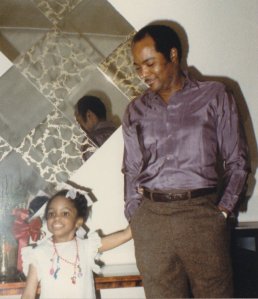
    Me and Daddy

    Family, friends, and beloved guests, I want to thank you for attending my father’s memorial service.  Not only was he a devoted brother, husband, and father, but above all, he was a born again child of God.

    Even though I’ve lived for only 19 years, I praise God for the memories I shared with my father. I remember my father teaching me how to ride a bike at Eisenhower Park.  Although he did not have a son, I fulfilled that role when he taught me how to play football.  I look back memorably on the last Sunday of each January when my father and I would sit and watch the Super Bowl.  My father has taught me everything I need to kow to watch sports with my future husband.  He taught me that soccer is true football and that no one (but Americans) calls football soccer.  He raised me on cheering for the New York Yankees, but would take me to a Mets game when he had the opportunity.

    All the areas of my father’s life seems to be all right but he felt an emptiness that he could not explain.  To fill this longing in his heart, he set out on his quest to find God.  Raised as a staunch Catholic, he realized he could not find what he needed in the traditions of man.  God led him to Bible Baptist Church where he accepted Jesus Christ as his Lord and Savior.  As a born again Christian, he began reading the Bible and learned that he could go directly to God for the forgiveness of his sins, not through a priest.  Because of my father’s earnest efforts to bring me to a Bible-believing church, in July of 1998, I also came to know Jesus Christ as my Savior.

    As my father immersed himself in the Bible, God changed his heart and gave him a joy that he had never possessed.  A verse from his favorite Psalm reads, “The Lord is my rock, and my fortress, and my deliverer; my God, my strength, in whom I will trust; my buckler, and the horn of my salvation, and my high tower.”  When trials headed his way, he turned to God for comfort and assistance.  Leaving New York for a Christian college in Florida was not the easiest thing for me to do, but my father was at peace with the decision, knowing that I was doing the will of God.

    When people ask how they can help ease the pain of my father’s passing, there’s only one answer: To do what I know my father would want people to do, and that is to believe on the Lord Jesus Christ for the remission of their sins.  Everyone in this room is a sinner.  Romans 3:23 in the Bible says, “For all have sinned, and come short of the glory of God.” Romans 6:23 says, “For the wages of sin is death; but the gift of God is eternal life through Jesus Christ our Lord.”  The ultimate punishment of sin is death, but because my father believed upon Jesus Christ’s finished work on the cross, he is now living eternally in heaven with God.  People should be sad today because my father is no longer physically present.  But I know that my father is in a better place right now, not because he deserved to be, but because God made salvation available to my father as He is making it available to everyone here.  John 3:16 says, “For God so loved the world, that he gave His only begotten Son that whosoever believeth in Him should not perish, but have everlasting life.”  Do not focus on my father’s death; instead, I ask you to focus on your eternal destination.  It doesn’t matter whether you’re 19 or 90, each of us will die eventually.  Then where will you go?  There’s a heaven above, a hell below and nothing in between.  Had my father not trusted in Jesus Christ, he would have suffered from eternal torment.

    Has there ever been a time in your life when you told God that you believed Jesus Christ died, was buried and resurrected for your sins so that you could have access to the gates of heaven? In John 14:6, Jesus states, “I am the Way, the Truth, and the Life: no man cometh unto the Father but by me.”

    Philippians 4:13 emphasizes, “I can do all things through Christ which strengtheneth me.”  If anyone is without Christ, he can do nothing. But I praise God that when He calls me to my home in heaven, I can see my father again.  Can you say with definite assurance that you are on your way to heaven?  If my father’s death has not made you questions your eternal destination, then he will have died in vain.  But if someone here realizes that he is a sheep wandering without a shepherd, the Lord Jesus is beckoning you to come to Him.


    August 22, 1942–December 9, 2001

    Thought of the Day

    Are you more devoted to your idea of what Jesus wants than to Jesus Himself? If so, you are likely to hear one of His harsh and unyielding statements that will produce sorrow in you. What Jesus says is difficult— it is only easy when it is heard by those who have His nature in them. Beware of allowing anything to soften the hard words of Jesus Christ. — Oswald Chambers, My Utmost For His Highest, August 18