Natural Disasters Aren’t Complete Disasters


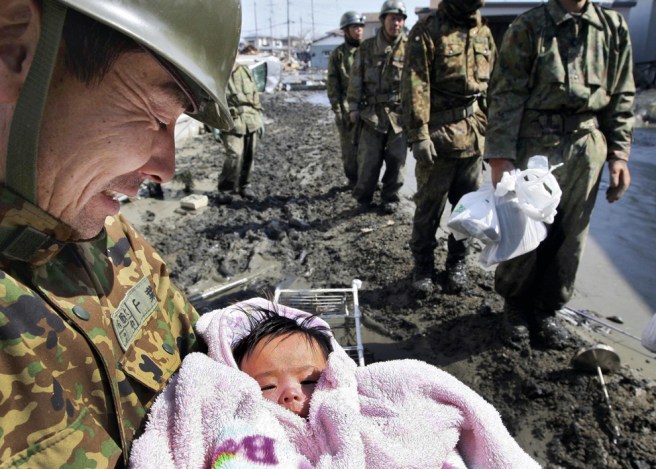
A soldier holds a four-month-old baby who survived the tsunami with her family at Ishinomaki city in Miyagi prefecture on March 14, 2011. (Yomiuri Shimbun/AFP/Getty Images)

The earthquake in Japan has touched my heart and mind. I do have a friend in Japan who is all right (she updated her Facebook profile), and while I am sad about the loss of life and devastation, I am also glad that Japan is a first-world country with proper infrastructure that can help minimize damage in the face of shifting plates and waves rolling across the land. Haiti lacked all of these things including access to basic health care, which made the death toll in last year’s earthquake all the more worse for the impoverished country.

Natural disasters (or “acts of God”) are devastating. They result in loss of life, extensive property damage, and put people in harm’s way for the future (ie, Haiti: cholera; Japan: radiation exposure). But these same disasters that bring so calamity upon a people also bring a sense of community. People of an entire country band together like never before in recent memory to assist one another. Sure, there are looters—but these vagabonds are not the norm; they are the exception. People are digging their neighbors and coworkers out of rubble. They are grieving with people’s names they do not know upon discovering that their loved ones bodies have washed upon the shore. They are sharing food, transportation, and words with a form of compassion that may not have existed two weeks ago.

People around the world are touched by the frailty of human life when these tragedies strike, and the outpouring of love, money, and support is evidence of that.

Perhaps I’m exercising dispensational eschatology in believing that the United States is poised for its own great earthquake in the next 10 years. And I don’t fear California so much as I fear the “inactive” plate that’s sitting miles beneath the ground I live on. None of us are prepped or poised for that.

And I can only hope and pray that the world will be as good to us then as we have tried to be to them.


Haiti: six months later… have you forgotten?

CBS News Photo

With constant news of the BP Oil Spill in the Gulf of Mexico dominating the media for the past two to three months, it’s been easy to forget about Haiti. We’ve gone back to our cushy lives and forgotten about the people who are still suffering with no imminent relief of recovery.

A dear friend alerted me to Democracy Now!’s interview with Sean Penn who has consistently been a great part of the earthquake relief among NGOs (non-governmental [private] organizations). Penn, co-founder of the J/P Haitian Relief Organization, had tremendous insight on the current condition in Haiti and what the future holds for the country. However, I want to call out a particularly interesting bit of information from the interview:

AMY GOODMAN: $11 billion promised. Where is it?

PENN: I don’t think about $11 billion. I don’t believe in $11 billion. I think that pledge money is smoke and mirrors that evaporates as the years go on. The way it’s going to happen, is if bold organizations come in here, create manufacturing— I’d like to see them start as co-ops with philanthropic commitment to that for a period of time with a kind of sunset and then they can participate in the profit.

But right now, the donor’s conference, I think, was completely misconceived. And the way that it should have been done is somebody should have raised their hand and said, “I’m gonna rebuild every school in Haiti.” Somebody else should have raised their hand and said, “I’m gonna rebuild the hospitals and we’re gonna do it right now.”

—And instead, what happened was one after another, in Port-au-Prince — the biggest city in the biggest natural disaster in human history —systematically hospitals closed following the earthquake because money was not available and not coming in to those hospitals. The money exists and existed.

Six months later and only two percent of the promised reconstruction aid has been delivered to Haiti. The Haitian government remains crippled, most governmental humanitarian forces have left the country leaving NGOs to do the dirty work of rebuilding the country.

So what needs to be done?

  • Construction and architecture. Construction needs to come in and start clearing away fallen debris. Architectural planning of new buildings  should begin to address the issues that caused such devastation in the first place. Beginning with the Haitian Presidential Palace would serve two purposes:

  1. Symbolic move: it would show the people of Haiti and the world that action is being taken.
  2. Practical move: it would set the wheel in motion for the government to have a central place of operation again.

  • Societal infrastructure. Community planning organizations need to begin mapping out feasible infrastructure (eg, roads, sewers, clean water) starting with the capital then working outward to nearby villages.
  • Job opportunities. Manufacturing needs to come in and Haitians need to be put to work to earn a decent living.

These are basic things that occurred in America and Europe during the Industrial Revolution. Is Haiti so far backward that we can’t even get 18th and 19th century innovation started in a third-world country? Yes, Haiti has suffered much devastation since January 12 but the country is also fertile ground for positive change if people are willing to invest the money and the time.

An open letter to God, re: Haiti

WARNING: Objectionable photos below the cut. Viewer discretion is advised.

Dear God,

I know I’m supposed to pray in a private place with the door shut and stuff but I hope you won’t excuse me writing this and making it public. I think some people feel the same way I do. I can’t officially speak for them but I know I’m not alone when I ask you the following:

Do you hate the Haitian people?

No, I mean, seriously? Like, do you hate them? Did Satan make a deal with you that he’d pick this one country in the Western Hemisphere and beat it down and allow all others to look comfortable in comparison? Is Pat Robertson right? Did you curse this country because some idiot slaves wanted to be free from French rule?

I am conflicted, Lord. I was born in New York. I am a first-born American. Yet, Haitian blood flows through my veins. I am more related to a country that was reigned by terror and plagued with fear than a country that gave people of my skin color the right to attend any school of their choosing only 45 years ago. I have never known the fear of Papa Doc and Baby Doc but then again, I have never known the fear of the Ku Klux Klan or other white supremacy organizations. I feel straddled between two countries.

I have never been to Haiti. Out of concern for my safety and protection, my mother and father would never take me there. “It’s not the country it used to be,” they lament.

Lord, were there ever glory days in Haiti? What was it like when my parents were growing up? They speak of it fondly as though those were the good ol’ days. But you allowed my grandfather to be gunned down in cold blood during those good ol’ days. Political strife was still present even back then.

Even though I have never been to Haiti, it is a country my parents grew up in. I am first-generation. I guess I don’t need to tell you that; you ordained it. As a result, when I see the images of bodies strewn everywhere, buried under rubble, piled up on one another–I am cut to the quick. Continue reading “An open letter to God, re: Haiti”