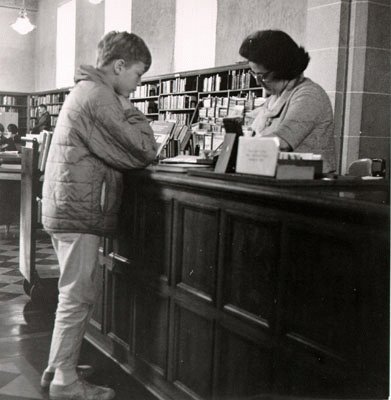
What I’ve Learned from Working at the Library

Image from usa.gov

I’ve been working in the library system for 2 years now, and as I move from one library to another, I want to take the time to reflect on what I’ve learned from working at the library.

1. Most people are nice.I can think of only once incident in which I’ve had a bad experience. That’s not bad for 2 years gone by.

2. Most people want a friendly face. Even if the patron just wants to get in and out very quickly, they usually appreciate a friendly face who is courteous and willing to help them. Often, they will return a smile.

3. Libraries are more than just books. Libraries are community centers where people can get access to the latest movies, music, and audiobooks along with the ability to use computers and take advantage of quality programming.

4. Libraries are the 411 of knowledge. Want to know whether the “a” in “at” in Sergeant-at-Arms is capitalized? (That’s a real question I’ve received.) We can answer that for you. Want to know whether Mrs. Jones still lives on 123 Main Street in King of Prussia, PA? If it’s public knowledge, we can tell you.

5. Libraries aren’t the quiet places they used to be. You can easily find children screaming or running around. In the children’s department at one library I’ve worked at, we were allowed to play music to showcase our musical selection. And with the population getting older and unfortunately getting hard of hearing, you can hear circulation clerks talking a bit loudly. In fact, circulation clerks are probably the loudest people in the library next to small children.

6. Gone are the days of no food or drink. One library I know of has a small cafe area that sells coffee, beverages, cookies, and fruit. Other libraries I know of don’t bat an eye if your drink is too close for comfort near a CPU (central processing unit). Didn’t finish your drink from Starbucks? Feel free to bring it on in!

7. It’s not necessary to know the Dewey decimal system as in the days of yore. The Dewey decimal system is still in use, and some knowledge of it is helpful, but if you want to find comic books, you likely can head straight for the graphic novels section instead of browsing through 741. Some libraries have even ventured to put subject classifications up, e.g., Art, Economics, World War II, Travel so you can browse for things yourself instead of needing to ask whether 917 is still U.S. travel or whether the 200s still house religion.

8. In the case of children’s series, it’s no longer necessary to know the author. Many libraries now have series sections for popular titles such as Magic Tree House, Diary of Wimpy Kid, or 39 Clues. This process simplifies things greatly, especially in the case of the 39 Clues books, which can be written by multiple authors and would be spread throughout.

9. Many libraries now offer a vast selection of e-books, e-audiobooks, and even music. Got an e-reader? It is most likely compatible with the library’s online lending service. Some libraries with large budgets can lend music online, and others with limited budgets simply offer e-books. This online lending service is at little to no cost and often incurs zero fines. Check with your local library if they offer e-books for download and how to take advantage of this valuable service.

10. Check out a magazine! Really want to read last week’s issue of People magazine? Wanted to flip through last month’s In Style but it’s already off the stands? You have the option of either leisurely flipping through a magazine at the library or checking it out for a minimum of one week.

11. Need information on local history? Your local library probably has a local history section with archives and niche publications.

12. Can’t find the latest release of a movie or album? Ask at the desk! Often, when movies or music are just released, you won’t see them on the shelves because they are out circulating with other patrons. The best way to ensure you get your hands on new material is to ask circulation assistants or reference librarians. They can either check the back office to see if it’s sitting on their shelves waiting to be put out or they can add your name to a waiting list. That way, you won’t have to walk into the library every week hoping you’ll finally see the new release you’ve been waiting for. (And you probably won’t see popular titles for months if you’re not on a list.)

Those are just some of the things I’ve learned from working at a library. What have you learned about the library that you didn’t know before?


Living Life Intentionally

This weekend I tried (although did a rather lousy job) of taking a personal retreat in which I spent time alone, focusing on developing a full life plan, which resulted in an outline of my priorities and goals in life. As a result of completing this, I had to say no to many of the things I was considering pursuing.

Image from michaelhyatt.com/life-plan

The idea of a personal retreat comes from Michael Hyatt, former CEO (and current Chairman) at Thomas Nelson. He developed a free e-book called Creating Your Personal Life Plan, adapted from Building Champions, in which he discusses the following:

  1. The Outcome of Your Life (how you want to be remembered)
  2. The Priorities in Your Life (what is important to me?)
  3. The Action Plan for Each Priority (outlining where you are and where you want to be)
    1. Purpose Statement (your purpose with each priority)
    2. Envisioned Future (how you ideally see yourself with interacting with each priority)
    3. Supporting Verse (if applicable, or perhaps a quote that motivates and inspires you)
    4. Current Reality (how does what is happening now stack up to your envisioned future?)
    5. Specific Commitments (developing a practical plan to move from current reality to envisioned future)

Hyatt recommends reviewing your life plan quarterly but following up on your specific commitments weekly to make sure that you are accomplishing what you need to accomplish toward your envisioned future.

When I think of Jesus, I think of a man who lived his life on earth intentionally and with a purpose. He didn’t do things haphazardly or “nilly willy.” If this is the example that Jesus has set for his followers, why do we as Christians simply bumble along in life simply trying to survive?

Ten Things Your Public Librarians Won’t Tell You

Image from acuratedlifestyle.blogspot.com

1. We are not stupid. We know when you are gaming the system. We know when you are trying to be deceitful. And we will monitor you if you raise suspicion or seem consistently dishonest.

2. When you come to the checkout counter (aka circulation desk) with more than 5 CDs at time, we pretty much know you’re burning these CDs on your machine but it’s not our job to police you.

3. We would really, really appreciate it if you stopped using that big floppy disk that has virtually nil storage capacity compared to a tiny flash drive that has tons of storage. In this case, bigger is not better.

4. It’s almost always not a stupid question.

5. We know that you swear on your dog’s life that you returned that book and returned it on time, but if we can’t find it on our shelves, we’re pretty certain it’s still in your possession in some form, most likely under a seat in your car. Please check and double-check under the seats in your car before adamantly insisting that you’ve returned an item.

6. You are responsible for a borrowed library item in your possession. As a result, we will hold you responsible if it is returned damaged or missing in any way (eg, water damage, cracked CDs, missing DVDs from a set, an unidentifiable sticky substance we do not want to touch without using a biohazard suit).

7. We love talking to our patrons and spending time with them at the circulation desk, but be conscientious of others. Sometimes lines quickly and quietly form behind right behind you and it’s not pleasant for another person to be kept waiting because you want to keep talking. If you really want to keep talking, at least move to the side so we can speedily assist the next person but really everyone would prefer it if you saved the conversation for a less busy time.

8. Please do not shelve things yourself. You’ll most likely put it back in the wrong place and cause undue distress to others because it can’t be found. If you pull any library item off a shelf and choose not to check it out, please ask the staff where you should place it. In some libraries, there are carts for depositing items you do not want. If this is not the case, leave the items on an empty table or (even better!) bring it to the circulation desk and tell the staff you don’t want the items.

9. We are not tax advisors. Do not get huffy when we cannot offer tax advice beyond the location of your tax forms. (Actually, some librarians might be cheeky enough to tell you this.) Some libraries have third-party tax assistance that comes in and helps patrons with tax inquiries; ask your local library whether this is a service it offers. In addition, do not get huffy with us if we have run out of tax forms. We do not poop out these documents on site and we are not intentionally withholding them from you; they are provided to us by the government who would prefer that you file electronically by walking into H&R Block or using Turbo Tax. Blame them, not us.

10. Using the library is a privilege. If you rack up fines, pay them. If they’re extremely excessive, you may be able to negotiate them down some by speaking to the person who oversees circulation. If the fines are constantly excessive, we lose patience and sympathy. Take care of the items that are loaned to you (remember rule #6!), return them within the allotted time frame (or pay promptly if returned late), and be courteous to staff.

If the library is your primary source for books and other media, then you need library staff to be your “friends.” Being a nice, courteous patron goes a long way and staff will go out of their way to make your visits pleasant and satisfactory. Be a consistently rude or difficult patron… well, don’t be surprised if all your library experiences suddenly become harrowing.