Monday, August 11, 2014 will be one of those days that live on in infamy for me. I will never forget where and when I heard the news…
I was working at the library for the evening and a patron came in.
“Did you hear the news? So sad.”
All three of us looked at her like she had three heads. What are you talking about? we all wondered.
She caught on to our looks and replied, “Robin Williams died. Isn’t that sad?”
At first, we gave each other puzzled looks, wondering who in our community was named Robin Williams and then… oh, we realized it was the big-time actor.
Note: This post is extremely long after the jump. I’ve broken it out into sections. It’s a compilation of thoughts after losing a dear friend to late-detected, aggressive liver cancer. She’s the first friend (non-family member) I’ve ever lost to death.
This week has been a rather trying week. On the same day that my husband was admitted to the hospital for a nasty Staph infection, I learned that my friend and talented hairstylist Stephanie was in the process of dying and by the afternoon, had passed away.
I’m very much in shock over learning of her death as it was only last week that she called me and weakly told me that they had just released her from the hospital and that she’d get better soon. Never did I think that would be the last time I would speak to her. I just figured I’d text her again this week to see how she’s doing. Although Steph had beaten breast cancer earlier this year in February, she developed liver cancer that went undetected in the interim—and it rapidly progressed to the point where there was nothing the doctors could do.
Sometimes, death is so sudden and comes without a warning. One part of my brain has accepted the news of her death as a fact. The other part of my brain (or perhaps, my heart, really) keeps saying, “No way. Nope. She’s not dead. This is all just an illusion and she’s at home and she’ll be fine. She’ll bounce back. That’s what she did before and it’s what she’ll do again. In no time, I’ll be sitting in her chair and we’ll be chatting up the latest movies and music.”
I think of all the close people in my life who have passed away: my uncle, my father, my husband’s grandfather, and now my dear friend. In each instance, I either saw or spoke to the person shortly before the person died. In one of those instances, I prepped myself, but I was still young and the news came to me as a shock regardless.
Believe it or not, my favorite verse in dealing with death is John 11:35 in which the Bible says, “Jesus wept.” Two simple words. How can they be so powerful?
I am reminded that even though Jesus knew he would raise Lazarus from the dead in a matter of minutes, in his humanity, Jesus felt the pain of death at that moment. The irreversible effects of the Fall may have weighed heavily on Jesus as he reflected that death isn’t the natural order of things. Death isn’t supposed to happen. The god-man knew that death was never what God originally intended for man to experience. Because while death takes the life of loved ones, death on this side of heaven doesn’t have the most impact on the person dying; death has the most impact on the people who are left behind as a result of the person’s passing.
Death is a cruel thing to wrestle with. One minute a person is here in our lives, impacting us, shaping us, affecting us; the next moment, the person is gone, life extinguished from the body, never to speak, embrace, or breathe again.
Think of major catastrophic events that have occurred throughout U.S. history: September 11, the 2011 occurrence of devastating tornadoes in the Midwest (namely Missouri), Pearl Harbor, Oklahoma City, Hurricane Katrina, even the 1989 World Series Earthquake. All of these pretty much came out of the blue with little to no warning. Even with hurricane warnings for Katrina, no one could have foreseen the impact that it would have had on the levees that broke. One minute people were fine. The next, they were not; some were injured, some were homeless, and some had died. While I don’t have any scientific proof, human brains tend to process things gradually. That’s why we like “transitions.” It provides an appropriate smooth shift from one thing to another in which without that shift, the change in events would be jarring.
Death is its own form of personal catastrophe to the people it impacts. Each and every single time. It is not natural and it shouldn’t happen. Jesus knew this. That’s why he cried before he raised Lazarus from the dead. I used to think it was merely an example from Jesus giving humans permission to grieve over a loved one. The older I get, the more I realize “Jesus wept” for real. That hurt was real and deep. Jesus raised Lazarus as an example, but Jesus also knew that this was temporary. Lazarus would die again. And his death would be much more semi-permanent.
My friend’s father died on Friday, prompting a whirlwind weekend of funeral services and grieving during the Memorial Day weekend. The family is Catholic and my friend’s father partook of his last sacraments before he became too incapacitated.
I sat through two mini-Catholic services, the first a brief eulogy for my friend’s father who we’ll refer to as Mr. W, and the second a shortened version of a Mass with an emphasis on praying for Mr. W’s soul.
Had this happened 10 or even 5 years ago, I would have been indignant at the Catholic church, ranting and raving at all the things they do wrong as indoctrinated by my years of Christian Baptist fundamentalism. I would have rolled my eyes at the pointless sign of the cross and the dumb responses to the priest after a statement. My heart would have been angry at the Whore of Babylon for leading people astray and I would have not been able to grieve the loss of a dear father and husband who was beloved by many.
But no, this weekend, my heart was quiet before the Lord in reverence to my friend, her family, and the passing of her father. I actually rather enjoyed the first Catholic eulogy and Father T who performed it did an excellent job. I thought to myself, Wow. What a difference a decade makes. I don’t hate Catholicism anymore.
I had no opposition to performing the sign of the cross to open and close the service. (Scripture doesn’t expressly forbid such actions so I no longer take issue with it.) I was surprised at how easily the congregational responses came back to me after years of not attending a Mass or Catholic school. Glimmers of lyrics from many of the spiritual songs shimmered in my mind from my childhood as we sang. We recited the “Our Father” without that ending that I’ve become accustomed to since leaving Catholicism (“For Thine is the kingdom…”). The Catholic Church has changed slightly but not too much. (They’ll be changing the congregational response from “also with you” to “with your spirit.” Ghastly! /sarcasm)
At the second service, I realized while I’m no longer angry or opposed to the Catholic Church, it will never be the church for me again. I do not agree with praying for the souls of the dead as I can’t find Biblical justification for it. I can’t in good Biblical conscience recite the “Hail Mary” any longer. However, instead of ranting and raving against the Catholic Church for unbiblical practices (as I would have in the past), I took the time to still my heart before God and prayed for the family grieving the loss of Mr. W. I prayed for the light of the gospel to shine in their lives, hoping that even through the Catholic Church, they could find salvation and trust in Jesus Christ.
The father at the second service encouraged everyone present to pray for Mr. W’s soul every time they thought of him or his family. I will not begrudge my friend and her mother their novena, but I will continue to lift them up in prayer to the glory of God the Father.
[This is part V of a multi-part series on Rob Bell’s book, Love Wins. Note: Chapter 3 on Hell has been broken up into two parts due to excessive length. You can find Part I on this chapter here.]
Image from Jesus-is-lord.com
Bell retells the parable of the rich man and Lazarus because it the most vivid description of hell we get from Jesus. Bell points out that the rich man is able to communicate from hell to Abraham in heaven. After ignoring the poor man Lazarus in his earthly life, the rich man in death wants Lazarus to serve him. He tells Abraham that he wants Lazarus to fetch him water then says that he wants Lazarus to warn his family of what’s in store for them in the afterlife. Bell’s perspective of this is insightful:
“The rich man wants Lazarus to serve him.
In their previous life, the rich man saw himself as better than Lazarus, and now, in hell, the rich man still sees himself as above Lazarus. It’s no wonder Abraham says there’s a chasm that can’t be crossed. The chasm is the rich man’s heart! It hasn’t changed, even in death and torment and agony. He’s still clinging to the old hierarchy. He still thinks he’s better.”
Bell expounds on this some more:
“Jesus teaches again and again that the gospel is about a death that leads to life. It’s a pattern, a truth, a reality that comes from losing your life and then finding it. This rich man Jesus tells us about hasn’t yet figured that out. He’s still clinging to his ego, his status, his pride—he’s unable to let go of the world he’s constructed, which puts him on the top and Lazarus on the bottom, the world in which Lazarus is serving him.
He’s dead, but he hasn’t died.
He’s in Hades, but he still hasn’t died the kind of death that actually brings life.
He’s alive in death, but in profound torment, because he’s living with the realities of not properly dying the kind of death that actually leads a person into the only kind of life that’s worth living.”
I don’t disagree with Bell at all. A few pages later, Bell says brilliantly:
“There is hell now,
and there is hell later,
and Jesus teaches us to take both seriously.”
With this statement, Bell does not deny the existence of hell “in this age or the age to come.” However, I do take issue with a few statements prior to this, mainly because they start to muddy the waters, making his belief in hell seem unclear.
When Bell talks about the rich man, he says that the rich man “hasn’t yet figured out… that the gospel is about a death that leads to life.”
Yet is an important word. Its implication is that even though something hasn’t happened, there’s a chance it will. I believe Bell is a man who chooses his words carefully so when he says that the rich man hasn’t yet figured things out, it’s because if he does (in due time), only then he’ll be able to live “the only kind of life that’s worth living.” Bell doesn’t give any indication that the rich man is forever shut out and utterly without hope. In fact, through Bell’s recounting of this parable, the dead rich man has more hope of life than I’ve ever heard before.
From pages 75-79, I infer that Bell thinks people can get a second chance after death if their heart changes. When Bell says that the “chasm… can’t be crossed [because] the chasm is the rich man’s heart,” I get the impression that if the rich man’s heart changes, then the chasm can be crossed.
So far, I’ve concluded that Bell believes hell exists (on earth and in the afterlife) and that people really do go there. It also seems that Bell says people can choose hell because they cling to an “old hierarchy” of belief but if that belief changes, they can move from death unto life even in the afterlife. Statements later on in the chapter give me the impression that Bell believes judgment for hell isn’t final, isn’t forever, and that God is a god of second and third and multiple chances until we get it right.)
“What we see in Jesus’s story about the rich man and Lazarus is an affirmation that there are all kinds of hells, because there are all kinds of ways to resist and reject all that is good and true and beautiful and human now, in this life, and so we can only assume we can do the same in the next.”
Is your head swimming yet? Because mine is.
Bell goes on to reference Ezekiel 16 in showing that Sodom and Gomorrah’s fortunes will eventually be restored and quotes Jesus in Matthew 10 in which he says, “It will be more bearable for Sodom and Gomorrah on the day of judgment than for you.”
Bell overall concludes that if there’s still hope for a place like Sodom and Gomorrah (widely thought of as being condemned forever) that no longer exists, then there’s hope for everyone outside of these towns.
“Failure, we see again and again, isn’t final,
judgment has a point,
and consequences are for correction.”
I don’t know how Bell lines up this thinking with Hebrews 9:27 which says “it is appointed for man to die once, and after that comes judgment.” Hence, the book raises a question for me that the author never addresses.
Bell begins to wrap Chapter 3 up by speaking of restoration and quotes how God over and over in the Old Testament, especially among the minor prophets, speaks of the restoration of His people. (Note: there is no wider context given among the 10 verses on restoration that Bell lists.)
Bell ends Chapter 3 with this summed-up definition:
“To summarize, then, we need a loaded, volatile, adequately violent, dramatic, serious word to describe the very real consequences we experience when we reject the good and true and beautiful life that God has for us. We need a word that refers to the big, wide, terrible evil that comes from the secrets hidden deep within our heats all the way to the massive, society-wide collapse and chaos that comes when we fail to live in God’s world God’s way.
And for that,
the word ‘hell’ works quite well.
Let’s keep it.”
Chapter 3 proved to be a rather challenging chapter on a variety of levels. It forced me to read critically and question nearly everything Bell said, especially since many things weren’t referenced. I’ve already challenged some of Bell’s statements in order to, perhaps, paint a fuller view of the issue, but really, I really just touched the tip of the iceberg.
On page 80, Bell uses Jesus’ statement from Matthew 26 in which he says those who “draw the sword will die by the sword” is used to depict Jesus a strictly non-violent, pacifist leader.
“To respond to violence with more violence, according to Jesus, is not the way of God.”
But in Luke 22, Jesus encourages his disciples to sell their cloaks and buy swords. When the disciples said they had two swords, Jesus replied, “It is enough.” (v. 38) If Jesus was extremely non-violent, he would’ve discouraged the disciples from even arming themselves. Even though Jesus worked through non-violent means, it doesn’t mean that his entire philosophy is non-violent. I think Jesus really embodies Ecclesiastes 3, but on this issue, his philosophy was probably more along the lines of verse 8’s “a time for war and a time for peace.” To paint Jesus as a total pacifist would be misleading.
Or perhaps let’s also tackle page 89 in which Bell says:
“‘Satan,’ according to Paul, is actually used by God for God’s transforming purposes. Whoever and whatever he means by that word ‘Satan,’ there is something redemptive and renewing that will occur when Hymenaeus and Alexander are ‘handed over.'”
Whoever and whatever? Of a lot of the things in this book, I have a serious problem with Bell flippantly referring to Satan as “whoever” and “whatever.” And it makes me extremely uncomfortable that a pastor of a Christian church (emergent, it may be) puts Satan’s name in quotes as if he’s not real, doesn’t exist, or is a figure of speech for something humans are not sure about. Having read Brian McLaren’s A New Kind of Christianity, this kind of talk gets dangerously close to how McLaren refers to evil.
Toward the end of the chapter, Bell pulls out the Greek dictionary again to translate words better, and I’m frustrated and annoyed. It’s not just Bell who does this though; many pastors do this. It’s as if they’re saying “the English translations we have aren’t good enough so let me translate this a little bit better for you.” Really, of the 25+ English translations out there, you couldn’t find one suitable to reference so you had to retranslate it for us yourself? Do people who don’t have access to the Greek worse off because they’re reading something that hasn’t been translated to its best extent in the English language? (Oh, this kind of stuff gets my rankles up.)
On the flip side, Bell sometimes says things that challenge my conceptions of how I traditionally view Christian teaching. If I can’t find anything scripturally that contradicts Bell, I pause to consider the truth in what he says. (Mind you, I will not take an opposing view against Bell simply to be belligerent.) I quote pages 82-83 because I think his view his striking:
“Many people in our world have only ever heard hell talked about as the place reserved for those who are ‘out,’ who don’t believe, who haven’t ‘joined the church.’ Christians talking about people who aren’t Christians going to hell when they die because they aren’t . . . Christians. People who don’t believe the right things.
But in reading all of the passages in which Jesus uses the word ‘hell,’ what is so striking is that people believing the right or wrong things isn’t his point. He’s often not talking about ‘beliefs’ as we think of them—he’s talking about anger and lust and indifference. He’s talking about the state of his listeners’ hearts, about how they conduct themselves, how they interact with their neighbors, about the kind of effect they have on the world.
Jesus did not use hell to try and compel ‘heathens’ and ‘pagans’ to believe in God, so they wouldn’t burn when they die. He talked about hell to very religious people to warn them about the consequences of straying from their God-given calling and identity to show the world God’s love.
This is not to say that hell is not a pointed, urgent warning or that it isn’t intimately connected with what we actually do believe, but simply to point out that Jesus talked about hell to the people who considered themselves ‘in,’ warning them that their hard hearts were putting their ‘in-ness’ at risk, reminding them that whatever ‘chosen-ness’ or ‘election’ meant, whatever special standing they believed they had with God was always, only, ever about their being the kind of transformed, generous, loving people through whom God could show the world what God’s love looks like in flesh and blood.”
Overall, Chapter 3 was a challenging read. There was no way to walk away from it without thinking one of three things:
My beliefs and preconceptions on hell have been reinforced as a result of reading this chapter.
My beliefs and preconceptions on hell have changed as a result of reading this chapter. (Even if it’s ever so slightly.)
My beliefs and preconceptions on hell have not changed as a result of reading this chapter but have given me a different perspective that I had never considered before.
I fall into category 3. I certainly don’t agree with Bell on a lot of things, but he makes many good points about not overlooking the hell here and now in favor of the hell later. Christians would do well to heed some of his warnings.
It should be no secret to anyone on this blog that I suffer from bipolar disorder (formerly manic depression), although more along the lines of the depressive spectrum. I’m pretty positive that this affects my outlook on nearly everything and how I deal with life sometimes.
I can be a real downer. For days, perhaps even weeks, at a time. I am not a sparkling ray of sunshine 365 days a year although you’d never know it if you met me at my job. I’m pretty much Bubbly Betty or Cheerful Charlene.
For a lot of people, it’s disconcerting to meet someone who’s constantly down on themselves and their lives when they’ve got so many blessings and things to be thankful for. But let’s face it: we all have our own problems and our own sinkholes to patch up. Some are a bit more expressive than others.
Nine years ago today, my father died. I didn’t find out for certain until December 14. But the pain of his passing strikes me on and off for about a week and a half during the month of December.
I get frustrated with myself because I need to stop grieving afresh each year as the Christmas season approaches. But of course, I didn’t grieve for the first three to four years after his death so maybe I’m just encountering a delayed reaction. Maybe it’s as if he died in 2004 and I’m just going through something that would have been natural if it occurred six years ago.
I’m at work today so I’m not bawling my eyes out but my heart is heavy with sorrow. I need to take frequent breaks to gather myself together because I so much miss this man who has helped shape who I am.
I was honest with God today. I told Him “I fucking hate the fact that You took my father away from me.” The arrogance of the statement struck me as soon as it left my mouth. I don’t own my father. I never have; my father has never belonged to anyone except God. I see it as God taking my father away but really it’s God just deciding to bring my father home.
My father was alive for only 19 years of my life. But I started to lose my father to mental illness when I became a teenager, around 13 or 14 years old. Perhaps I’m not as much angry that he’s physically gone as the fact that he mentally began leaving me five to six years before his actual passing. My most vivid memories of my father are some of the saddest (but also funniest, in a mental illness sort of way) ones.
The memories of his sane years are leaving me because I was so young:
Memories of going to Eisenhower Park in Nassau County and tossing around a football that I was too afraid to catch. (Totally girly; totally unathletic.)
Memories of putting a picnic blanket out on carpet of my parents’ master bedroom in our apartment every Sunday night to eat dinner and watch CBS’s “60 Minutes” because that’s where the TV was. (The only time we had dinner together as a family and watched TV together.)
Memories of my father playing music on Saturdays as he and my mother cleaned the apartment from top to bottom
Memories of my father playing Nat King Cole and Dean Martin for my mother during the Christmas holiday season
So many memories that I’m struggling to remember because they are so easily leaving me as I grow older.
So I try so hard to keep my father alive through the legacy he left me:
A love for sports (namely baseball and football)
Keeping up on current events (news and politics)
The continuation of fiction writing (he believed I had a gift since I was six years old)
A love for music of all kinds (my iPod plays Lady Gaga, The Beatles, Tina Turner, Miranda Lambert, and Yo-Yo Ma)
Paying bills on time (he was meticulous about this)
Social (my father could talk your ear off. I can too after I warm up to you)
Some of the things I didn’t inherit:
Neatness – Every Saturday morning into afternoon, he’d clean the apartment thoroughly: disinfecting, vacuuming, dusting, and organizing. I think he was OCD (not kidding). But I also know that he did it for me since I had severe eczema and a cleaner environment helped my skin.
Fashion sense – He was always well dressed. I was always sort of an embarrassment to him if I tried to dress myself.
Puritan-like work ethic – He’d almost NEVER miss work before he became mentally ill. (Not so with me!)
Handyman usefulness – He obtained his degree in civil engineering, worked in maintenance, and could fix nearly anything mechanical or electrical. Great with math. (Again, not so with me!)
Womanizing – As a kid, I didn’t understand why he dressed so nicely and went out on Saturday nights and left my mom at home with me but yeah, I’m pretty thankful to have not inherited this part of him.
He may not have been the best husband to my mom but he was an amazing father—the best he knew how to be. Perhaps I developed some perfectionism issues as a result of his overbearingness but I know he meant well. He simply was a Haitian immigrant who wanted his American-born daughter to succeed in life and excelling in academics was the answer to that.
So perhaps I’m not lamenting my father’s physical passing so much as I am finally grieving over the father that I lost so long ago. It’s difficult to grieve over someone while they’re still alive. If I could liken the mental loss of my father to anything, it would be like losing a loved one to Alzheimer’s. Slow and painful until death is all that’s left.
I know he’s in a better place but there’s a selfish part of me that still wished he were here. And I don’t know how to fight the illogic of that.
I used to be ashamed to be of my Haitian descent for the longest time. In a lot of ways, I’m not fully over it.
What good have I ever had to say about the country my parents came from? The Haitian government receives aid, money, and supplies and simply squanders it. The Haitian Creole (Kreyol) language is not popular. Eighty percent of the Haitian people are poor. In fact, Haiti, which shares an island with the Dominican Republic, is the poorest country in the Western Hemisphere. My parents came from a third-world country. Once I learned that, I figured there was nothing to be proud of in that.
So many times I wished I was something else, something cool. Like, oh say, Hispanic. It’s cool to be Hispanic. Spanish is a useful language to know, especially in America.
Now, it’s suddenly cool to be Haitian. Haiti, devastated by a recent earthquake, is at the forefront of the world’s mind. Suddenly, this tiny, pathetic country is huge, taking up space on the airwaves, dominating news, and pressing upon people’s hearts. Blink-182 had their signature rabbit running with the Haitian flag on a T-shirt and Lady Gaga created a T-shirt with the word “Haiti” and Haitian flag colors dominating throughout. As I type this, “Hope For Haiti Now” is on TV with the biggest and brightest of superstars lending their support to raise funds for a country that has none. People who never gave a damn before give a damn now.
I can lift my head up a little higher when I speak to people about my heritage now. Everyone seems to want to connect with a Haitian. A country that no one cared about—a throwaway nation—is suddenly front and center. When I used to tell people that my parents were from Haiti, at times, I received baffled looks, sometimes accompanied with a “Where’s that?” Everyone had heard of Cuba; Haiti? Not so much.
When the earthquake first occurred and aid poured into Haiti, I initially got upset at everyone, including myself. “Oh NOW, suddenly you care about Haiti?” Haiti has never been okay, Haiti has never been doing fine, and no one cared to assist a country that was sorely in need. Now that hundreds of thousands of people have died, the world’s eyes have been opened. The plight of the Haitian people has come before the world and moved it to compassion by giving generously to a country that may never be able to give back.
But 10 days later after the great 7.3-magnitude Haiti earthquake, I’m at a point where I can reassess and think, “Wow. People actually care. This shows the best of people. The world is moved to assist a country that it never cared about before or even knew existed.” And I must thank God. I’m not happy that so many people had to die for the world to notice Haiti. But I’m humbled by seeing the outpouring of love and support from other nations including one that I am a citizen of—the United States. I am humbled by seeing both old and young being pulled alive out of rubble days after they should have been dead. I know only a merciful God can sustain them.
The faith of the Haitian people has humbled me. To hear stories of Haitians singing “How Great Thou Art” in spite of death and decay humbles me. Yes, there is voodoo common throughout the country but Haitians are a people of faith—a people who believe in God. In fact, they refer to Him as “bon Dieu” (translated as “good God”) in almost everything. A common saying tacked on at the end of many plans is “si Dieu veux” (translated to “God willing”). Perhaps it’s superstitious and embedded in the culture but it’s there. A belief in God—not just any god but a good God—is pervasive. And it’s the faith that has carried many Haitians through, it’s the faith that has carried many buried people found alive, and it’s the faith that will help rebuild the country.
I haven’t really cried or shed tears so far but it’s simply a reminder of how much I miss the man who was so integral in shaping me into the person I am today. I haven’t spoken to my mother about it but I wonder if she thinks about him this time of year too.
I suffer from the guilt of existence. I’d feel guilty if I had a child before some of my friends I know who have desired children for years. Especially since I also know they desire children so much more than me.
And the ability to stay home and live primarily off my husband’s income so I can devote my time and attention to my novel (which I have no idea whether it will be any good or be able to earn any money). I have so many friends and family members who do not have this opportunity. I feel bad. Something tells me I must work full-time like them to make life fair even though I don’t have to.
It’s not fair that people who want to live must die when there’s someone like me who thinks so little of herself that she would trade places with someone who was dying.
I wait every night, you know, to die.
I’ve given up on suicide because I’ve tried numerous times and I can’t succeed. People tell me it’s because God says it’s not my time to go.
So every night, I wait for God. I wait for Him to take me. I anticipate “my time to go.” That final breath, that final gasp of air that God won’t let me recover from. I wait for it nightly.
But then I wake up each morning, somewhat stupefied as to why I’m still alive. What’s God’ s purpose for me? Am I meant to accomplish something monumentally great or simply exist to bring a smile to my husband’s face each day for the next 60 years?
And what’s wrong with that? Why can’t I be content simply to exist only to make other people happy?
“I tend to be of the mindset that in order to be pleasing to God, I have to do something big, something that leaves an evident footprint in the world. I think deep down I know this isn’t a true philosophy, but when I just live everyday life, I feel useless.” –Sizzledowski, “Sometimes I talk to myself… a lot“
No, I’m not content because I’ve been taught that “bigger is better.” (Well, except when it comes to weight.)
Servant leadership.
My father used to work in the maintenance department of a large ad agency and sometimes he’d get whatever leftovers were no longer wanted. One time, the agency developed (or recycled, I’m not sure) a slogan and printed up more T-shirts than they could use so my dad brought a bunch of them home. The slogan has stayed with me to this day:
“Good enough is not enough.”
So I’ll always feel like a failure. Because once I achieve that one “great” thing, I’ll always be looking for the next great thing. It’s a vicious cycle–always looking to outdo myself. This was also part of Michael Jackson’s downfall. As a perfectionist, he was always trying to “top” himself. The “Thriller” album sold 26 million copies worldwide back in the 80s, immediately becoming the best-selling album of all time. In fact, it is STILL the best-selling album of all time with more than 100 million copies sold worldwide. (The next album that comes even close is AC/DC’s “Back in Black” with 49 million copies.)
“Good enough is not enough.”
Jackson wanted to continue to break records and continue to top the charts even after “Thriller” but was never able to relieve that kind of success again in his lifetime.
So where does it stop? A person can’t always be number one.
Jesus said the first shall be last and the last shall be first. (Mk. 10:31, Matt. 20:16) As a Christian, what does this mean to me?
It means the only way to truly lead is by serving. That is what Jesus did. And not to minimize my Lord in any way but that is also the example all the great human heroes followed: Ghandi, Martin Luther King, Jr., Mother Teresa. Not self-serving but serving others. Who will have had more of an impact 100 years from now: Madonna or Martin Luther King, Jr.? God bless Madonna if history textbooks mention her musical impact from the 1980s but MLK, Jr. has changed the lives of many people in this country. From the White House down to little ol’ me, he continues to have a lasting impact beyond his death. As a result of MLK, Jr.’s tireless work, I can write a blog post with fairly good grammar and spelling that reaches a multicultural audience because I had the opportunity to receive a stellar education from Kindergarten through college. (Let’s just conveniently ignore the fact that the last sentence was atrociously written, though.)
The world says to be number one and never settle for last place. My Lord says the first shall be last and the last shall be first. The world says take the lead; be a leader. Jesus says, “Follow me” (Matt 4:19); be a servant (Jn. 13:12-17).
With things like pride and self-sufficiency (really a subset of pride), being a true, consistent servant is difficult:
Never seeking glory for yourself.
Always doing things for the benefit of others.
Constantly knowing your limitation so you can ask for help for the sake of others.
Am I fearful? Fear is a focus on phantoms of the theoretical future. But the future is God’s, not mine; mine is only the present moment. I am fearful because I’m thinking I have to live the rest of my life. But I don’t. I only have to live the next five minutes. To me belongs obedience; to Him belongs outcomes.
…
Am I depressed? The concept of doing “the next thing” is just the ticket. Granted, I am far too weak to go on with life—but I can do a load of laundry. And after that I can make the kids breakfast. And after that I can pick up the phone and call a deacon for help on balancing that checkbook. One foot in front of the other: Do “the next thing.” — The next thing by Andrée Seu
I have been pondering death a lot lately. Each night, I give my husband multiple kisses and hugs “good night” in the event I may not see him alive in the morning. I have a huge fear of waking up next to my husband’s cold, lifeless body. Creepy thought isn’t it?
Then I think to how I should react: keep it together and call the police, scream and cry forever, and the most unlikely—shock from the sight and terrifying realization that I’m now widowed causes me to fall over and have a heart attack, joining him in eternity.
My life has always been ruled by fear in one way or another: mostly in social situations. Now, I’m afraid of losing those I love.
I’m afraid of not seeing my mom (who lives all the way in New York) again. I’m afraid that the next time the phone rings, it’ll be a call telling me my 99-year-old beloved grandmother has passed on from old age (she’s in perfectly good health otherwise). My father’s death came out of the blue; who’s next? No one is guaranteed tomorrow.
Then my husband’s grandfather’s suicide was a shock that I still haven’t gotten over. Sure, I’ve accepted the fact that he’s gone but the way he went… it’s still unbelievable.
Am I afraid of dying so much? A little. I’m a bit afraid of what it will be like to go but I don’t worry for others after me. They’ll be fine. Whenever that is.
But if I lose my husband, I’ll be lost. I’m dependent on him for nearly everything. I don’t want to live my life without him. And God can take him away if He wants but I don’t want Him to. I went from my mother’s house to being a wife. I have no idea what it’s like to be “independent.” I’m afraid that I’ll sadly fail to survive without my husband and my mom around. I think of how life could suck. I think of how life used to suck. And it doesn’t feel that way. Life really is good right now.
Thinking about losing my husband to death makes me appreciate every kiss and hug I get from him. I don’t want any regrets in death—his or mine. But I need to stop my fear of losing him and begin enjoying living with him again.
I’ve been feeling really sentimental lately with all these celebrity deaths. As a result, it’s gotten me thinking of my father who passed away in 2001. I was at PCC and he died on Sunday, December 9. It was the week of finals and my family (mother and my dad’s two sisters) thought it’d be better to let me finish up my finals without distractions so they didn’t tell me until they were driving me home from the airport on Saturday, December 14. I got 104 (extra credit) on Mr. Zila’s History test and knew my dad would love to hear that since he loved any grades that were 100+. Instead, I suddenly found myself preparing a eulogy for my father’s funeral on December 17.
Most of you know by now that I’m a huge Michael Jackson (MJJ) fan. Well, you can thank my dad for that. Back in 1992 around the time the Free Willy movie came out, MJJ came out with a song called “Will You Be There.” My father loved that song TONS and back then said he wanted it played at his funeral. Well since I had no hand in funeral preparations (and I was still in the clutches of IFBism), it was never played. It’s something I regret not fighting for. To make up for it, I chose to walk down the aisle to “Will You Be There” as a tribute to my father.
All that to say that 8 years later, I still miss my dad. I’m over the bitterness about my family not telling me my father died sooner because I know they did it in my best interest. (Apparently when my uncle died of AIDS in the early ’90s, they had to give me a sedative to get me to calm down because I was so hysterical. They figured if that’s what happened with my uncle, I’d be ridiculous upon my father’s death. I wasn’t.) I talk to my husband about him but I feel like I’m talking about some imaginary person who never existed. (BTW, I know that’s a redundant phrase.) I don’t know how to keep his memory alive. What makes things worse is that I really lost my dad a long time ago. My father struggled with schizophrenia/paranoia and so the father that I had at 12 was radically different from the father I ended up with when I was 16. He passed away from a heart attack when I was 19. My mom said she watched his eyes fly open and gasp for air. He started foaming out the mouth and couldn’t breathe. She watched him die on their bed in their bedroom. She couldn’t bring herself to talk to me about his passing until a few years later.
Many of the memories I have of my father are fading and that scares me. We used to go to the park and toss around a football even though I was hopelessly nonathletic. (I still enjoyed it immensely.) One Christmas when all my parents could afford was one gift, he found out which CD I wanted the most that year and got it for me (Alanis Morissette’s Jagged Little Pill). When MJJ’s Live in Bucharest concert was being played on VH1 (wow – remember when they used to play music videos?!) after we first got cable, he called me in from my bedroom because he knew I’d love to see it. (His “Smooth Criminal” choreography always amazes me but I found out he stole it from Fred Astaire.) I’m writing this out, hoping it stays with me.
Anyway, I wrote all that as a partial vent and also to ask how do you keep the memories of your loved ones alive. My husband will never know my father on this earth. My kids (if I ever have any) will think of my dad only as some kind of fairy tale. Pictures of him are limited but here’s one I found and scanned into my computer. I just try to think that he’s still looking down at me and smiling—whether I’m perfect or not.


 I have been pondering death a lot lately. Each night, I give my husband multiple kisses and hugs “good night” in the event I may not see him alive in the morning. I have a huge fear of waking up next to my husband’s cold, lifeless body. Creepy thought isn’t it?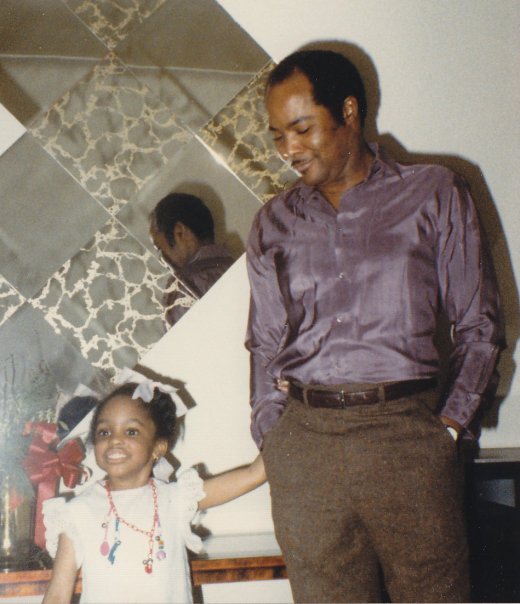
 This Journey Is My Own