Three Lessons I Learned Today

1. I am prideful. My husband pointed out that it’s a trait I get from my mother, attempting to look like I have it all together. “Well, when you put it that way…” I said with a shiver running down my spine. My mother’s need to look like she had it all together kept my father from getting treatment for his paranoia/schizophrenia and kept his sisters out of the dark for too many years. Knowing that quality exists in me is a rather scary thought.

I went to a prayer retreat today and again, tried to act like I had it all together. Truth be told, I’ve been going through a spiritual drought. My prayers have consisted of nothing but “why” questions and I earnestly began to pray that I would seek to “know God more than my need to understand Him.” Through the guidance and counseling of two wonderful Christian friends, they prayed with me and reminded me of God’s promises through Scripture. My faith began to see the beginnings of restoration. Continue reading “Three Lessons I Learned Today”

Personal thoughts on Tim Keller’s book, Counterfeit Gods

I recently published a book review on Tim Keller’s book, Counterfeit Gods, but wanted to write a post that is a bit more personal in nature. I left off with this:

To dethrone any and all other idols apart from God, Jesus’ sacrificial death on the cross must be real. The heart of the matter can be summed up in this question:

What is operating in place of Jesus Christ as your real, functional salvation and Savior?

It is a question that Christians should not neglect to ask themselves every single day.

The cynic in me struggles with this. God knows how much I am very much a doubting Thomas, plagued with questions like:

  • “Jesus, were you real?”
  • “Are you really coming back?”
  • “How come you haven’t done anything for so long?”
  • “Can the compilation of what people claim to be Your word (the Bible) really be trusted?”

I’ve come to the realization that I am the very least, a Jew. (Yeah, go ahead and make a Sammy Davis, Jr. joke now.) I believe wholeheartedly in the Old Testament. But the more I think about it, the more the Old Testament constantly points back to Jesus. (The Book of Matthew is a great book for discovering how the Old Testament continuously points to Jesus.)

Now while the Pharisees were gathered together, Jesus asked them a question: “What do you think about the Christ, whose son is He?”
They said to Him, “The son of David.”
He said to them, “Then how does David in the Spirit call Him ‘Lord,’ saying,

‘THE LORD SAID TO MY LORD,
“SIT AT MY RIGHT HAND,
UNTIL I PUT YOUR ENEMIES BENEATH YOUR FEET”‘?”

If David then calls Him ‘Lord,’ how is He his son?”
No one was able to answer Him a word, nor did anyone dare from that day on to ask Him another question. ~ Matthew 22:41-46

A puzzling question to me as well.

So the basic hurdle that I am confronted with is whether I believe fully in Jesus Christ, who he is, and his purpose for being born on earth–his existence as fully human and fully God; that he is the Son of God, born to a virgin, lived, died on a cross bearing God’s wrath for the sins of humankind, was buried, and rose again three days later. If I accept this (and I do), then I also accept that the triune God alone is worthy of worship, leading me to adhere to the following commandment:

You shall love the Lord your God with all your heart, and with all your soul, and with all your mind. ~Matthew 22:37

This is not in conflict with the first commandment God issues (located in Exodus and Deuteronomy):

I am the LORD your God, who brought you out of the land of Egypt, out of the house of slavery. You shall have no other gods before Me.  ~Exodus 20:2-3 & Deuteronomy 5:6-7

Jesus reiterates that God must take the primary place in our heart, soul, and mind. He is to be the only One people worship. He must constantly occupy our daydreams and imaginations even. I quoted this passage from Keller’s book in my previous post but it strikes and convicts me so that I feel compelled to repost it:

Archbishop William Temple once said, “Your religion is what you do with your solitude.” In other words, the true god of your heart is what your thoughts effortlessly go to when there is nothing else demanding your attention. What do you enjoy daydreaming about? What occupies your mind when you have nothing else to think about? Do you develop potential scenarios about career advancement? Or material goods such as a dream home? Or a relationship with a particular person? One or two daydreams are no [sic] an indication of idolatry. Ask, rather, what do you habitually think about to get joy and comfort in the privacy of your heart?

If I’m honest, I must admit God does not constantly occupy my thoughts as He should. I also frequently fail to follow this directive from the apostle Paul as listed in Philippians 4:8:

Finally, brethren, whatever is true, whatever is honorable, whatever is right, whatever is pure, whatever is lovely, whatever is of good repute, if there is any excellence and if anything worthy of praise, dwell on these things.

How often do I dwell on the things that are false, dishonorable, wrong, impure, ugly, and bad repute, full of mediocrity and worthy of condemnation!

As a result, I’ve instantly created an idol. Keller writes:

Idolatry is not just a failure to obey God, it is a setting of the whole heart on something besides God.

In my previous post, I listed all the idols Keller identifies. While I’ve struggled with many of those idols at one time or another, these are the main idols that currently dethrone God in my life: Continue reading “Personal thoughts on Tim Keller’s book, Counterfeit Gods”

Tim Keller’s Counterfeit Gods (Book Review)

My church recently distributed Tim Keller’s book, Counterfeit Gods, for Christmas to whomever wanted it. I’ve heard people sing Tim Keller’s praises but have never read his books or visited his church or church plants. Therefore, I decided to pick this book up first before picking up Keller’s other bestsellers that have piqued my interest: The Reason for God and The Prodigal God. And besides, it was FREE. How can you beat a FREE book?

I made a goal to finish reading the book before the clock struck midnight for 2010 and achieved that goal. The hardcover book, barely larger than 5 x 7 inches, is just under a 200-page read (including the Introduction but not including Notes, Bibliography, or Acknowledgments). I’m a bit of a slow reader so I was able to complete the book in about three days (of dedicated reading). A fast reader could easily complete this book in a day–it’s that small.

Upon completion of the book, I was pleasantly surprised to discover how much I enjoyed it. And it stood in marked contrast to a book I most recently finished, It’s Your Time by Joel Osteen, that touts health and wealth as proof of God’s favor upon an individual. Usually, I take a couple of days and allow my mind to fully absorb the contents from the book before making a full judgment, however, Counterfeit Gods impacted me so much, I view it as a life-changing book.

Perhaps life-changing seems like an exaggeration but for me it is not. I operate on a five-star rating scale, basically using the Amazon system:

* (one star) – I hated it
** (two stars) – I didn’t like it
*** (three stars) – It’s OK
**** (four stars) – I liked it
***** (five stars) – I loved it

Counterfeit Gods gets FIVE stars from me. It’s not easy for a book to garner that high a rating from me but I personally can’t find any fault with it. (Perhaps a pastor or some high-falutin’ theologian would.) Keller is clear, concise, uses modern-day and Biblical examples to support his points, and instructs readers on how to identify and replace any idols in their lives.

Keller leaves no graven image unturned in this book. This book, aptly titled Counterfeit Gods, could also have been titled If You’re Breathing, You’re Probably Breaking the First Commandment. Keller posits that anything that dethrones Jesus Christ as the sole object of worship in our lives is an idol. He also asserts that the remaining nine commandments are basically elaborations on the first:

I am the LORD your God, who brought you out of the land of Egypt, out of the house of slavery. You shall have no other gods before Me.  ~Exodus 20:2-3 & Deuteronomy 5:6-7

Since Counterfeit Gods is a relatively recent book, he begins by addressing the economic fallout of 2008-2009 that led the United States into a recession. He refers to wealthy investors who made money their sole god. So when the bottom dropped out of the economy and those investors lost millions upon millions of dollars, they had nothing left to turn to. As a result, many of them committed suicide. Except for one bright shining hope in an investor named Bill who gave his life to Christ in 2005. Bill testifies:

If this economic meltdown had happened more than three years ago, well, I don’t know how I could have faced it, how I would have even kept going. Today, I can tell you honestly, I’ve never been happier in my life.

Don’t get the idea that Keller is saying becoming a follower of Jesus Christ leads to a life of butterflies and sunshine. Quite the contrary, he implies Christians have a tougher road ahead of them because they are called to a higher standard. As a result, Keller points out that today’s (mainly Western) Christians often don’t look much different from non-Christians.

Contemporary observers have often noted that modern Christians are just as materialistic as everyone else in our culture. Could this be because our preaching of the gospel does not, like Saint Paul’s, include the exposure of our culture’s counterfeit gods?

Harsh words. It certainly convicted me.

For starters, it would be good to define what an idol is. Here is the basic definition Keller provides:

It is anything more important to you than God, anything that absorbs your heart and imagination more than God, anything you seek to give you what only God can give.

Despite the book’s subtitle, The Empty Promises of Money, Sex, and Power, and the Only Hope That Matters, Keller does not limit his discussion of idols to money, sex, and power. Not at all. Here’s a full list of the idols he identifies (located in the Notes section) with brief descriptions: Continue reading “Tim Keller’s Counterfeit Gods (Book Review)”

It’s Your Time Book Review: Dump this book, Discard much of what you learn, Desist reading

Inspired by this post from Matthew Paul Turner, basically making fun of Pastor Joel Osteen’s (NOT OLsteen, maybe LOLsteen) new book, It’s Your Time and a one-star review on Amazon in which the “reviewer” essentially wrote that Osteen was a fraud, he hadn’t read the book, and never intended to read the book (the review’s since been taken down), I felt prompted to go where most Biblical evangelical Christians choose not to go.

I decided to read Joel Osteen’s latest book to see if dollar signs would really begin flashing right before my eyes. However, I need to add a disclaimer of a sort:

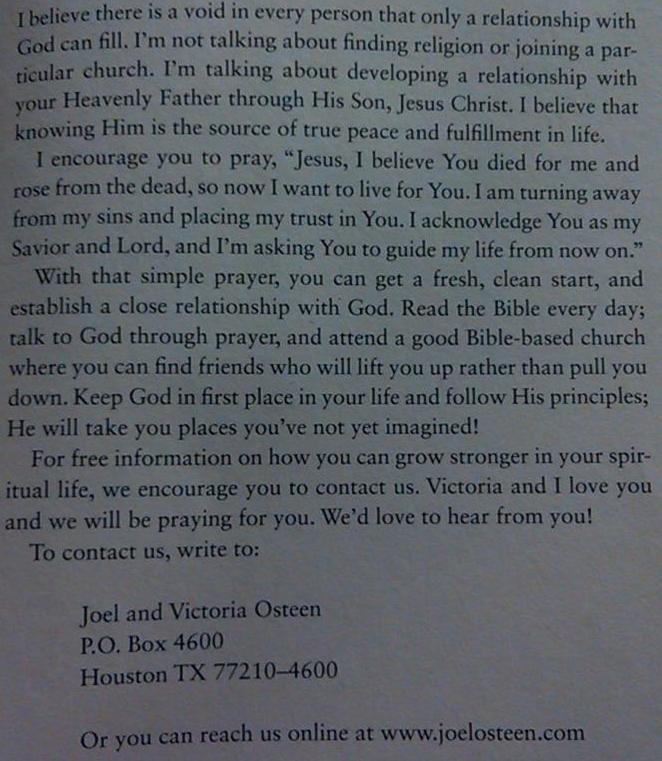
Last page with text in "It's Your Time"I am a little sensitive to Joel Osteen and his ministry and likely not as hard as I should be. Thank my mother. I believe that God used Pastor Osteen’s ministry to bring my mother to a saving knowledge of Jesus Christ. She was hesitant for many, many years but after watching Pastor Osteen regularly, softened up, accepted Jesus as her Lord and Savior, and now regularly attends a local Bible-believing church. I have seen Osteen’s telecast and at the end, he does give an invitation (though many Biblical evangelicals would consider it a weak one) to accept Jesus. Although the criticism is that Jesus is secondary to his preaching of the “health and wealth” gospel,” which we’ll get to later on in the review. (Click on the photo on the left to enlarge it and essentially read the “invitation” Joel Osteen provides.)

I wrote an unfinished review of It’s Your Time and was probably more favorable to it than most Biblical Christians would have been. So now that I’ve completed this book, how would I rate it overall?

Two stars.

What were the issues then that led me to give this book a rating comparable to “poor”? Quite a bit. Sit back and have a nice cup of coffee or tea as you review this list with sometimes lengthy explanations. Continue reading “It’s Your Time Book Review: Dump this book, Discard much of what you learn, Desist reading”

Still searching for an identity… part 4

Faith, religion, God.

I’m currently reading Joel Osteen‘s latest book, “It’s Your Time” and annoying the Twitter world with my #ItsYourTime-related tweets. I subscribe to a brand of Christianity that does not subscribe to Osteen’s brand of Christianity. So why am I reading this book if I don’t agree with him? Several reasons actually:

  1. Curiosity. It’s fun to make fun of what we know of the guy but has the message changed?
  2. Legitimate criticism. I tire of Christians panning books they’ve never read and never intend to read. I want to legitimately pan–or extol (unlikely, though)–Osteen’s book.
  3. Amusement. His optimism amuses me. He’s easy to make fun of and his anecdotes are sometimes hilarious.
  4. Thought-provoking. In a twisted mode of thought, I enjoy finding verses and passages that are distorted or examples that are taken out of context. Makes me feel like a mini-theologian. 🙂

The trouble with Osteen’s book, however, is that there’s a lot of truth in it but there’s enough wrong to make it bad.

I’ve been assuming the majority of my readers are Christians who know about Joel Osteen in some way. Maybe you’re not a Christian or you’re simply not familiar with Mr. Osteen. Well, let me introduce you.

Osteen, in a nutshell, is considered by his supporters as “America’s voice of hope and encouragement” while his critics deem him as a proponent of the prosperity “health and wealth” gospel. Indeed, I can see truth from both sides.

Osteen writes in a very personable way, which makes it feel as though he’s speaking specifically to each reader. If a person is feeling discouraged, no doubt, Osteen has the gift of encouragement. (Even renowned evangelical Mars Hill pastor Mark Driscoll has said such!) Osteen is the ultimate optimist. (Sometimes, he’s so optimistic, it’s sickening.) I’m very much a cynic and a pessimist. I really have no business reading this book.

But there are scriptural truths that he does point out that I, as a pessimist, tend (and prefer) to overlook. For example, God tells us to ask Him for anything. (Matt. 7:7-11) And Osteen can even legitimately use Matthew 21:22 (“And whatever things you ask in prayer, believing, you will receive”) if he so desires. I’d argue in favor of Osteen if someone tried to tell me Matthew 21:22 wasn’t a straightforward verse. (Even taken in its context.)

However, where Osteen errs is by leading readers to believe that God will “fulfill all the desires of your heart.” (Psalm 37:4) If we look at the entire verse, which says, “Delight yourself also in the LORD, and He shall give you the desires of your heart,” it implies first “delighting in God.” When believers delight themselves in God (and the things He’s after), the desires of their heart will align with the desires of God’s heart, not the desires of our sinful lusts. James 4:2-3 again confirms this by saying:

You lust and do not have. … You do not have because you do not ask. You ask and do not receive, because you ask amiss, that you may spend it on your pleasures.

Christians sometimes have this fallacious belief that God does not answer prayer. Not so! God does answer prayer with a yes or no. Sometimes he doesn’t always answer right away but he does eventually answer our requests. Often, some people take a “no” response to really mean “no answer” because we keep hoping He’ll say “yes.” I can pray my little heart out to be as rich as Bill Gates one day. It’s legitimate to ask for it since I can ask for anything. However, I must also realize it’s legitimate for God to flat-out–or take His time in saying no.

Has Osteen’s book helped me to dream a bit bigger? Well, yes–cautiously.

Osteen has a pretty big God and I think Osteen’s critics sometimes view through the lens of cynicism and try to make God so much smaller than He really is. Truth is, no one can contain God–not you, not me, not Osteen, and definitely not Osteen’s book or sermons. Can God bestow much wealth and restore full health upon you? He sure can; I believe that. Will He? I don’t know but the likelihood of obtaining exceptional wealth is slim. (When I mean “wealth” here, I’m referring to the Americanized definition of “massive accumulation of wealth,” which is the language Osteen uses.)

And that’s where I have a problem with Osteen. Can God do anything? Yes. Will He do anything and everything simply because I ask Him to? No. God is not a magic genie we must rub the right way. This becomes a works-based, legalistic theology. People must obey God simply because He is God. He created all things and therefore gets to make the rules whether we like it or not.

But Osteen tells his readers if they believe they’ll receive whatever they ask for and have enough faith, it will happen. He can support this with Matthew 21:22, remember? How do you refute that?

Osteen’s book so far has challenged me to have more faith in what I pray for. Not some lackadaisical half-hearted faith (“Well, I’ll pray for it, but it likely won’t happen.”) but a real, bold faith that could position me for embarrassment if it doesn’t happen (“I prayed for it and have NO DOUBT it’ll come to pass!”). I’m challenged to pray with confidence, not expecting disappointment but with a realistic mindset that my prayers may not be answered exactly the way I’d like them to be. (I prayed fervently for an Italian husband and got NOWHERE CLOSE to that. But I wouldn’t trade my husband of Anglo-Sax/German heritage for any other man.) God’s ways and wisdom are so much higher than mine. He’s a better judge of good things that I could ever be.

Relationship with God.

Lately, I’ve felt like a Christian in name only (CINO). I hear all these stories of how Christians are told by non-Christians that they “are different” and that “there’s something special” about them they’d like to also have. That has never, ever happened to me. I’ve never been able to “lead” one person to the Lord. Does that make me a terrible Christian?

I know Christians are supposed to be “in the world and not of it.” I always got the impression that the life of a Christian would look different than that of a non-Christian–in a positive way. However, when I evaluate my life, I’m troubled that I can’t tell a marked difference than that of my neighbor who doesn’t go to church. And I don’t mean simply n a public level; I also take my private life into consideration. I don’t get on my knees by my bed to pray every night. In fact, my prayers are sometimes quick requests made in passing throughout the day. I don’t have consistent devotions daily. (There’s that lack of consistency thing again.) I can sometimes go days without talking to God or reading His word. I know my eternal salvation doesn’t depend on me (and thank God it doesn’t because I’m doing a lousy job right now) but James emphasizes “faith without works is dead” (2:17, 26). What good is the salvation I have if I don’t put it into action? My life in Christ needs to be alive and vibrant–and I’m at a total loss as to how to do that. (Remember my little problem with consistency and regularity?)

I want to be different for God. I want to be a God-honoring Christian. I want to put my faith in action. I want to have a close, personal relationship with God. I want to revere God better than I revere any celebrity but I also want to be comfortable with Him like He’s my “homie.” So comfortable I can cry, “Abba, Father, Daddy” (Rom. 8:15, Gal. 4:6) in the most personal and familiar of terms.

Until then, I feel as though I am back at square one like when I was Catholic 12 years ago–CINO. I am hungry and desperate for a savior. I want–perhaps need–to accept Jesus all over again. Maybe daily.

Isn’t consistency key?
—————-
Now playing: Sara Groves – Maybe There’s A Loving God
via FoxyTunes

Still searching for an identity… part 1

Topics running through my mind:

1. Motherhood
2. Writing
3. Blogging
4. Career
5. Job with contract company
6. Faith/religion/God
7. Lack of consistency/discipline
8. My personality–always desiring to be someone I’m not

My mind is all over the place so let’s cover all of these topics–though not necessarily in the order listed and definitely not all in this post. I ended up handwriting this post first (over the course of 2 hours) which amounted to about 22 pages on 7″ x 10.5″ paper. So this will end up being a series posted during the next couple of days.

Desiring to be someone who I’m not.

So I follow all these pastors, read their works, and am a HUGE fan, ie, Driscoll, Piper, and Packer. And sometimes I find myself wishing I could be a pastor. But it’s not a dream I can entertain myself with since I’m a woman and believe the Bible says only men are called to be pastors. (Yes, I know female pastors exist but I don’t agree with them.)

I find myself thinking, “Lord, why didn’t you make me a guy?” But then I realize guys don’t have it easy. My husband has to answer to God for the spiritual direction of our family. No, thank you. It’s hard enough being responsible for myself!

I used to look at other women and wish I could be them–wish I could have their lives or attractive personalities. For example, my older cousin whom I love to pieces. I used to look up to her. In a lot of ways, I still do. She’s strong, she’s a leader, she’s independent, and she’s self-sufficient. But she’s not married and doesn’t have any good prospects in the wings (that I know of). Do I really want to trade my husband just so I can have all those awesome qualities I am so envious of?

Funny like one of my friends. I wish I was like that. I wish I was sweet and likable like my former co-worker. I wish I didn’t care what anyone thinks of me like my hairdresser. Who looks at me and gets envious? But I guess we can all find something to envy about each other, right?

Materialism.

I’m not incredibly materialistic but hoo boy am I definitely tied to the things of this world. Money–something I use, not necessarily for material possessions (although my current obsession is IKEA), but to make myself feel worth something.

Yes, I tie my worth to whether I make money. Problem is, I don’t know how to “untie” it.

When a month or two go by and I haven’t heard from the company I contract for regularly, I self-deprecate and get negative:

“What if they never call me again?”

“What if my work from last time was sloppy and they just don’t want me back?”

“I’m not earning any money so I’m worthless and useless and my life and existence is pointless.”

But when I work, I suddenly have worth again. I feel I can legitimately complain about how the government uses taxpayer money because 30 percent of what I make goes to state and federal taxes each quarter. (That’s what happens when you’re self-employed in the U.S.!)

But what will happen when my full-time job becomes mother? How will I assess my worth then? Will I be worthless as a citizen of the U.S. with a purposeful existence as a mother? Will I be more useful than I’ve ever been?

My husband argues that his money is my money. I don’t see it that way. I have access to his earnings and he can have access to mine (I make significantly less than he does so he rarely has any need to) but I treat our earnings separately. I tithe off of whatever I make and don’t ever touch his. I don’t feel right taking his money–that he worked 40+ hours during the week to earn–and acting like it’s mine. I didn’t earn it. I never showed up to code a software program; he did. It’s not mine. And buying a gift with his money just seems so lame; I’d rather buy nothing at all. I can inherit it if he dies–just like I inherit my mother’s house–but it’s not mine until then. I’ll use it with his permission but I’ll always feel indebted to him. (Out-of-context verse time!) The borrower is slave to the lender.

Motherhood.

I don’t like to publicly discuss this in detail since I never wanted kids before last year and still really wrestle with the prospect of being a responsible, mature mom. As a result, I’ll be brief: I’m impatient, I’m disappointed every time I find out I’m not expecting, and I wonder if motherhood is what God has for me.

The Magic Eye of Christianity

It’s pointless.

I’m worthless.

I’m useless.

Those are the things running through my head lately.

What’s pointless? Life.

Who’s worthless and useless? I am.

I’m very aware of my humanity and frailty. I’m aware that my beating heart could stop. At any time.

I’m conscious that my last breath could be. Any moment.

I am enduring a mild depression. Without medication. And it’s scary.

I have given up on suicide. I’ve failed at my multiple attempts. I obviously won’t succeed anytime soon.

I’m enduring a crisis of faith. I still believe in God but wonder about Christianity. Continue reading “The Magic Eye of Christianity”

My position on gays and gay rights

An opinion piece ran in The Onion called, “If God Had Wanted Me To Be Accepting Of Gays, He Would Have Given Me The Warmth And Compassion To Do So.” Although I know The Onion is satire, I sometimes get this vibe off of other Christians.

I am unequivocal about my position on gay rights. Although I’m a Bible-believing Christian, my personal views don’t always line up with God’s. (Bad, I know.)

pride flagI’m not sure why I’m so passionate for gay rights. I don’t have any close gay friends who I see struggle with discrimination. I’ve come into contact with gay people at various points in my life (I’m friends with a few on Facebook) and always wish I had that token gay guy friend (think: My Best Friend’s Wedding).
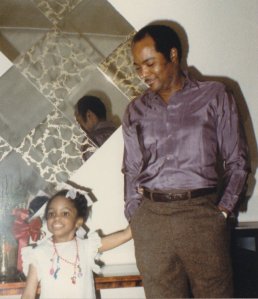
The closest reasoning I can come up with that makes sense is that my favorite uncle (and godfather), who passed away from complications due to AIDS in March of 1994, was gay. My uncle was married to a woman and had two kids but for some reason, never felt the freedom to openly be who he was. In some wacky family drama, he brought his lover, Gus, into his life (and his home) and a few family functions. Gus died not too long after my uncle.

I guess ever since, I’ve had this hang-up about homosexuality. Not only with other Christians but with God. Within the first six months of becoming a born-again Christian by accepting Jesus Christ as Lord and Savior, I seriously questioned whether I wanted to be part of a religion that didn’t allow two consenting adults—regardless of gender—to love each other. As a Bible-believing Christian, Romans 1 is clear. Homosexuality is sin. But so is unrighteousness, evil, coveteousness, malice, envy, murder, strife, deceit, maliciousness, gossiping, slandering, atheism, insolence, haughtiness, boastfulness, disobedience, etc.

So yes, I know the truth of God’s word.

But when I look at two men or two women who genuinely love each other and want nothing more than to spend the rest of their lives together, I have to stop and think, “God, why would you want to keep two people who love each other apart?” Continue reading “My position on gays and gay rights”

Spiritual paralytic

Sometimes one of our friends or loved ones becomes a spiritual paralytic. The affliction or trial he or she has undergone has virtually immobilized the person spiritually. He is unable to help himself. Not only that, but the spiritual “mat” he is lying on — that is, faith in God and trust in His promises — is no more than the equivalent of a thin, straw-filled mattress. If you try to encourage him through Scripture, he will look at you blankly and tell you Scripture just doesn’t mean anything to him anymore. he has tried to claim God’s promises, but nothing “works.” God just isn’t there.

This person has become an awkward, heavy spiritual burden. You cannot pray with him, you can only pray for him. But just as the paralytic’s friends persisted until they brought him to Jesus, so we too must persist in bringing this person to the throne of grace until God heals him spiritually. — Jerry Bridges, Transforming Grace (p. 234)

Bridges is describing me right now. If you’re reading this and you think of it, pray for me. Thanks.

A masterful, descriptive definition for Biblical Counseling

Biblical counseling involves identifying our original design, diagnosing how we fall short of that design, and dispensing God’s grace to empower people to mature into the dignified likeness of Christ, the image of the invisible God.

Read more at Grace Dependent.

A eulogy delivered on December 17, 2001

Me and Daddy

Family, friends, and beloved guests, I want to thank you for attending my father’s memorial service.  Not only was he a devoted brother, husband, and father, but above all, he was a born again child of God.

Even though I’ve lived for only 19 years, I praise God for the memories I shared with my father. I remember my father teaching me how to ride a bike at Eisenhower Park.  Although he did not have a son, I fulfilled that role when he taught me how to play football.  I look back memorably on the last Sunday of each January when my father and I would sit and watch the Super Bowl.  My father has taught me everything I need to kow to watch sports with my future husband.  He taught me that soccer is true football and that no one (but Americans) calls football soccer.  He raised me on cheering for the New York Yankees, but would take me to a Mets game when he had the opportunity.

All the areas of my father’s life seems to be all right but he felt an emptiness that he could not explain.  To fill this longing in his heart, he set out on his quest to find God.  Raised as a staunch Catholic, he realized he could not find what he needed in the traditions of man.  God led him to Bible Baptist Church where he accepted Jesus Christ as his Lord and Savior.  As a born again Christian, he began reading the Bible and learned that he could go directly to God for the forgiveness of his sins, not through a priest.  Because of my father’s earnest efforts to bring me to a Bible-believing church, in July of 1998, I also came to know Jesus Christ as my Savior.

As my father immersed himself in the Bible, God changed his heart and gave him a joy that he had never possessed.  A verse from his favorite Psalm reads, “The Lord is my rock, and my fortress, and my deliverer; my God, my strength, in whom I will trust; my buckler, and the horn of my salvation, and my high tower.”  When trials headed his way, he turned to God for comfort and assistance.  Leaving New York for a Christian college in Florida was not the easiest thing for me to do, but my father was at peace with the decision, knowing that I was doing the will of God.

When people ask how they can help ease the pain of my father’s passing, there’s only one answer: To do what I know my father would want people to do, and that is to believe on the Lord Jesus Christ for the remission of their sins.  Everyone in this room is a sinner.  Romans 3:23 in the Bible says, “For all have sinned, and come short of the glory of God.” Romans 6:23 says, “For the wages of sin is death; but the gift of God is eternal life through Jesus Christ our Lord.”  The ultimate punishment of sin is death, but because my father believed upon Jesus Christ’s finished work on the cross, he is now living eternally in heaven with God.  People should be sad today because my father is no longer physically present.  But I know that my father is in a better place right now, not because he deserved to be, but because God made salvation available to my father as He is making it available to everyone here.  John 3:16 says, “For God so loved the world, that he gave His only begotten Son that whosoever believeth in Him should not perish, but have everlasting life.”  Do not focus on my father’s death; instead, I ask you to focus on your eternal destination.  It doesn’t matter whether you’re 19 or 90, each of us will die eventually.  Then where will you go?  There’s a heaven above, a hell below and nothing in between.  Had my father not trusted in Jesus Christ, he would have suffered from eternal torment.

Has there ever been a time in your life when you told God that you believed Jesus Christ died, was buried and resurrected for your sins so that you could have access to the gates of heaven? In John 14:6, Jesus states, “I am the Way, the Truth, and the Life: no man cometh unto the Father but by me.”

Philippians 4:13 emphasizes, “I can do all things through Christ which strengtheneth me.”  If anyone is without Christ, he can do nothing. But I praise God that when He calls me to my home in heaven, I can see my father again.  Can you say with definite assurance that you are on your way to heaven?  If my father’s death has not made you questions your eternal destination, then he will have died in vain.  But if someone here realizes that he is a sheep wandering without a shepherd, the Lord Jesus is beckoning you to come to Him.


August 22, 1942–December 9, 2001

Thought of the Day

Are you more devoted to your idea of what Jesus wants than to Jesus Himself? If so, you are likely to hear one of His harsh and unyielding statements that will produce sorrow in you. What Jesus says is difficult— it is only easy when it is heard by those who have His nature in them. Beware of allowing anything to soften the hard words of Jesus Christ. — Oswald Chambers, My Utmost For His Highest, August 18

In search of an identity… Christianity.

CrossWho am I… as a Christian?

As a Bible-believing Christian, this topic could be endless.

Under the banner of Christianity,  I am a number of things:

  • a sinner (Romans 3:23)
  • lost without Christ (John 14:6)
  • redeemed and forgiven of all my sins (Colossians 1:13-14)
  • God’s child (John 1:12)
  • bought with a price (I Corinthians 6:19)
  • a citizen of heaven (Philippians 3:20)
  • God’s workmanship (Ephesians 2:10)

The list goes on. But what does that mean for me as an individual?

I read God’s Plans For You by J. I. Packer in the hopes that I’d get some kind of divine revelation as to who I’m supposed to be. Nothing of the sort happened. Although I did gain some further insight as to what kind of individual God wants me to be.

An erroneous thought circulating in Christian circles is that, above all things, God wants us all to be happy. Above all things, God wants Christians to be holy. Achieving that apart from the guidance of the Holy Spirit is no easy task. What does the pursuit of holiness mean? (Another good book for me to read.) It means going after the things that are pleasing to God and pursuing the fruits of the Spirit: love, joy, peace, patience, kindness, goodness, faithfulness, gentleness and self-control (Galatians 5:22-23).

Here’s where God has led me in my Christianity so far:

That’s about as individual as it gets right now. There’s nothing profound or earth-shattering in this post. It’s simply an attempt to get me to figure out who I am as a Christian.

In search of an identity…

Who am I?
What is my purpose?

questionThose two questions run through my mind at least once a day. (I’m probably providing a conservative estimate on that front.) Well, here are the basic answers to each question:
1. Who am I?
First and foremost, a Christian female; an adopted child of God bought with a price and a joint-heir with Christ.

2. What is my purpose?
To glorify God, and to enjoy him for ever. (Westminster Shorter Catechism, Q1)

Those are the general things, applicable to a wide variety of Christian women. But specifically, who is the person that I’m supposed to be—the person no one else can be? What is God’s individual purpose for my life? Let’s start with a list of things that make up who I am:
Who I am
  • Christian
  • Female
  • Daughter
  • Wife
  • Cousin
  • Niece
  • Black
  • Writer
  • Friend
  • New Yorker
Really, is there much more to it than that?
Some of who I am is pretty straightforward in my opinion and does not need to be pursued much further, ie, female, daughter, wife, cousin, niece, friend. However (for me), it can get complicated when one of those things becomes a noun and the other becomes an adjective: What does it mean to be a Christian female? Or a Christian wife? Or a Black Christian? Or Black female? Here are the main topics I struggle with regarding my identity:

Christianity: What does it mean to be a Christian?

Race: What does it mean to be black in America, especially since I am first-generation American and am also married to a white American male?

Career: What kind of a writer am I? How do I pursue this, namely in a dying profession such as print journalism?

Location: My heart longs to be in no other place than New York but I’ve become content to live in Philadelphia. Am I still a New Yorker? Can I call myself a Philadelphian too now?

After exploring the main topics that plague my identity, I’ll try to address the issue of what my purpose in my life. I have the scary feeling, however, that the task will be much more difficult that trying to figure out who I am.