As Rebecca St. James sung about Jesus through my headphones, I spent my entire walk on a nice, sunny day lamenting about how I didn’t have someone to share it with.
How foolish.
Attempting to live and breathe for an audience of one

As Rebecca St. James sung about Jesus through my headphones, I spent my entire walk on a nice, sunny day lamenting about how I didn’t have someone to share it with.
How foolish.
I have a slight problem with Brian McLaren’s graph from p. 34 of A New Kind of Christianity. His graph is shown above in the picture; my revised version is shown below.

McLaren places Eden on the level of Heaven which basically equals perfection. That might bother some but it doesn’t bother me. The only difference between my graph and his is the direction of the “Hell/Damnation” arrow. While nitpicky, I have a fundamental disagreement with McLaren on this one.
From a theological perspective, what bothers me is the downward direction of the arrow. Perhaps he drew it that way because we always think of heaven as existing above and hell existing below. I redrew it to make it a continuous straight line not only because I have semi-OCD tendencies but also because the destination as a result of condemnation is hell/damnation. It’s not a downward trajectory from condemnation but rather, a continuous path that is not separate from it. According to the Bible, this is the spiritual path that all souls are on as a result of the fall (Romans 5:17-19).
I’d also like to add that I’m interested in reading McLaren’s response to the pluralism question: “How should followers of Jesus relate to people of other religions?” On page 21, he briefly summarizes what he’ll try to address:
So we ask: Is Jesus the only way? The only way to what? How can a belief in the uniqueness and universality of Christ be held without implying the religious supremacy and exclusivity of the Christian religion?
I think it’s an interesting question to posit and answer, oops, I mean “respond to.” (There are no answers according to McLaren, only responses in an effort to stimulate and continue conversation. For a great Biblical counseling perspective on this conversation, check out Bob Kellermen’s series in which he provides responses to McLaren’s questions.)
So here are my initial responses before reading the chapter in which McLaren expounds on the pluralism question:
I’m excited about reading through A New Kind of Christianity. I have an open mind about this and am totally willing to transform my Christian faith and live it in a new way with only one caveat: it must remain true to the Bible. If McLaren argues something that goes against what the Bible says, I’ll point it out. We know very little about Jesus apart from the Bible. And we would know nothing about Jesus’ teachings without the Bible. So holding McLaren and his questions and responses to a Biblical standard is neither unreasonable nor unfair since he is talking about the the Christian faith.
I hope you’ll join me in my journey through this book. If you don’t know who Brian McLaren is or what a little bit of background on what part of the Christian faith he comes from, please check out my series on the emergent movement.

I’m reading through Brian McLaren’s A New Kind of Christianity and will post my thoughts on my blog as they strike me. You can find the first one here: http://bit.ly/8YYns6. I am working on a second.
For blog posts from a Biblical counseling perspective, please follow Bob Kellermen’s series.
A quote I found interesting:
When you talk to the people who walk down the aisle at a Billy Graham crusade to make a “first-time Christian commitment,” who say something called the “sinner’s prayer” in response to an evangelistic invitation, or who join a new church, you discover that over 90 percent of them are already lifelong churchgoers. That means that over 90 percent of the so-called new converts come from the 40 percent of the population who are already “in the choir,” and less than 10 percent come from the “unchurched majority.” So we have a lot of Baptists becoming Pentecostals, and Catholics becoming Episcopalians, and so on, but surprisingly few “unchurched people” getting connected with the church. (p. 4)
McLaren’s point is interesting in light of this piece from the Huffington Post, “Listen Up, Evangelicals: What Non-Christians Want You To Hear”: http://is.gd/aaCCI. An observation from this piece that struck me:
“I have no problem whatsoever with God or Jesus – only Christians.”
Sad. I have heard this from other Christians as well.
 I’m not writing a book review on Hear No Evil because I wasn’t planning on it. But as I read through Matthew Paul Turner’s book, I wanted to offer a few thoughts. (Thanks to Jezamama for sending the book to me after winning her book giveaway contest!) I found some choice quotes that seemed especially insightful to me:
“The odd thing about Christians pursuing fame is that they do it while pretending not to be interested in fame. Their goal, most say, is not to bring fame and fortune to themselves. Their only interest is to make Jesus known. But in the process of making Jesus better known than he already is, a lot of Christian musicians find fame and fortune for themselves too.”
This thought gets to the heart of two main things about Christians:
Turner does an especially great job at illustrating this through his encounter with Jeff and Jack. (Btw, the section where he describes meeting Poppa Gladstone and going to his concert was HILARIOUS to me.)
Another quote that jumped out at me:
“I liked being Calvinist because it made me feel controversial and edgy to believe something different than what my parents believed. … I think that’s why people like Josiah and me sometimes turned into Calvinists. We could be passive-aggressive toward our parents and our past lives without being considered unchristian. Reformed doctrine offered a different way to think about God. And sometimes different, even when it really isn’t that different, is all we need to make us feel alive, creative, and in control of our own destiny.”
I’m part of a Christian message board in which the Calvinism vs. Arminianism debate is as worn out as a pair of sandals on a Middle Easterner. But a recent debate I engaged in questioned whether young people adopt Calvinism to buck responsibility. Turner sums the adoption of Calvinistic thought among young adults much better than I could have ever thought to put it.
Overall, I found Hear No Evil to be a humorous and an amazingly well-written book.
I didn’t grow up Independent Fundamental Baptist (IFB) but it is amazing how I was able to relate to many of Turner’s anecdotes despite my short stint in that realm in young adulthood. In a way, Hear No Evil is really Chicken Soup for the Recovering Independent Fundamental Baptist’s Music Soul. Turner’s book on his general IFB experience, Churched, is on my must-read list now. You can connect with Turner on his blog at http://jesusneedsnewpr.blogspot.com or through Twitter: http://www.twitter.com/jesusneedsnewpr.
—
Apologies for not providing page numbers for the quotes. I’m already shipping the book off to a friend who lost a contest to win the book. This book is too good to keep to myself.
When it comes to looking at other female Christians, I’ve always felt like an outsider. Through the lens of my “doo doo” eyes, these females tend to be white, wholesome, and happy. Now that I run with the 30 and older crowd, they also have babies or toddlers. I tell myself I’d die if I were a mommy blogger. I don’t mind being a blogger who happens to be a mom but adding “mommy blogger” to my job description would just about kill me.
Or maybe not. Because I have no problem being a sellout because I am that desperate for acceptance. On a forum I frequent, someone posted a link to a job description as a reporter for a popular politically conservative website. I’m not particularly conservative politically but I’m not liberal enough for the Huffington Post either. But I’d spout conservative principles if I had to just for the opportunity to write for a living. Unfortunately, on the liberal side, I’d only go so far since the abortion issue is a big problem for me. If I could blog as a pro-life liberal, I’d be okay on that end.
My counselor in Kentucky used to say to me and my husband, “People desire two things in life: to be right and to be accepted.” I so would prefer to be accepted than to be right. If all the conservatives hated my political views but thought I was an otherwise cool chick, I’d be ecstatic. I don’t care if my friends think I’m a total idiot as long as they love me anyway.
The only time I’ve ever felt accepted by a group in my entire life was when I joined a sorority at the first (secular) college I attended. In a sense, I feel like I earned the ability to be accepted. I left the college shortly after so my feeling of acceptance by my sorority sisters was short-lived.
The feeling of acceptance decreased ever since. I attended a fundie Christian college for a few years where I stood out like a sore thumb in various ways: my shirts were too tight or too see-through (even though I didn’t think they were all that bad); I didn’t have a plethora of skirts or dresses I could rotate through; I didn’t look or think as wholesome as those other homeschooled Christian girls; I wasn’t as naive (or maybe I was). I moved joyfully to the melody of hymns during church services while the few friends I had desperately crowded around me to make sure I didn’t get in trouble for moving in time to the rhythm of the music. (I called myself “Bapticostal” during that time.) What was wrong with dancing to music? Didn’t David dance joyfully while worshiping the Lord? Gosh, I was such a freak.
I still think of myself as a freak. Continue reading “Midnight ramblings”
As a product of the instant gratification generation, I want to know the answer to who I am and why I’m here NOW. The two basic questions I grapple with on a daily basis are:
And when I say daily basis, I mean, daily as in every single day. Usually the standard answer I give myself is the first Q&A from the Westminster Shorter Catechism:
What is the chief end of man? To glorify God and to enjoy Him forever.
I’m not sure how those in the Reformed faith applied that practically in 1646 but I’m trying to figure out what that looks like in 2010.
Does that result in a list of do’s and don’ts? There’s a call to holiness: how do I live that out? I’m called to be a Christian witness 24/7 but often feel like a practical atheist—speak of God, am interested in the things of theology but do not really talk about my faith outside of… my faith. Quite the impractical faith. But I’m not trying to get into a discussion of evangelism and witnessing right now. I’m trying to figure out how to accomplish my meaning and purpose in life by glorifying God and enjoying Him forever.
Glorifying God and enjoying Him look different for each person. We are not all the same and we are not called to be alike. While we all have the same chief end, how that plays out looks different in an individual’s life.
So in my life, what does glorifying God look like? Well, to be quite honest, I’m not so sure. As a Christian though, there are certain things I am called to:
And how do I enjoy Him? You’ve got me. I know how to enjoy His creation but enjoying Him is an entirely different matter.
My husband and I visited a local church nearby and the verse the pastor preached on resonated me:
“Peace I leave with you, My peace I give to you; not as the world gives do I give to you. Do not let your heart be troubled, nor let it be fearful.” —John 14:27
The pastor went on to explain what kind of peace Jesus was talking about and how personal that peace had become to him, especially since the pastor’s mother had passed away at 5:45 this morning.
This resonated with me as well since peace has been something I have been praying about. The two non-sin issues I struggle with most in my Christian walk are joy and peace but especially peace. As a person who suffers from depression and anxiety, naturally joy and peace are what I would seek most.
It is comforting to know that there is peace in Jesus Christ: the peace of knowing him, and the peace of that final destination as a result of knowing him. It is not the peace that the world gives or hopes to give but that blessèd assurance that all is well with my soul.
I now know the peace Jesus speaks of and realized I’ve had it all along in my Christian walk but like the disciples, kept looking for the wrong kind of peace—the world’s peace. It’s possible to be a believer and never experience the peace that rests inside you because you are searching for the world’s peace and not the peace Jesus speaks of.
I can best describe this peace, not as a warm, fuzzy feeling or a moment of tranquility but rather an assurance that in the face of trials, tribulations, natural disasters, rampant disease, and death, I know what the end will be because I know Who I serve. It’s quite a different peace than the one I was seeking and not at all what I expected. And because I am a sinner, prone to being tossed to and fro in the waves of life, my peace will also be shaken—mainly because I will be seeking after that worldly peace. But if I keep my eyes on Jesus through this journey of life, my peace will remain sure and solid—moreso than the ground I stand on.
And that’s what I must remember: my faith is a journey. I will not be perfect all the time but if I challenge myself to tuck that verse away in my heart, perhaps I will remember a bit more often what true peace is.

What does it mean to be a woman in America? Continue reading “Rechecking my gender”
Dear God,
I come before You now humbly repenting. I was foolish to think I knew better and that my human ways are wiser than Your divine ways. I echo David’s prayer of Psalm 51:
Be gracious to me, O God, according to Your lovingkindness;
According to the greatness of Your compassion blot out my transgressions.
Wash me thoroughly from my iniquity
And cleanse me from my sin.
For I know my transgressions,
And my sin is ever before me.
Against You, You only, I have sinned
And done what is evil in Your sight,
So that You are justified when You speak
And blameless when You judge.
Behold, I was brought forth in iniquity,
And in sin my mother conceived me.
Behold, You desire truth in the innermost being,
And in the hidden part You will make me know wisdom.
Purify me with hyssop, and I shall be clean;
Wash me, and I shall be whiter than snow.
Make me to hear joy and gladness,
Let the bones which You have broken rejoice.
Hide Your face from my sins
And blot out all my iniquities.
Create in me a clean heart, O God,
And renew a steadfast spirit within me.
Do not cast me away from Your presence
And do not take Your Holy Spirit from me.
Restore to me the joy of Your salvation
And sustain me with a willing spirit.
Then I will teach transgressors Your ways,
And sinners will be converted to You.
Deliver me from bloodguiltiness, O God, the God of my salvation;
Then my tongue will joyfully sing of Your righteousness.
O Lord, open my lips,
That my mouth may declare Your praise.
For You do not delight in sacrifice, otherwise I would give it;
You are not pleased with burnt offering.
The sacrifices of God are a broken spirit;
A broken and a contrite heart, O God, You will not despise.
By Your favor do good to Zion;
Build the walls of Jerusalem.
Then You will delight in righteous sacrifices,
In burnt offering and whole burnt offering;
Then young bulls will be offered on Your altar.
Since I wrote an open letter to You, publicly asking questions, again I repent publicly expressing my sorrow and seeing how my limited judgment stilted my view of the work that you’re doing in Haiti.
God, You’ve inspired me. Pastor Mark Driscoll of Mars Hill Church and director of Churches Helping Churches has no idea who I am and probably will never know who I am. But his 32 hours on the ground in Haiti has touched my heart and given me a better perspective. A perspective I should have had but was hasty instead to rush to judgment.
I watched his special sermon to his congregation called 32 Hours: The Church in Haiti and was spiritually brought to my knees. In anger, I accused You of not caring, of not being loving, of not being fair, just, or kind when in fact, You are being more merciful that I could have possibly imagined.
I don’t know how many people watched Driscoll’s sermon; in some ways, I don’t care. But at the beginning of his sermon, he spoke of how he barely knew of Haiti and its people. I then realized that fact was true for many people around the world.
And it is through this tragedy, Lord, that people on a mass scale are FINALLY noticing, caring about, and loving Haiti. It is through this tragedy that You have forced people to come to grips with a country in the Western Hemisphere that is in impoverished in almost every single way. Haiti has received more attention in the past two weeks than it ever has before. I’m still not happy that hundreds of thousands of people had to die but I see now their deaths were not in vain. Though we know not their names, they served a purpose—they gave their lives so others might know about their country. They gave their lives so Brazil, Peru, Spain, France, and China to name a few countries, could lend medical care, provide basic needs, and help rebuild a country that has been broken for too long.
Though they may not all have known You, the hundreds of thousands of people who died gave their lives for Your gospel. Through Driscoll’s video, I realized that churches who overlooked Haiti as a mission field before are now extremely burdened for the souls of those people. Pastors who never knew Haiti existed are now begging their congregations to give generously to a country that can never give back.
And I am forced to say nothing other than “thank You.”
People wiser than I encouraged me to read the Book of Habakkuk and see how Your servant asked You questions then awaited an answer and the judgment to come. You have given me an answer, Lord. And I thank You. Because that answer has shown me what I really knew all along but couldn’t really see—that You are being glorified and magnified.
In a week or so from now, the images of Haiti will fade from most people’s minds, we’ll return to our normal lives, and the burden we feel for the country now may lessen. But you have imprinted Haiti on certain people’s hearts as a result of this and now many people from all sects of Christianity will flood into the country and witness the love of Christ in word and in deed. Some may give their lives as the country is still unstable. But the Haitian people will know of Your love and will know that Your people around the world care for them.
Thank You, Lord, for the forgiveness that You provide through Jesus Christ; thank You that You have been gracious and merciful to me to answer my prayers; and thank You for drawing me closer to You and for reigniting a flame in my heart that was slowly beginning to die and lose hope. Show me how I can be of help to a hurting country and a hurting people. Please, God, never ever let me lose sight of the work that You’ve done in my heart and the work that You’re doing in Haiti.
And, while I’m at it, thanks for making me Haitian.
Merci pour tout bagai ou b’am mwen, bon Dieu.
Love,
Me
I don’t know if this will work but I’ve embedded Pastor Driscoll’s video on Haiti below. If it doesn’t work, feel free to see it Embedding doesn’t work. See it here. It’s on YouTube now so I’m able to embed it. It’s over an hour long but it’s the best hour I’ve spent in a long time. I’d encourage anyone—Christian or not—to watch it.
1. I am prideful. My husband pointed out that it’s a trait I get from my mother, attempting to look like I have it all together. “Well, when you put it that way…” I said with a shiver running down my spine. My mother’s need to look like she had it all together kept my father from getting treatment for his paranoia/schizophrenia and kept his sisters out of the dark for too many years. Knowing that quality exists in me is a rather scary thought.
I went to a prayer retreat today and again, tried to act like I had it all together. Truth be told, I’ve been going through a spiritual drought. My prayers have consisted of nothing but “why” questions and I earnestly began to pray that I would seek to “know God more than my need to understand Him.” Through the guidance and counseling of two wonderful Christian friends, they prayed with me and reminded me of God’s promises through Scripture. My faith began to see the beginnings of restoration. Continue reading “Three Lessons I Learned Today”
I recently published a book review on Tim Keller’s book, Counterfeit Gods, but wanted to write a post that is a bit more personal in nature. I left off with this:
To dethrone any and all other idols apart from God, Jesus’ sacrificial death on the cross must be real. The heart of the matter can be summed up in this question:
What is operating in place of Jesus Christ as your real, functional salvation and Savior?
It is a question that Christians should not neglect to ask themselves every single day.
The cynic in me struggles with this. God knows how much I am very much a doubting Thomas, plagued with questions like:
I’ve come to the realization that I am the very least, a Jew. (Yeah, go ahead and make a Sammy Davis, Jr. joke now.) I believe wholeheartedly in the Old Testament. But the more I think about it, the more the Old Testament constantly points back to Jesus. (The Book of Matthew is a great book for discovering how the Old Testament continuously points to Jesus.)
Now while the Pharisees were gathered together, Jesus asked them a question: “What do you think about the Christ, whose son is He?”
They said to Him, “The son of David.”
He said to them, “Then how does David in the Spirit call Him ‘Lord,’ saying,‘THE LORD SAID TO MY LORD,
“SIT AT MY RIGHT HAND,
UNTIL I PUT YOUR ENEMIES BENEATH YOUR FEET”‘?”If David then calls Him ‘Lord,’ how is He his son?”
No one was able to answer Him a word, nor did anyone dare from that day on to ask Him another question. ~ Matthew 22:41-46
A puzzling question to me as well.
So the basic hurdle that I am confronted with is whether I believe fully in Jesus Christ, who he is, and his purpose for being born on earth–his existence as fully human and fully God; that he is the Son of God, born to a virgin, lived, died on a cross bearing God’s wrath for the sins of humankind, was buried, and rose again three days later. If I accept this (and I do), then I also accept that the triune God alone is worthy of worship, leading me to adhere to the following commandment:
You shall love the Lord your God with all your heart, and with all your soul, and with all your mind. ~Matthew 22:37
This is not in conflict with the first commandment God issues (located in Exodus and Deuteronomy):
I am the LORD your God, who brought you out of the land of Egypt, out of the house of slavery. You shall have no other gods before Me. ~Exodus 20:2-3 & Deuteronomy 5:6-7
Jesus reiterates that God must take the primary place in our heart, soul, and mind. He is to be the only One people worship. He must constantly occupy our daydreams and imaginations even. I quoted this passage from Keller’s book in my previous post but it strikes and convicts me so that I feel compelled to repost it:
Archbishop William Temple once said, “Your religion is what you do with your solitude.” In other words, the true god of your heart is what your thoughts effortlessly go to when there is nothing else demanding your attention. What do you enjoy daydreaming about? What occupies your mind when you have nothing else to think about? Do you develop potential scenarios about career advancement? Or material goods such as a dream home? Or a relationship with a particular person? One or two daydreams are no [sic] an indication of idolatry. Ask, rather, what do you habitually think about to get joy and comfort in the privacy of your heart?
If I’m honest, I must admit God does not constantly occupy my thoughts as He should. I also frequently fail to follow this directive from the apostle Paul as listed in Philippians 4:8:
Finally, brethren, whatever is true, whatever is honorable, whatever is right, whatever is pure, whatever is lovely, whatever is of good repute, if there is any excellence and if anything worthy of praise, dwell on these things.
How often do I dwell on the things that are false, dishonorable, wrong, impure, ugly, and bad repute, full of mediocrity and worthy of condemnation!
As a result, I’ve instantly created an idol. Keller writes:
Idolatry is not just a failure to obey God, it is a setting of the whole heart on something besides God.
In my previous post, I listed all the idols Keller identifies. While I’ve struggled with many of those idols at one time or another, these are the main idols that currently dethrone God in my life: Continue reading “Personal thoughts on Tim Keller’s book, Counterfeit Gods”
 My church recently distributed Tim Keller’s book, Counterfeit Gods, for Christmas to whomever wanted it. I’ve heard people sing Tim Keller’s praises but have never read his books or visited his church or church plants. Therefore, I decided to pick this book up first before picking up Keller’s other bestsellers that have piqued my interest: The Reason for God and The Prodigal God. And besides, it was FREE. How can you beat a FREE book?
I made a goal to finish reading the book before the clock struck midnight for 2010 and achieved that goal. The hardcover book, barely larger than 5 x 7 inches, is just under a 200-page read (including the Introduction but not including Notes, Bibliography, or Acknowledgments). I’m a bit of a slow reader so I was able to complete the book in about three days (of dedicated reading). A fast reader could easily complete this book in a day–it’s that small.
Upon completion of the book, I was pleasantly surprised to discover how much I enjoyed it. And it stood in marked contrast to a book I most recently finished, It’s Your Time by Joel Osteen, that touts health and wealth as proof of God’s favor upon an individual. Usually, I take a couple of days and allow my mind to fully absorb the contents from the book before making a full judgment, however, Counterfeit Gods impacted me so much, I view it as a life-changing book.
Perhaps life-changing seems like an exaggeration but for me it is not. I operate on a five-star rating scale, basically using the Amazon system:
* (one star) – I hated it
** (two stars) – I didn’t like it
*** (three stars) – It’s OK
**** (four stars) – I liked it
***** (five stars) – I loved it
Counterfeit Gods gets FIVE stars from me. It’s not easy for a book to garner that high a rating from me but I personally can’t find any fault with it. (Perhaps a pastor or some high-falutin’ theologian would.) Keller is clear, concise, uses modern-day and Biblical examples to support his points, and instructs readers on how to identify and replace any idols in their lives.
Keller leaves no graven image unturned in this book. This book, aptly titled Counterfeit Gods, could also have been titled If You’re Breathing, You’re Probably Breaking the First Commandment. Keller posits that anything that dethrones Jesus Christ as the sole object of worship in our lives is an idol. He also asserts that the remaining nine commandments are basically elaborations on the first:
I am the LORD your God, who brought you out of the land of Egypt, out of the house of slavery. You shall have no other gods before Me. ~Exodus 20:2-3 & Deuteronomy 5:6-7
Since Counterfeit Gods is a relatively recent book, he begins by addressing the economic fallout of 2008-2009 that led the United States into a recession. He refers to wealthy investors who made money their sole god. So when the bottom dropped out of the economy and those investors lost millions upon millions of dollars, they had nothing left to turn to. As a result, many of them committed suicide. Except for one bright shining hope in an investor named Bill who gave his life to Christ in 2005. Bill testifies:
If this economic meltdown had happened more than three years ago, well, I don’t know how I could have faced it, how I would have even kept going. Today, I can tell you honestly, I’ve never been happier in my life.
Don’t get the idea that Keller is saying becoming a follower of Jesus Christ leads to a life of butterflies and sunshine. Quite the contrary, he implies Christians have a tougher road ahead of them because they are called to a higher standard. As a result, Keller points out that today’s (mainly Western) Christians often don’t look much different from non-Christians.
Contemporary observers have often noted that modern Christians are just as materialistic as everyone else in our culture. Could this be because our preaching of the gospel does not, like Saint Paul’s, include the exposure of our culture’s counterfeit gods?
Harsh words. It certainly convicted me.
For starters, it would be good to define what an idol is. Here is the basic definition Keller provides:
It is anything more important to you than God, anything that absorbs your heart and imagination more than God, anything you seek to give you what only God can give.
Despite the book’s subtitle, The Empty Promises of Money, Sex, and Power, and the Only Hope That Matters, Keller does not limit his discussion of idols to money, sex, and power. Not at all. Here’s a full list of the idols he identifies (located in the Notes section) with brief descriptions: Continue reading “Tim Keller’s Counterfeit Gods (Book Review)”
Inspired by this post from Matthew Paul Turner, basically making fun of Pastor Joel Osteen’s (NOT OLsteen, maybe LOLsteen) new book, It’s Your Time and a one-star review on Amazon in which the “reviewer” essentially wrote that Osteen was a fraud, he hadn’t read the book, and never intended to read the book (the review’s since been taken down), I felt prompted to go where most Biblical evangelical Christians choose not to go.
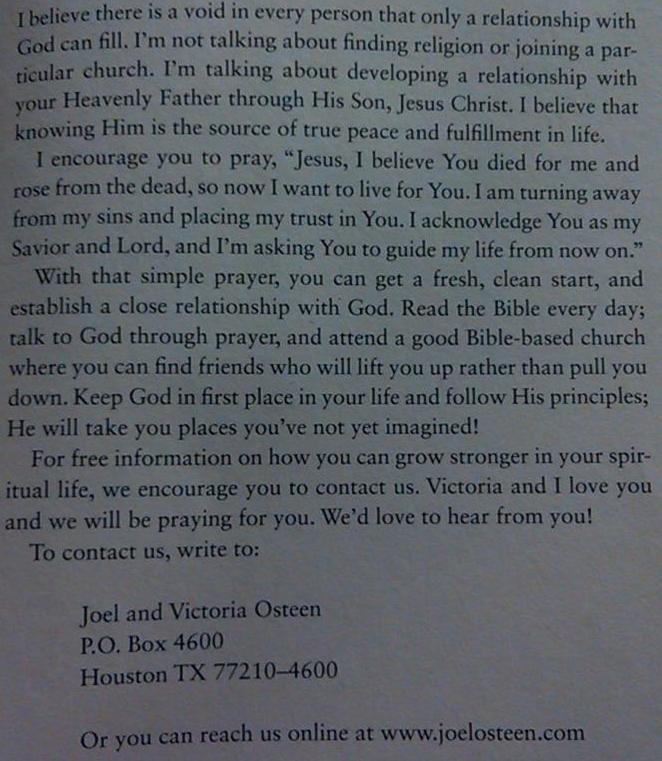 I am a little sensitive to Joel Osteen and his ministry and likely not as hard as I should be. Thank my mother. I believe that God used Pastor Osteen’s ministry to bring my mother to a saving knowledge of Jesus Christ. She was hesitant for many, many years but after watching Pastor Osteen regularly, softened up, accepted Jesus as her Lord and Savior, and now regularly attends a local Bible-believing church. I have seen Osteen’s telecast and at the end, he does give an invitation (though many Biblical evangelicals would consider it a weak one) to accept Jesus. Although the criticism is that Jesus is secondary to his preaching of the “health and wealth” gospel,” which we’ll get to later on in the review. (Click on the photo on the left to enlarge it and essentially read the “invitation” Joel Osteen provides.)
Two stars.
What were the issues then that led me to give this book a rating comparable to “poor”? Quite a bit. Sit back and have a nice cup of coffee or tea as you review this list with sometimes lengthy explanations. Continue reading “It’s Your Time Book Review: Dump this book, Discard much of what you learn, Desist reading”
 I’m currently reading Joel Osteen‘s latest book, “It’s Your Time” and annoying the Twitter world with my #ItsYourTime-related tweets. I subscribe to a brand of Christianity that does not subscribe to Osteen’s brand of Christianity. So why am I reading this book if I don’t agree with him? Several reasons actually:
The trouble with Osteen’s book, however, is that there’s a lot of truth in it but there’s enough wrong to make it bad.
I’ve been assuming the majority of my readers are Christians who know about Joel Osteen in some way. Maybe you’re not a Christian or you’re simply not familiar with Mr. Osteen. Well, let me introduce you.
Osteen, in a nutshell, is considered by his supporters as “America’s voice of hope and encouragement” while his critics deem him as a proponent of the prosperity “health and wealth” gospel. Indeed, I can see truth from both sides.
Osteen writes in a very personable way, which makes it feel as though he’s speaking specifically to each reader. If a person is feeling discouraged, no doubt, Osteen has the gift of encouragement. (Even renowned evangelical Mars Hill pastor Mark Driscoll has said such!) Osteen is the ultimate optimist. (Sometimes, he’s so optimistic, it’s sickening.) I’m very much a cynic and a pessimist. I really have no business reading this book.
But there are scriptural truths that he does point out that I, as a pessimist, tend (and prefer) to overlook. For example, God tells us to ask Him for anything. (Matt. 7:7-11) And Osteen can even legitimately use Matthew 21:22 (“And whatever things you ask in prayer, believing, you will receive”) if he so desires. I’d argue in favor of Osteen if someone tried to tell me Matthew 21:22 wasn’t a straightforward verse. (Even taken in its context.)
However, where Osteen errs is by leading readers to believe that God will “fulfill all the desires of your heart.” (Psalm 37:4) If we look at the entire verse, which says, “Delight yourself also in the LORD, and He shall give you the desires of your heart,” it implies first “delighting in God.” When believers delight themselves in God (and the things He’s after), the desires of their heart will align with the desires of God’s heart, not the desires of our sinful lusts. James 4:2-3 again confirms this by saying:
You lust and do not have. … You do not have because you do not ask. You ask and do not receive, because you ask amiss, that you may spend it on your pleasures.
Christians sometimes have this fallacious belief that God does not answer prayer. Not so! God does answer prayer with a yes or no. Sometimes he doesn’t always answer right away but he does eventually answer our requests. Often, some people take a “no” response to really mean “no answer” because we keep hoping He’ll say “yes.” I can pray my little heart out to be as rich as Bill Gates one day. It’s legitimate to ask for it since I can ask for anything. However, I must also realize it’s legitimate for God to flat-out–or take His time in saying no.
Has Osteen’s book helped me to dream a bit bigger? Well, yes–cautiously.
Osteen has a pretty big God and I think Osteen’s critics sometimes view through the lens of cynicism and try to make God so much smaller than He really is. Truth is, no one can contain God–not you, not me, not Osteen, and definitely not Osteen’s book or sermons. Can God bestow much wealth and restore full health upon you? He sure can; I believe that. Will He? I don’t know but the likelihood of obtaining exceptional wealth is slim. (When I mean “wealth” here, I’m referring to the Americanized definition of “massive accumulation of wealth,” which is the language Osteen uses.)
And that’s where I have a problem with Osteen. Can God do anything? Yes. Will He do anything and everything simply because I ask Him to? No. God is not a magic genie we must rub the right way. This becomes a works-based, legalistic theology. People must obey God simply because He is God. He created all things and therefore gets to make the rules whether we like it or not.
But Osteen tells his readers if they believe they’ll receive whatever they ask for and have enough faith, it will happen. He can support this with Matthew 21:22, remember? How do you refute that?
Osteen’s book so far has challenged me to have more faith in what I pray for. Not some lackadaisical half-hearted faith (“Well, I’ll pray for it, but it likely won’t happen.”) but a real, bold faith that could position me for embarrassment if it doesn’t happen (“I prayed for it and have NO DOUBT it’ll come to pass!”). I’m challenged to pray with confidence, not expecting disappointment but with a realistic mindset that my prayers may not be answered exactly the way I’d like them to be. (I prayed fervently for an Italian husband and got NOWHERE CLOSE to that. But I wouldn’t trade my husband of Anglo-Sax/German heritage for any other man.) God’s ways and wisdom are so much higher than mine. He’s a better judge of good things that I could ever be.
Lately, I’ve felt like a Christian in name only (CINO). I hear all these stories of how Christians are told by non-Christians that they “are different” and that “there’s something special” about them they’d like to also have. That has never, ever happened to me. I’ve never been able to “lead” one person to the Lord. Does that make me a terrible Christian?
I know Christians are supposed to be “in the world and not of it.” I always got the impression that the life of a Christian would look different than that of a non-Christian–in a positive way. However, when I evaluate my life, I’m troubled that I can’t tell a marked difference than that of my neighbor who doesn’t go to church. And I don’t mean simply n a public level; I also take my private life into consideration. I don’t get on my knees by my bed to pray every night. In fact, my prayers are sometimes quick requests made in passing throughout the day. I don’t have consistent devotions daily. (There’s that lack of consistency thing again.) I can sometimes go days without talking to God or reading His word. I know my eternal salvation doesn’t depend on me (and thank God it doesn’t because I’m doing a lousy job right now) but James emphasizes “faith without works is dead” (2:17, 26). What good is the salvation I have if I don’t put it into action? My life in Christ needs to be alive and vibrant–and I’m at a total loss as to how to do that. (Remember my little problem with consistency and regularity?)
I want to be different for God. I want to be a God-honoring Christian. I want to put my faith in action. I want to have a close, personal relationship with God. I want to revere God better than I revere any celebrity but I also want to be comfortable with Him like He’s my “homie.” So comfortable I can cry, “Abba, Father, Daddy” (Rom. 8:15, Gal. 4:6) in the most personal and familiar of terms.
Until then, I feel as though I am back at square one like when I was Catholic 12 years ago–CINO. I am hungry and desperate for a savior. I want–perhaps need–to accept Jesus all over again. Maybe daily.
Isn’t consistency key?
—————-
Now playing: Sara Groves – Maybe There’s A Loving God
via FoxyTunes

 This Journey Is My Own