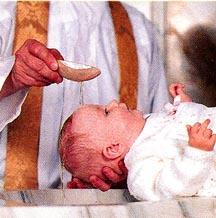
Day 22 of Enjoying God: Joy

I am really not in a place of joy.

I am discontent. I am distrustful. I am full of worry and anxiety. I lack peace.

Joy has always been one of my weaker qualities within the Christian life. I struggle with bipolar depression on the physical/mental side of things, but in the Christian life, I also suffer from a severe lack of joy in a lot of areas. Of probably all the fruits of the Spirit, joy competes for first place with patience for Christian qualities I lack.

However, the Bible is clear that joy is an essential quality of God and key to being able to enjoy a part of who He is. Psalm 16:11 and Psalm 21:6 tell us that in God’s presence is “fullness of joy” and joy “with gladness.” And a number of verses throughout the Psalms put this joy into practice, mainly vocally through singing and shouting, but there are also instances in which joy in the Lord is expressed through playing music (Psalm 43:4) and dancing (Jeremiah 31:12-13).

Biblical joy doesn’t seem to be merely happiness (or gladness) although that is a key component of it. Biblical joy includes praise to the Lord. Whenever joy or rejoicing is expressed in the Bible, it is usually accompanied with a form of praise to God. The 2011 Random House Dictionary defines praise in three primary ways:

  1. the act of expressing approval or admiration; commendation; laudation.
  2. the offering of grateful homage in words or song, as an act of worship: a hymn of praise to god.
  3. the state of being approved or admired: The king lived in praise for many years.

It’s not easy to possess joy all the time, but I’m thankful that God calls His children to partake in corporate worship as an act of joy (among other things).


Day 18 of Enjoying God: Patience

Image from timetotalkaboutit.com

Impatience. I haz it.

I have always been an impatient person. But namely when it comes to driving, I have ZERO patience. If you are a driver who stops or slows down at a (fully) green light, I will honk you. If you slow down to merge when there is no need to, I will honk you. If you take more than three seconds to move after a light turns green, I will honk you. And if you are CLEARLY driving under the posted speed limit, I will lay on the horn.

I also have no tolerance for customers who lie to me. (Something I’m pretty beefed about this week from work.) But I also recognize when customers are getting (legitimately) impatient at work, and I try to have their needs tended to quickly. No one likes to wait.

Americans tend to be impatient. We want what we want and we want it now. Then if we’re not enjoying it, we want to be done with it as soon as possible. We don’t really understand how to truly and savor and enjoy everything in life.  Perhaps this is a result of our ever-changing technology. Or maybe it’s our culture. Or maybe it’s a combination of both.

God, however, has constant source of patience. The Bible says He is slow to anger and one of the fruits of the Spirit is patience. (But I really wish the Bible had an anecdote of Jesus in line at the Department of Moving Camels to help me out. I’m just sayin’.)

I wonder how much I’d be better able to enjoy God and life if I just slowed down a bit (not so much that I’m under the speed limit) and tried to appreciate the seconds and minutes of my life ticking away. Any suggestions on how to enjoy God and life during a period of waiting?

Lord or Savior?

Thinking of a tweet a friend sent me a couple of days ago when I asked what was the difference between Jesus being Lord and Savior:

Savior & Lord have 2 diff meanings. I think the argument is that if you only want Jesus as Savior, but not Lord, then is he really your Savior? Is Jesus your fire insurance or is he really the Lord over your life BECAUSE he saved you from the pit?

If I’m really honest, Jesus is fire insurance. When someone is Lord over one’s life, they can also lord over it. I don’t believe Jesus is intrusive like that but somehow I need to be able to let Jesus rule over ever centimeter of my life if he wanted to. Every dark corner that hides, every bright light that shines: finances, relationships, career… give everything over to him.

Having only fire insurance sounds much better.

The Armor of Pretentious Spirituality & the Shield of Piousness

A friend said this to me on Twitter today:

I do think people are dishonest in general about their ‘spirituality.’

I have to agree with him. And I can’t help wonder why that is.

This statement forced me to look at my own spirituality. I like to think that I’m rather “real” when it comes to my Christian life. Too often I’m frustrated by people who try to act like they have it all together just because they have Jesus in their lives and I’m always comparing myself mercilessly to people who seem particularly pious and pray and read their Bibles all the time.

On the contrary, I also look at the people who practice yoga religiously or listen to the teachings of Eckhart Tolle and wonder if they’ve discovered some inner peace that I still find myself seeking.

So I’ve come to the conclusion that we all put on a front to some extent. There are days (perhaps sometimes weeks!) when I’ve got this spiritual connection going, some amazing mountaintop relationship with God and I really am a prayer warrior and in touch with a power greater than myself.

Then there are days (and weeks!) that go by when I don’t pray, get angry with God, feel lost as though I’m stumbling through life just trying to life in the physical, and going through the motion of attending church because it’s what I do and not necessarily because I want to. (Is that right to do? No.)

So it’s time for me to strip off the armor of pretentious spirituality and put down the shield of piousness:

  • I do not go to church every Sunday. Catholic guilt plagues me afterward but it’s true. I like my sleep more than I like fellowshipping or worshipping with the saints.
  • I do not formally pray every day. If I pray at all, it might be a quick “Lord, please make this migraine go away” but I don’t get down on my knees every night regularly and pray for my family, your family, everyone’s needs, and world peace. I sometimes formally pray but more often than not, I don’t. And more often than not, I forget. And even more often than that, I just don’t want to.
  • I take the Lord’s name in vain occasionally. (Sorry for the following, God.) I’ve caught myself saying a “Lord have mercy” or “Oh my, God” when it’s not necessary or directed to God. It doesn’t happen often and I try to get around it by saying “Heaven, have mercy” but that just sounds silly afterward.
  • I do not like to fellowship with other believers on most days. Some Christians love nothing more than good Christian fellowship all the time. Great for them. I prefer to be alone or around unbelievers. For some reason, I feel the need to pretend like everything’s fine around other Christians. Going to Bible study this summer was heart-wrenching for me as I spent month after month discovering I was not pregnant and not feeling like I could really share that with a group of women who were pregnant or already had kids (for the most part). I always left Bible study feeling worse off than when I arrived so I stopped going or helped with childcare.
  • Reading tons of theological books does not make me a theological maven. I’m reading three books on theology, God’s love, and the Bible and I feel more filled with head knowledge and no closer to any heart knowledge. I wonder if a return to the basics of Jesus Christ and the removal of deep reformed theology from my brain would help but I don’t know how to go back.
  • I wonder if non-Christians have it better than I do. Hate on Deepak Chopra all you want but the man doesn’t complain about unhappiness. And Oprah seems to be doing all right…
  • I question my own beliefs:
    • Jesus ascended into heaven bodily? Um, wouldn’t he explode once he reached a certain altitude?
    • Jesus is returning and after that, no more sin and world peace? When? Will it ever happen? Is that just a fairy tale?
    • It’s wrong to romantically love someone who is of the same gender?
    • God created Ryan Seacrest? (Just kidding.)
  • I question God’s purpose for me. Constantly. Why am I here? I mean, me specifically. You have a different purpose than I do. What am I supposed to accomplish before I die? Is the afterlife really peaceful?
  • And the most basic question of all: Am I a person who really, truly loves Jesus and would sacrifice ALL to follow him?

The answer to that last question is no. And if you’re reading this, you’re probably answering similarly if you’re honest with yourself. By the way, if you still think you’d sacrifice all to follow Jesus then let me challenge you do to this right now:

Sell your house,
Sell your SUV,
Sell your stock,
Sell your security,
And give it to the poor.¹

Won’t do/haven’t done that? Yeah, your answer’s the same as mine.

Perhaps the way back to genuinely following Christ is to strip off the facades we wear. Maybe if I showed up at church and asked someone how he was doing and he responded honestly, “A tough week but I’m hanging in there” rather than the standard “Just fine,” perhaps we’d exhibit a bit more Christ-likeness.

I love Mark Driscoll’s ministry and I think he’s done a lot to reach others for Christ in the 21st century, but the machismo thing bothers me. Sorry, I can’t quite picture Jesus going to Monday Night RAW or cheering on guys beating each other senseless in the UFC. On the contrary (which is probably Driscoll’s real point), I don’t think Jesus would’ve been a pansy flower child flashing the peace sign and getting high in the middle of a muddy field.

Jesus is the sovereign Lord of the universe. During his time on earth, he exhibited emotion and didn’t pretend to be something he was not. When Lazarus died, the Lamb of God felt the real sting of death and wept for his friend (before resurrecting him!). When money changers were desecrating the temple of God, Jesus displayed righteous anger in preserving a sanctuary that was supposed to be kept holy. And right before Jesus faced the cruelest death anyone could face, fear flowed through his body as he pleaded three times with his heavenly Father to take the task at hand away from him (before submitting himself to God’s will).

Wow. Sadness, anger, and fear. All from the one whom Christians call their Savior. Jesus didn’t pretend to be okay. Jesus wasn’t all macho like, “Yo, dudes, I got this. No sweat.” Not even with the apostles, his closest friends, who he asked to stay up with him before Judas betrayed him. Jesus was real.

And if Jesus was real, why do believers in him keep acting so damn fake?

¹Quoted from Derek Webb’s “Rich Young Ruler”

Anne Rice and association with Christianity

On July 28, famed author Anne Rice posted the following on her Facebook page:

For those who care, and I understand if you don’t: Today I quit being a Christian. I’m out. I remain committed to Christ as always but not to being “Christian” or to being part of Christianity. It’s simply impossible for me to “belong” to this quarrelsome, hostile, disputatious, and deservedly infamous group. For ten years, I’ve tried. I’ve failed. I’m an outsider. My conscience will allow nothing else. [source]

As I said below, I quit being a Christian. I’m out. In the name of Christ, I refuse to be anti-gay. I refuse to be anti-feminist. I refuse to be anti-artificial birth control. I refuse to be anti-Democrat. I refuse to be anti-secular humanism. I refuse to be anti-science. I refuse to be anti-life. In the name of Christ, I quit Christianity and being Christian. Amen. [source]

After quoting a number of verses from Matthew, I Corinthians, and John, she concludes her rejection of Christianity with this:

My faith in Christ is central to my life. My conversion from a pessimistic atheist lost in a world I didn’t understand, to an optimistic believer in a universe created and sustained by a loving God is crucial to me. But following Christ does not mean following His followers. Christ is infinitely more important than Christianity and always will be, no matter what Christianity is, has been, or might become. [source]

I’m not a fan of Rice mainly because I’ve never read her books but I’ve followed her developments and statements with minimal interest since she shifted from atheism to Catholicism. Such extreme pendulum swings in faith never fail to intrigue me. With Rice’s most recent statement, I’m forced to evaluate what it is about Christianity that’s so abhorrent that she’s chosen to renounce Christ?

Before her public repudiation, it’s clear that she was struggling with many unfortunate issues Christianity is associated with. A few Facebook posts from last Tuesday:

Gandhi famously said: “I like your Christ, I do not like your Christians. Your Christians are so unlike your Christ.” When does a word (Christian)become unusable? When does it become so burdened with history and horror that it cannot be evoked without destructive controversy? [source]

Since some of you mentioned the Westboro Baptist Church in comments below, I thought I’d publish this recent news story about them. This is chilling. I wish I could say this is inexplicable. But it’s not. That’s the horror. Given the history of Christianity, this is not inexplicable at all. —Link to “How Young Is Too Young to Learn Hate?” an article about Westboro Baptist Church [source]

This shocking link was provided by a poster below. No wonder people despise us, Christians, and think we are an ignorant and violent lot. I don’t blame them. This kind of thing makes me weep. Maybe commitment to Christ means not being a Christian. —Link to “GOP-linked punk rock ministry says executing gays is ‘moral’” an article about an anti-gay Christian nonprofit [source]

These things associated with Christianity in America are unfortunate not to mention the personal travails Ms. Rice has encountered (losing a daughter to leukemia, losing her husband of 41 years, and watching her other son — a gay rights activist — endure hate-filled rants and threats in the name of Christ). I’ve never experienced any of the things she’s experienced but it makes me understand why she would choose to “quit being a Christian… in the name of Christ.”

I’ve read a lot of posts by Christians questioning whether a person can tell Christ that she loves him but doesn’t want to be part of his Bride (that is, the universal body of Christ—commonly known as the Church). The common conclusion is that no, you can’t love Christ and not be part of his Bride.

But let’s look at this example: let’s say my husband had a close friend and this close friend of his saw me spewing bigoted remarks at other people and talking about killing people who I didn’t believe lived up to my husband’s ideal of how people ought to be. I think my husband’s friend would have every right to say, “Man, I like hanging out with you but I can’t be around when your wife is around. She acts so terrible, it reflects badly on who I am.”

Christians think that the Bride is above criticism because Christ instituted the Church. Jesus loves the Church, yes, but he sees our warts and flaws and knows it is comprised of sinners. And because Christians can be so pompous about what the Bible teaches (right or not), we sometimes drive those within our body away.

Do I agree with Rice’s decision? No, I don’t, but I respect it. I’ve read some other people argue that she should have stayed in the Church (in her instance, the Roman Catholic Church) and tried to effect change from within.

Another personal example, if you’ll allow me: After Obama’s historical election to the presidency in 2008, I chose to leave the Democratic Party. I am a staunchly pro-life (that is, anti-abortion, anti-death penalty) citizen and discovered that the Democratic Party’s stance on abortion had become so relaxed (with President Obama having the most relaxed abortion policies I’ve ever heard of) that there was no way staying in the party would allow me to effect change from within. Even though I am mostly a Democrat in other respects, to continue to be a part of an institution that I had such a fundamental disagreement with would have caused me more harm than good.

However, I’m still a Christian because I believe Jesus has called me to be a part of his Church no matter how many gripes I have with my fellow believers. I believe in the cause of Christ more than I believe in his followers. And I believe that Christ’s message of love and repentance is not just for a certain group of sinners but for all people. Jesus came not to call the righteous but sinners to repentance. He came for those who are sick, not those who are well.

Like I said, I don’t agree with Ms. Rice’s decision but I respect it. They are too many Christians who think that they’re righteous and well just because they claim the name of Christ. Ms. Rice will only return to the Church once she sees more Christians admitting that they’re sickly sinners.

Desperately seeking local female friend who loves Jesus, Justin*, and John**

A ramble/rant/possible form of incoherence.

I am trying to reconcile who I am with who God wants me to be as a married woman living in the Philadelphia area. More than that, I think, I struggle with trying to reconcile who I am with what I think Christianity expects or wants me to be.

I’ve written before about how I see differences between myself and other women. I am currently struggling with my role as a Christian woman within the church. I’m 28, married, and currently childless. I’m a minority at my church. Moreover, I’m suddenly starting to feel like a minority in my phase of life. I am having a difficult time accepting that I’m in the stage of life where many of my friends are married and having children and parenthood is not a place God has called me to yet.

I am also struggling with the idea of a glass ceiling in the church: how much can women serve and is that glass ceiling really ordained by God or by power-hungry, chauvinistic men hanging onto an archaic rule that served its purpose for that time and that culture? (My husband warned me that I sound all Brian McLaren with those thoughts, but I happen to think he’s a little biased considering he’s a guy and all.)

I spent the day crying (partially about what I don’t have but also) about what I like: social media; reformed theology; discussing mental health issues; writing fiction; blogging about topics that don’t include fashion, kids, or TV shows; pop music; and going to concerts. I am grieved by the superficial — apart from my faith, I share very little in common with the women of my church.

I whine about the days when I used to be able to call up a buddy and say, “Hey, want to go to a concert with me?” and she’d say, “Sure! Time and date, please!” and we’d just go. Perhaps it’s because I don’t have children that I still feel that kind of freedom. But even if I did, I’d hope that I’d still be able to go. (I attend concerts once or twice a year.)

I feel the need to live two different lives: a life with Christians where I act all Christian and do whatever Christian people do and a life with non-Christians where we share similar interests but nothing that unites as deeply as spiritual things do. Is it wrong for me to want the two worlds to collide? To want the crazy friend who dyes her hair pink and purple, loves music, literature, and Jesus just as much as I do (if not more), and would go to Hershey with me to see Justin Bieber? To want that friend who can say, “You wanna hang out on Saturday and find a place in Philly where a local band is playing?” or “I’m in a really dark place right now in my life. Could you come over, talk, and pray with me?” Perhaps it’s never too late to develop imaginary friends. Or, slightly less creepy, put an ad up on the Philadelphia craigslist. (Maybe imaginary friends are safer, though. Hmm…)

I have friends all over the United States who I connect with on different levels, but in suburban Philadelphia, an area I’ll likely call home for the rest of my life, I still feel lost. I still see myself as the freak loser even though I’ve never gone to school here and have never had anyone tease me here. I have lots of local friends, but when I’m depressed, upset, and hurting, I don’t have that “one” friend I feel comfortable calling. Mostly because I know they’ve all got their kids and their husbands, and hence their busy lives that have little room or space for me.

I keep wondering how to rectify the situation. How to find my crazy Christian friend who loves Jesus, loves pop music, lives within 20 minutes, and can educate me on the greatness of Proust and Faulkner.

Or maybe I’ll just stick to this solitary life of writing novels and keeping hoping and wishing that I had different so I didn’t feel so immature, so isolated, and so alone.


How is a Christian woman supposed to act? In the novel I’m currently working on, my protagonist gets a brief lesson on being a Titus 2/Proverbs 31 (Biblical) woman. I’m feeling about as flummoxed as my character. The Biblical woman is ever working, ever busy, ever faithful, ever diligent. Striving to be like the woman the Bible outlines is striving for perfection — a goal I’ll surely never attain. Why bother at all?

I struggle with ambition. I am an ambitious woman. I don’t know what I want to do but I want to do something. But all I can do is write. There’s not much of a need for that in my local church.

I could go on and on but the rest of my thoughts are a jumble, I’m feeling tired and depressed again about how I’m doomed to live with a 16-year-old mentality in a 28-year-old body and a New York mentality in suburban Philadelphia, and how I have no kids and probably too much time on my hands. I need to get involved in something in which I can utilize my talents regularly but I’m not sure what.

*Justin Bieber
**John Piper

How I see it: paedobaptism (aka infant baptism)

In the discussion of paedobaptism (aka infant baptism), I’ve debated in my head whether I find the practice to be Biblically justified. It’s not that I don’t want to understand how it’s a Biblical practice, I just don’t see how. For the past three years since becoming a member of the Presbyterian Church in America (PCA), I’ve read several articles and discussions at length and have listened to a full sermon on why a church says the practice is Biblical. The issue has gained theological steam in my mind as I watch several church members and dear friends baptize their infants. These events have me contemplating whether this is a necessary event I would like my family to participate in should I ever be blessed with a baby. (Heaven knows I won’t be up to the task of figuring this deep theological stuff out with pregnancy brain.)

After much thought, prayer, and deep discussion with my spouse, I’ve decided I do not support the practice of paedobaptism. While I wouldn’t leave my church over it (I joined knowing this) or rail on anyone who administers baptism to infants (I’m so past those days), it’s a practice I disagree with until I can be convinced otherwise. (My husband is also against the practice, if you’re wondering.)

Here are my reasons why I do not support infant baptism: Continue reading “How I see it: paedobaptism (aka infant baptism)”

Former IFB still in recovery…

I don’t talk much about my short stint in Independent Fundamental Baptist (IFB) Land but the scars are still there. So much that I feel compelled to write a book (fiction) about it. I don’t know if there’s a Christian publisher out there crazy enough to publish it but I see it as a story that needs to be told. (I like to think Matthew Paul Turner‘s publisher might be a good place to start…)

For the first 16 years of my life, I grew up Roman Catholic. I went to Catholic schools throughout my entire primary and secondary education. I was baptized into the Catholic Church, received communion, and was even confirmed. (My confirmation name was Kateri Tekawitha.)

My uncle and aunt on my dad’s side began attending a church on the border of Queens and Nassau County, Long Island and soon my father began to go to church with them. I later joined my father and was immediately introduced to born-again Christianity. The first time I heard of hellfire and brimstone was the very day that I raised my hand and went forward during the altar call hoping I could avoid eternal damnation. I don’t think I became a “believer” that very day but it was a turning point for me in my Christian spirituality.

As a Catholic, I found that the one thing keeping me from committing suicide was the teaching that if I killed myself, I’d be plunged into an eternal hell. As a born-again Christian, I found the one thing that kept me alive was the teaching that Jesus loved me so much and died in my place to keep me out of hell. Perhaps this is why I gladly left the Roman Catholic Church for a Protestant one. (Although IFB preachers shun the term “Protestant.”)

The main character and protagonist of my novel, Ms. Montez, is based off of me. I’m careful not to make her exactly like me but the similarities are evident and many of the events affecting her and surrounding her are based on my personal experiences.

Ms. Montez is a 16-year-old Hispanic female who suffers from depression and frequently sees suicide as a viable option after struggling with being teased at school, the abandonment of her older brother, and the absence of real-life friends. But just like most people who attempt suicide, Ms. Montez does not want to necessarily die—she wants to be freed from the pain of depression; Ms. Montez is on a quest for inner peace.

When Ms. Montez visits an IFB church that her aunt goes to, she expresses an interest in knowing more about Jesus. She is drawn in and “sold” on born-again Christianity when it sounds as though she is promised freedom from depression, loneliness, and suicide through the cross of Jesus Christ.

There is more to the story but the book goes on to address issues that are common not just in IFB churches but in many Christian churches today: mental health, hypocrisy, greed, gossip, adultery, and legalism. If taken the wrong way, I firmly believe the book could be read as a condemnation on Christian churches, but it is not meant to be so. The book is about a young girl’s struggle to find and maintain a relationship with God in the midst of this messy, broken-down world of sin—the church not excluded. Continue reading “Former IFB still in recovery…”

Here, There, and Everywhere

“To lead a better life, I need my love to be here.”


I have a bunch of things I feel like writing about but they’re not topically related so here’s my mishmashed post.

Music.

I am enjoying listening to Danger Mouse’s new group, The Broken Bells. Hat tip to Derek Webb on that one.

Theology.

Up on The Resurgence blog this week:

Question 74 – Should infants, too, be baptized?
Answer – Yes. Infants as well as adults belong to God’s covenant and congregation. (Gen. 17:7; Matt. 19:14) Through Christ’s blood the redemption from sin and the Holy Spirit, who works faith, are promised to them no less than to adults. (Ps. 22:11; Is. 44:1-3; Acts 2:38, 39; 16:31) Therefore, by baptism, as sign of the covenant, they must be grafted into the Christian church and distinguished from the children of unbelievers. (Acts 10:47; I Cor. 7:14) This was done in the old covenant by circumcision (Gen. 17:9-14), in place of which baptism was instituted in the new covenant. (Col. 2: 11-13)

I seriously struggle with the idea of infant baptism also known as paedobaptism. I am a member of the Presbyterian Church in America (PCA) and appreciate that I do not need to agree with the concept of paedobaptism to be a member of the covenant community. I’m not even fully convinced that I hold to covenant theology but that’s too broad of a matter to tackle within the subject of paedobaptism.

The best case I’ve seen for infant baptism has been presented by Greg Bahnsen here. But again, it’s not that I’m not open to viewing infant baptism as scriptural or that I am adamantly opposed to it per se but I find that there is a clearer Biblical case for believer’s (or as some have called it, “professor’s”) baptism.

Perhaps, however, if I fully subscribed to covenant theology and saw baptism as a replacement for circumcision, then infant baptism would make logical sense. As a Christian who previously subscribed to dispensational theology, the jump to covenant theology is not easy. (Here’s a chart for a comparison between the two. However, I did stumble upon this, and from a quick glance, it would seem like I agree more with New Covenant Theology.)

Scripture.

Relevant Magazine had an article on the most misused verse in the Bible:

Jeremiah 29:11 that says, “‘For I know the plans that I have for you,’ declares the LORD, ‘plans for welfare and not for calamity to give you a future and a hope.”

I thought the article had great insight, especially given that as humans, we have a tendency to look at God as a vending machine: pop our prayer request in the coin slot and wait for our requested result. The author expounds on the context surrounding this oft-quoted verse which shows this verse is not telling readers that God will give us whatever we desire.

Stay-at-home dads.

Matthew Paul Turner at JesusNeedsNewPR tweeted a link to Nicole Wick’s post about Mark Driscoll who bashed stay-at-home dads.

The video is a little old but I was surprised to hear this view from Driscoll given the fact that I usually agree with him. The fact that he was only willing to make “rare exceptions” for men to stay at home to take care of the family was rather appalling to me. In this economic climate and culture, it’s possible for wives to have a better-paying and steadier job than their husbands. In that case, the right way for a husband and father to provide for his family is to let his wife bring in the necessary income for them so that he can be at home rearing the children. (We are assuming in this scenario that the parents have decided they will live off of one income so that one of the parents can be home to raise the children.) An ideal situation would be for a mom to be at home with her children (should she choose to do so) but that is not always the case and I don’t believe that it must always be the case. Driscoll is way off the mark here.

Miscellaneous.

I think there’s more a-brewin’ in my head but the words are all jumbled and I can’t get them out coherently. Some other things going on:

  • I’ll begin editing on my novel soon so that will be quite a challenge. (See hard copy mess in right photo.)
  • I’ll be leading the women’s weekday Bible study during the summer so that’s another exciting thing on the horizon.
  • I’ll also be part of a book club in which we’ll we reading Ed Welch’s When People Are Big and God Is Small. I read through it for the third time last year but highly enjoy the book and find that it’s chock full of wisdom to the point where I don’t mind reading through it again.
  • My husband and I may be going on a trip to Cancun during the summer with my paternal cousins, which I’m highly looking forward to so that I can establish solid relationships with them.

Perhaps you didn’t care to know all that but it made me feel better to type it out.

Food for thought #5: A New Kind of Christianity

The Bible Authority Question

Not too long ago, I wrote this:

I’m excited about reading through A New Kind of Christianity. I have an open mind about this and am totally willing to transform my Christian faith and live it in a new way with only one caveat: it must remain true to the Bible. If McLaren argues something that goes against what the Bible says, I’ll point it out. We know very little about Jesus apart from the Bible. And we would know nothing about Jesus’ teachings without the Bible. So holding McLaren and his questions and responses to a Biblical standard is neither unreasonable nor unfair since he is talking about the the Christian faith.

In Part II of McLaren’s book, he attempts to address the kind of authority the Bible should have in people’s lives. Considering the Bible is the standard I’m holding him to, I wanted to see how he’d address this issue. First, he addresses how the Bible has been misused. He lists three problem areas:

1. Scientific Mess

Fundamentalism… again and again paints itself into a corner by requiring the Bible be treated as a divinely dictated science textbook providing us true information in all areas of life, including when and how the earth was created, what the shape of the earth is, what revolves around what in space, and so on. (p. 68)

He goes on to say Christians constantly end up “on the wrong side of truth” because of this and talks about how Christians who use the Bible as their scientific standard were wrong in Galileo’s time (heliocentric theory), were wrong in Darwin’s time (evolution), and are even wrong now (climate change/”ecological crisis”). [Note: In a sense, I agree with McLaren—the Bible was never designed as a science textbook and to treat it as such, I think is wrong. I believe what the Bible says on how everything was created but beyond that, the Bible doesn’t get into scientific specifics and to try to deduce things that aren’t there isn’t wise.]

    2. Ethical quandaries

    The Bible, when taken as an ethical rule book, offers no clear categories for many of our most significant and vexing socioethical quandaries. We find no explicit mention, for example, of abortion, capitalism, communism, socialism, schizophrenia, bipolar disorder, obsessive-compulsive disorder, autism, systemic racism, affirmative action, human rights, nationalism, sexual orientation, pornography, global climate change, imprisonment, extinction of species, energy efficiency, environmental sustainability, genetic engineering, space travel, and so on—not to mention nuclear weapons, biological warfare, and just-war theory. (p. 68-69)

    He goes on to say that Christians have misused the Bible to support unethical positions such as segregation and preventing interracial relationships. [Note: The Bible is not a socioethical rulebook nor I do believe it is intended for that purpose. However, the Bible is very much a moral book—it gives people basic rules to live, clearly saying what should and should not be done. Moral standards influence ethical decisions, hence, why some people refuse to tell even a “white” lie (because God says “do not bear false witness”).]

    3. Trouble relating to peace

    Basically, McLaren paints a broad brush of Christians generally being more hawkish and too eager for war. [Note: I’d actually agree with him here.]

    We must find new approaches to our sacred texts, approaches that sanely, critically, and fairly engage with honest scientific inquiry, approaches that help us derive constructive and relevant guidance in dealing with pressing personal and social problems, and approaches that lead us in the sweet pathway of peacemaking rather than the broad, deep rut of mutually assured destruction. (p. 70)

    In an attempt to show how Christians have radically misused the Bible to support unethical positions, McLaren takes his readers through a historical account of slavery quoting sections of pro-slavery books defending the practice of slavery. While my heritage is not directly tied to American slavery, I found the quotes McLaren used to be painful to read. One or two passages might have sufficed to prove his point, but he devotes more than FIVE pages to pro-slavery writing—something I found needlessly excessive. Why does McLaren have to search so hard to justify his points by quoting idiots? I’m sure there were abolitionist books that quoted the Bible too but that would weaken McLaren’s argument so there’s none of that here.

    Then in Chapter 8, readers discover how McLaren really views the Bible:

    At every turn, we approach the biblical text as if it were an annotated code instead of what it actually is: a portable library of poems, prophecies, histories, fables, parables, letters, sage sayings, quarrels, and so on. (p. 79)

    There can be no argument with McLaren here—he’s made up his mind about how he views the Bible. To him, the Bible is nothing more than a beautiful piece of literary text. He thinks that the Bible should not be seen as an inflexible constitution or rule of law but rather as “a library of culture and community.” (p. 81) Continue reading “Food for thought #5: A New Kind of Christianity”

    New Steps

    Bonnie Gray, who serves up daily shots of faith over at Faith Barista, issued an invitation for bloggers to write about the hamburger of renewal and new steps. I gladly accepted.

    The challenge to write about new steps is based on Ephesians 4:22-24 in which Paul writes:

    lay aside the old selfbe renewed in the spirit of your mind and put on the new self

    So I’m sitting here, wondering what aspect of my old self I should discuss casting off, what renewal would look like, and how to put on the new self and what that would look like. So here’s an aspect I’ve chosen to address:

    Perseverance. Continue reading “New Steps”

    Something to consider: thoughts from the non-mommy blogger

    I was looking into attending a Christian conference for bloggers and maybe meeting with other Christian blogger-types in the hopes of making real-life connections. When I stumbled upon the conference site, I got the sense that the conference was geared toward married women with children although it was not something that was explicitly stated. After a bit of researching, I very much indeed realized that every woman at that conference had a husband and at least one child and most had dubbed themselves “mommy bloggers.”

    Then I thought about the Christian women who aren’t mommy bloggers and how left out they must feel. It’d be kind of rude to have a Christian conference for wives who are childless bloggers or a Christian conference solely for single women. The thought of such an exclusionary meeting is even kind of depressing.

    I know several single Christian women and I can only imagine the pain they must endure as ignorant women (like me) babble on about how great their husbands are or how wonderful and sweet their children can be. I also wonder if these same women who desire children get particularly annoyed at parents who complain frequently about their children.

    But I digress.

    God has called us to live in community and not divisiveness which makes me wonder if there is a place for all Christian women to come together—a conference where women in all walks of life can share their faith and fellowship with one another. I understand it’s harder for single Christian women to take time off for a conference but that doesn’t mean the option to do so should be closed off to them. And a childless wife shouldn’t feel shut out of conferences simply because she is not a mother (for whatever reason).

    Gary Thomas, author of the book Devotions for a Sacred Marriage (derived from the wildly successful book Sacred Marriage), had a chapter titled, “Thoughtlessly Cruel” about performing actions that weren’t intended to be hurtful but were anyway. It made me wonder if, in our quest to find people who are just like us and in our stage of life, we are thoughtlessly cruel by shutting them out. Many of us don’t intend to be rude, divisive, or cliquish… it just naturally happens that way. So we end up with groups like “mommy bloggers” then… everybody else. (I’m a semi-regular blogger without a blogger title.)

    Please don’t get me wrong: I am not knocking mommy bloggers (although I’ll admit to not being fond of the term). Mommy bloggers have become such a powerful force within recent years that advertisers and merchants are taking advantage of this group by hosting giveways on their blogs. Mommy bloggers are quite the influential group and I have a few mommy blogger friends myself.

    But what about the childless bloggers? The unmarried bloggers (who may or may not be childless)? Perhaps there’s a group I’m even forgetting. Don’t these people matter?

    Beyond Christian conferences, however, my challenge is really directed to believers who are part of a local church. How often do we overlook the people who are single but have a strong desire for marriage and children? How often do we ignore the pain of couples who desire a child so greatly but have not been able to conceive or adopt? And how have we shut out couples who have prayerfully chosen to remain childless in a religious culture that makes it an imperative to have children?

    Just something to consider.

    *

    (Side note: In the future, I hope to be a blogger who happens to be a mom rather than a mommy blogger. I worry that the identity of becoming a mother will take me over and swallow me whole leaving me with nothing but just a shell of who I used to be. But that is a post for another day.)

    Following Jesus: the best illustration I’ve ever read

    From Donald Miller’s Blue Like Jazz:

    A long time ago I went to a concert with my friend Rebecca. … I heard this folksinger was coming to town, and I thought she might like to see him because she was a singer too. … Between songs, though, he told a story that helped me resolve some things about God. The story was about his friend who is a Navy SEAL. He told it like it was true, so I guess it was true, although it could have been a lie.

    The folksinger said his friend was performing a covert operation, freeing hostages from a building in some dark part of the world. His friend’s team flew in by helicopter, made their way to the compound and stormed into the room where the hostages had been imprisoned for months. The room, the folksinger said, was filthy and dark. The hostages were curled up in a corner, terrified. When the SEALs entered the room, they heard the gasps of the hostages. They stood at the door and called to the prisoners, telling them they were Americans. The SEALs asked the hostages to follow them, but the hostages wouldn’t. They sat there on the floor and hid their eyes in fear. They were not of healthy mind and didn’t believe their rescuers were really Americans.

    The SEALs stood there, not knowing what to do. They couldn’t possibly carry everybody out. One of the SEALs, the folksinger’s friend, got an idea. He put down his weapon, took off his helmet, and curled up tightly next to the other hostages, getting so close his body was touching some of theirs. He softened the look on his face and put his arms around them. He was trying to show them he was one of them. None of the prison guards would have done this. He stayed there for a little while until some of the hostages started to look at him, finally meeting his eyes. The Navy SEAL whispered that they were American and were there to rescue them. Will you follow us? he said. The hero stood to his feet and one of the hostages did the same, then another, until all of them were willing to go. The story ends with all the hostages safe on an American aircraft carrier.

    I never liked it when the preachers said we had to follow Jesus. Sometimes they would make Him sound angry. But I liked the story the folksinger told. I liked the idea of Jesus becoming man, so that we would be able to trust Him, and I like that He healed people and loved them and cared deeply about how people were feeling.

    When I understood that the decision to follow Jesus was very much like the decision the hostages had to make to follow their rescuer, I knew then that I needed to decide whether or not I would follow Him. The decision was simple once I asked myself,

    • Is Jesus the Son of God,
    • are we being held captive in a world run by Satan, a world filled with brokenness, and
    • do I believe Jesus can rescue me from this condition?

    I like that story about the Navy SEAL, true or not. I like to think of Jesus as my rescuer becoming like me, crouching beside me in my brokenness, putting his arm around my shoulder, and asking me to follow Him.

    I like that very much. Thank you for that illustration, Mr. Miller.

    Food for Thought #4: A New Kind of Christianity

    The Narrative Question

    I’m particularly amused by McLaren’s quote about not taking the Bible literally but then he proceeds to take the Bible… literally. Here’s an example:

    It is patently obvious to me that these stories aren’t intended to be taken literally, although it didn’t used to be so obvious, and I know it won’t be so now for some of my readers. It is also powerfully clear to me that these nonliteral stories are still to be taken seriously and mined for their rich meaning, because they distill time-tested, multilayered wisdom—through deep mythic language—about how our world came to be what it has become. They’re intended, as all sacred creation narratives are, to situate and orient us in a story, so we will know how to live. (p. 48)

    Then:

    Scene 1. God tells Adam and Eve they are free (this is a primary condition of their existence, 2:16) with one exception. If they eat of one specific tree, on the day they eat, they will die. Notice, the text does not say they will be condemned to hell, be “spiritually separated from God,” be pronounced “fallen” or “condemned,” or be tainted with something called “original sin” that will be passed on to their children. There is only one consequence indicated by the text: they will die—not spiritually die, not relationally die, not ontologically die, but simply die. And not die eventually, but on the day they eat. (p. 49)

    McLaren argues that there is no literal fall—a term he argues we’ve been “brainwashed” into believing through our reading of the Bible from a Greco-Roman perspective. In fact, he asserts Genesis recounts a story initially of ascents:

    It is a first stage of ascent as human beings progress from the life of hunter-gatherers to the life of agriculturalists and beyond. Their journey could be pictured like this:

    But also of a descent:

    But the ascent is ironic, because with each gain, humans also descend into loss. They descent (or fall—there’s nothing wrong with the word itself, just the unrecognized baggage that may come with it) from the primal innocence of being naked without shame in one another’s presence.
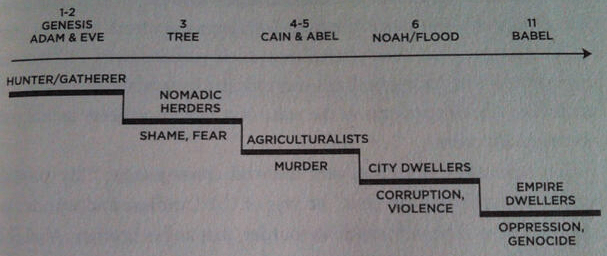
    Each step of socioeconomic and technological ascent thus makes possible new depths of moral evil and social injustice. (p. 50-51)

    As humans, with progress (implication of ascent) there is also loss (which in turn puts humans on a descent). Thereby, we now lose the vertical pattern of Platonic perfection-ideal as expressed through the Greco-Roman view of Eden but have a more progressive view of the Bible—a stepping stone, if you will.

    If Genesis sets the stage for the biblical narrative, this much is unmistakably clear: God’s unfolding drama is not a narrative shaped by the six lines in the Greco-Roman scheme of perfection, fall, condemnation, salvation, and heavenly perfection or eternal perdition. It has a different story line entirely. It’s a story about the downside of “progress”—a story of human foolishness and God’s faithfulness, the human turn toward rebellion and God’s turn toward reconciliation, the human intention toward evil and God’s intention to overcome evil with good. It begins with God creating a good world, continues with human beings creating evil, and concludes with God creating good outcomes that overcome human evil. We might say it is the story of goodness being created and re-created: God creates a good world, which humans damage and savage, but though humans have evil intent, God still creates good, and God’s good prevails. Good has the first word, and good has the last. (p. 54)

    If this view sets the stage for how to read the Bible, we are certainly in for a very interesting (and bumpy) ride.

    In Chapter 6, McLaren argues that the beginning of his quest to view Christianity through a new lens was shaped by his liberal arts education and bolstered by a lack of formal theology training. I found this quote interesting:

    Deconstruction is not destruction, as many erroneously assume, but rather careful and loving attention to the construction of ideas, beliefs, systems, values, and cultures.

    Merriam-Webster defines deconstruction this way:

    1 : a philosophical or critical method which asserts that meanings, metaphysical constructs, and hierarchical oppositions (as between key terms in a philosophical or literary work) are always rendered unstable by their dependence on ultimately arbitrary signifiers
    2 : the analytic examination of something (as a theory) often in order to reveal its inadequacy

    Deconstruction is not careful and loving attention to construction, no matter what McLaren says. Deconstruction is critical assessment performed in order to reveal inadequacies.

    But McLaren is openly stating that he’s reading the Bible through a literary lens where he can identify protagonists, antagonists, plot, tension, conflict, resolution, and character development.

    So as we head into Exodus, we read of a God who “sides with the oppressed, and God confronts oppressors with intensifying negative consequences until they change their ways, and in the end the oppressors are humbled and the oppressed are liberated.”

    I can’t help but comment that McLaren is back to nonliteralism now as he says God sends a “firm but gentle” plague on the Nile River that “turns red like blood.” But let’s read what Exodus 7:14-21 says. In fact, let’s use The Message version, Eugene Peterson’s paraphrase of what the Bible says:

    God said to Moses: “Pharaoh is a stubborn man. He refuses to release the people. First thing in the morning, go and meet Pharaoh as he goes down to the river. At the shore of the Nile take the staff that turned into a snake and say to him, ‘God, the God of the Hebrews, sent me to you with this message, “Release my people so that they can worship me in the wilderness.” So far you haven’t listened. This is how you’ll know that I am God. I am going to take this staff that I’m holding and strike this Nile River water: The water will turn to blood; the fish in the Nile will die; the Nile will stink; and the Egyptians won’t be able to drink the Nile water.'”

    God said to Moses, “Tell Aaron, ‘Take your staff and wave it over the waters of Egypt—over its rivers, its canals, its ponds, all its bodies of water—so that they turn to blood.’ There’ll be blood everywhere in Egypt—even in the pots and pans.”

    Moses and Aaron did exactly as God commanded them. Aaron raised his staff and hit the water in the Nile with Pharaoh and his servants watching. All the water in the Nile turned into blood. The fish in the Nile died; the Nile stank; and the Egyptians couldn’t drink the Nile water. The blood was everywhere in Egypt.

    The quote above is simply a paraphrase—someone’s interpretation of what is occurring in the Bible. I’m amazed that McLaren is so intent on reading the Bible non-literally that he tries to explain away what’s happening in the Bible through literal means: “Ironically, perhaps through a red tide, the Nile turns red like blood.” As a result of McLaren’s literary reading of Biblical passages, he begins to make literal assumptions about these passages that aren’t there.

    On page 58, McLaren says “God never works directly, only indirectly” and reduces the plagues often seen as something extraordinary and supernatural into nothing more than ordinary and natural. He diminishes the work of God.

    McLaren argues the Bible presents three narratives:

    1. God as creator
    2. God as liberator from external and internal oppression
    3. God as reconciler

    After reading beautiful literary passages from Hosea, Joel, and Isaiah, McLaren encourages his readers to see the future as something that “is not fatalistically predetermined” but rather see history as “live”—“unscripted, unrehearsed reality, happening now—really happening.” (p. 62-63) Here, McLaren rejects the premise of a predetermined, foreknown future by God (Jeremiah 29:11; Acts 2:22-23; Romans 8:28-30; I Corinthians 2:7; Ephesians 1:5,11).

    Then McLaren attempts to literalize Scripture within a modern framework despite saying, “As this approach relieves of literalistic interpretations, it frees us to let the poetry work as poetry is supposed to”:

    Swords into plowshares. Today that would mean dreaming about tanks being melted down into playground jungle gyms and machine guns being recast as swing sets. (p. 63)

    That’s just one example. It’s a clever reading of the passage but the fact of the matter is, McLaren is trying to take the literal, make it literary, and then convert the literary as the literal he wants to see. To put it bluntly, McLaren is reading things in the Bible that simply aren’t there.

    McLaren is very good at igniting passion and hope for a better tomorrow that seems as if it can occur today.

    If the Genesis story sets the stage by giving us a sacred vision of the past, and if the Exodus story situates us in the sacred present on a pilgrimage toward external and internal liberation, then the story of the peace-making kingdom ignites our faith with a sacred vision of the future, a vision of hope, a vision of love. It represents a new creation, and a new exodus—a new promised land that isn’t one patch of ground held by one elite group, but that encompasses the whole earth. It acknowledges that whatever we have become or ruined, there is hope for a better tomorrow; whatever we have achieved or destroyed, new possibilities await us; no matter how far we have come or backslidden, there are new and more glorious adventures ahead. And, the prophets aver, this is not just a human pipe dream, wishful thinking, whistling in the dark; this hope is the very word of the lord, the firm promise of the living God.

    Perhaps I’m not as optimistic or those darn Greco-Roman glasses keep getting in the way.

    Again, I appreciate McLaren’s attempt to read the Bible with a new perspective but there needs to be a balance between the literal and literary interpretations. I understand that some people Bible see the Bible as purely a literal work of God; others see the Bible as nothing more than a beautiful piece of literature. McLaren looks as the Bible as a beautiful piece of literature and then tries to recast it into a literal work with explanations that are a stretch. Frankly, McLaren’s attempt at a new kind of Christianity appears headed extremely off-course as I go into reading Chapter 7.