Love Wins Analysis: Chapter 2: Here Is the New There

[This is part III of a multi-part series on Rob Bell’s book, Love Wins.]

“First,
heaven.”

Image from onceuponacross.blogspot.com

“I show you this painting because, as surreal as it is, the fundamental story it tells about heaven—that it is somewhere else—is the story that many people know to be the Christian story.”

The painting above isn’t the black-and-white replica that Bell has in his book but it’s pretty close and retained the same ideas.

Bell’s point in Chapter 2 is to challenge the reader’s conceptions about heaven and all that they’ve heard or think (or know) to be true. He references the parable of the rich man who wants to know how to get eternal life. According to Bell:

“When the man asks about getting ‘eternal life,’ he isn’t asking about how to go to heaven when he dies. This wasn’t a concern for the man or Jesus. This is why Jesus doesn’t tell people how to ‘go to heaven.’ It wasn’t what Jesus came to do.

Heaven, for Jesus, was deeply connected with what he called ‘this age’ and ‘the age to come.'”

Bell’s references to “this age” and “the age to come” become foundational to Love Wins:

“We might call them ‘eras’ or ‘periods of time’:
this age—the one we’re living in—and the age to come.

Another way of saying ‘life in the age to come’ in Jesus’s day was to say ‘eternal life.’ In Hebrew the phrase is olam habah.

What must I do to inherit olam habah?

This age,
and the one to come,
the one after this one.”

Bell defines ‘age’ further:

“Now, the English word ‘age’ here is the word aion in New Testament Greek. Aion has multiple meanings… One meaning of aion refers to a period of time, as in ‘The spirit of the age’ or ‘They were gone for ages.’ When we use the word ‘age’ like this, we are referring less to a precise measurement of time, like an hour or a day or a year, and more to a period or era of time. This is crucial to our understanding of the word aion, because it doesn’t mean ‘forever’ as we think of forever. When we say ‘forever,’ what we are generally referring to is something that will go on, 365-day year, never ceasing in the endless unfolding of segmented, measurable units of time, like a clock that never stops ticking. That’s not this word. The first meaning of this word aion refers to a period of time with a beginning and an end.

So according to Jesus there is this age, this aion
the one they, and we, are living in—
and then a coming age,
also called ‘the world to come’
or simply ‘eternal life.'”

When Bell has paragraphs that meaty, they beg to be explored. Continue reading “Love Wins Analysis: Chapter 2: Here Is the New There”

Love Wins Analysis: Chapter 1: What About the Flat Tire?

[This is part II of a multi-part series on Rob Bell’s book, Love Wins.]

Here is a summary of Chapter 1 for you:

For real. When I began reading Chapter 1, I thought to myself, I’ve read this already. No, I hadn’t. But I’d heard it before through Bell’s video dramatization. (Most of his speech is derived from Chapter 1.)

And so I breeze through Chapter 1 because yes, some of it I’ve heard before but then there are parts that make me wince:

  • Renee Altson’s experience of being raped by her father while reciting the Lord’s Prayer and assorted Christian hymns
  • The Eastern European Muslim who refuses to set foot in a Christian Church in America because the Christians in his country rounded up all the Muslims and executed them
  • The Christians who stand on a busy street corner with signs, screaming into bullhorns about judgment and hell

Bell goes through a list of possible things on how one gets to heaven. Actions? Behaviors? He even picks apart the “personal relationship with Jesus” answer that many Christians offer.

“The problem, however, is that the phrase “personal relationship” is found nowhere in the Bible.”

Bell has me in agreement with him on this issue. So far. Then he has to go and ruin it by saying the following:

“Nowhere in the Hebrew scriptures, nowhere in the New Testament. Jesus never used the phrase. Paul didn’t use it. Nor did John, Peter, James, or the woman who wrote the Letter to the Hebrews.”

Did you see how he ruined it for me? Continue reading “Love Wins Analysis: Chapter 1: What About the Flat Tire?”

Love Wins Analysis: Introduction & Preface

[This is a multi-part series on Rob Bell’s book, Love Wins.]

I could say that I read 198 pages of a mind-bending Q & A & Q book. If Love Wins were a movie, it would be Inception.

Great script. Lots of confusion. And there’s never-ending speculation about how it ends.

I suppose I should warn readers that Love Wins isn’t my first experience with Rob Bell’s books. I read Velvet Elvis upon the recommendation of a friend and loved it so much that I bought my own copy. I hope to reread Velvet Elvis again next year, but I remember wanting to give it 5 stars because it was that good.

Love Wins… not so much. But not for the reasons you’d think or the ones that have been commonly cited.

  • Does Bell deny the existence of hell? Eh, kind of, not really.
  • Does Bell assert that Jesus is the only way to heaven? Well… yeah.
  • Is Bell a universalist? Eh… yes and no. That’s a loaded question that requires explanation and is never explained quite clearly (to me anyway).

The reason I nearly loathe Love Wins and probably will never read it again is… are you ready for this? Continue reading “Love Wins Analysis: Introduction & Preface”

God Is Using Rob Bell for His Glory

There are a ton of blogs that are currently bashing Rob Bell, labeling him as a universalist, bewailing that he’s walked away from the orthodox Christian faith, and written him off as a heretic.

I see Rob Bell being used of God in unimaginable ways to His honor and His glory.

Bell has jumpstarted the conversation on heaven and hell—who gets to those places and who doesn’t. His recent book, Love Wins, and interviews have challenged Christians to coherently defend what they believe (I Peter 3:15) on this issue. It used to be easy to say “Those who believe in the gospel of Christ go to heaven; those who don’t go to hell.” But now Christians have been challenged to put an attitude of love behind this statement or whatever they believe about hell, and that’s not so easy.

I’m not sure I agree with Mr. Bell on many aspects of this issue. (I’ll reserve definitive judgment until I complete my reading of his recent book.) I believe Scripture is clear that hell exists in some form: whether it be the literal torment of hellfire and brimstone or simply eternal separation from God (which would be a colloquial description of “hell” compared to heaven in God’s presence) as exemplified through C.S. Lewis’s The Great Divorce. Perhaps Mr. Bell believes this too.

Mr. Bell’s aims, however orthodox Christians may interpret them, are noble. (Some may use the terminology “sincerely wrong” here.) Bell, with Love Wins, is attempting to bridge that nasty gap between Christians who seem to say “Nanny nanny boo boo, I’m going to heaven, and you’re going to burn in a lake of fire” and unbelievers who think “even if I live a good life, remain a law-abiding citizen, and don’t blaspheme God, I still go to hell? That’s just not fair.”

It’s not. And the truth is, God isn’t fair.

But Christians need to be sensitive to the fact that the doctrine of hell is an offensive doctrine and any explanation of it should come from an attitude of love and not one of haughtiness. This is what Mr. Bell is attempting to do. I give him tons of credit for the attempt. Whether the execution comes off well (in my opinion) will remain to be seen.

12 Things You Probably Didn’t Know About Your Public Library

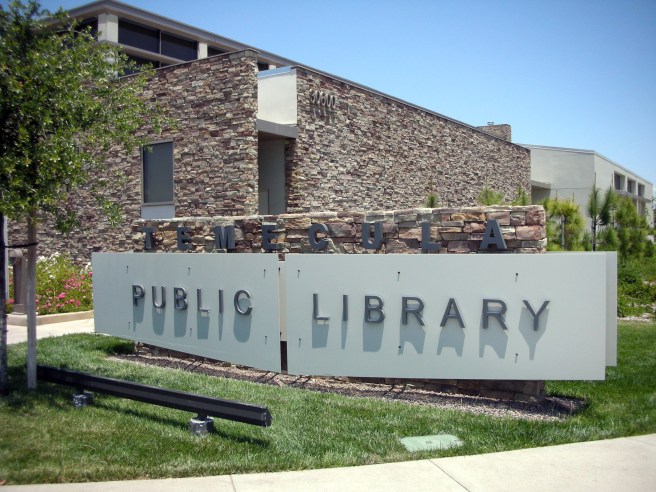
Temecula Public Library (Calif.) image from http://www.leightongeo.com

Taking a detour to more lighter-hearted fare, I wanted to add a bit of insight into Things You Probably Didn’t Know About Your Public Library. Dale Spindel over at “Hey, There’s a Dead Guy in the Living Room” posted two wonderful posts about misperceptions at public libraries (see first post and second post).

Spindel hits the nail on the head on some of these. I began working at a library last summer and absolutely love it! I love helping people find what they need and providing quality customer service to every person. (In fact, I am considering going for a Master’s in Library Science next year as a result.) I’ll probably reiterate a few points Spindel had but also add a few of my own: Continue reading “12 Things You Probably Didn’t Know About Your Public Library”

Ten Things Your Public Librarians Won’t Tell You

Image from acuratedlifestyle.blogspot.com

1. We are not stupid. We know when you are gaming the system. We know when you are trying to be deceitful. And we will monitor you if you raise suspicion or seem consistently dishonest.

2. When you come to the checkout counter (aka circulation desk) with more than 5 CDs at time, we pretty much know you’re burning these CDs on your machine but it’s not our job to police you.

3. We would really, really appreciate it if you stopped using that big floppy disk that has virtually nil storage capacity compared to a tiny flash drive that has tons of storage. In this case, bigger is not better.

4. It’s almost always not a stupid question.

5. We know that you swear on your dog’s life that you returned that book and returned it on time, but if we can’t find it on our shelves, we’re pretty certain it’s still in your possession in some form, most likely under a seat in your car. Please check and double-check under the seats in your car before adamantly insisting that you’ve returned an item.

6. You are responsible for a borrowed library item in your possession. As a result, we will hold you responsible if it is returned damaged or missing in any way (eg, water damage, cracked CDs, missing DVDs from a set, an unidentifiable sticky substance we do not want to touch without using a biohazard suit).

7. We love talking to our patrons and spending time with them at the circulation desk, but be conscientious of others. Sometimes lines quickly and quietly form behind right behind you and it’s not pleasant for another person to be kept waiting because you want to keep talking. If you really want to keep talking, at least move to the side so we can speedily assist the next person but really everyone would prefer it if you saved the conversation for a less busy time.

8. Please do not shelve things yourself. You’ll most likely put it back in the wrong place and cause undue distress to others because it can’t be found. If you pull any library item off a shelf and choose not to check it out, please ask the staff where you should place it. In some libraries, there are carts for depositing items you do not want. If this is not the case, leave the items on an empty table or (even better!) bring it to the circulation desk and tell the staff you don’t want the items.

9. We are not tax advisors. Do not get huffy when we cannot offer tax advice beyond the location of your tax forms. (Actually, some librarians might be cheeky enough to tell you this.) Some libraries have third-party tax assistance that comes in and helps patrons with tax inquiries; ask your local library whether this is a service it offers. In addition, do not get huffy with us if we have run out of tax forms. We do not poop out these documents on site and we are not intentionally withholding them from you; they are provided to us by the government who would prefer that you file electronically by walking into H&R Block or using Turbo Tax. Blame them, not us.

10. Using the library is a privilege. If you rack up fines, pay them. If they’re extremely excessive, you may be able to negotiate them down some by speaking to the person who oversees circulation. If the fines are constantly excessive, we lose patience and sympathy. Take care of the items that are loaned to you (remember rule #6!), return them within the allotted time frame (or pay promptly if returned late), and be courteous to staff.

If the library is your primary source for books and other media, then you need library staff to be your “friends.” Being a nice, courteous patron goes a long way and staff will go out of their way to make your visits pleasant and satisfactory. Be a consistently rude or difficult patron… well, don’t be surprised if all your library experiences suddenly become harrowing.

I’m reading a book… [video]

Image from failblog.org

The library makes a cameo in the video below. See, kids? There IS a place kinda like Netflix and Blockbuster where you can rent books instead of having to buy them from Barnes & Noble or Amazon. What a revolutionary concept!

Here, There, and Everywhere

“To lead a better life, I need my love to be here.”


I have a bunch of things I feel like writing about but they’re not topically related so here’s my mishmashed post.

Music.

I am enjoying listening to Danger Mouse’s new group, The Broken Bells. Hat tip to Derek Webb on that one.

Theology.

Up on The Resurgence blog this week:

Question 74 – Should infants, too, be baptized?
Answer – Yes. Infants as well as adults belong to God’s covenant and congregation. (Gen. 17:7; Matt. 19:14) Through Christ’s blood the redemption from sin and the Holy Spirit, who works faith, are promised to them no less than to adults. (Ps. 22:11; Is. 44:1-3; Acts 2:38, 39; 16:31) Therefore, by baptism, as sign of the covenant, they must be grafted into the Christian church and distinguished from the children of unbelievers. (Acts 10:47; I Cor. 7:14) This was done in the old covenant by circumcision (Gen. 17:9-14), in place of which baptism was instituted in the new covenant. (Col. 2: 11-13)

I seriously struggle with the idea of infant baptism also known as paedobaptism. I am a member of the Presbyterian Church in America (PCA) and appreciate that I do not need to agree with the concept of paedobaptism to be a member of the covenant community. I’m not even fully convinced that I hold to covenant theology but that’s too broad of a matter to tackle within the subject of paedobaptism.

The best case I’ve seen for infant baptism has been presented by Greg Bahnsen here. But again, it’s not that I’m not open to viewing infant baptism as scriptural or that I am adamantly opposed to it per se but I find that there is a clearer Biblical case for believer’s (or as some have called it, “professor’s”) baptism.

Perhaps, however, if I fully subscribed to covenant theology and saw baptism as a replacement for circumcision, then infant baptism would make logical sense. As a Christian who previously subscribed to dispensational theology, the jump to covenant theology is not easy. (Here’s a chart for a comparison between the two. However, I did stumble upon this, and from a quick glance, it would seem like I agree more with New Covenant Theology.)

Scripture.

Relevant Magazine had an article on the most misused verse in the Bible:

Jeremiah 29:11 that says, “‘For I know the plans that I have for you,’ declares the LORD, ‘plans for welfare and not for calamity to give you a future and a hope.”

I thought the article had great insight, especially given that as humans, we have a tendency to look at God as a vending machine: pop our prayer request in the coin slot and wait for our requested result. The author expounds on the context surrounding this oft-quoted verse which shows this verse is not telling readers that God will give us whatever we desire.

Stay-at-home dads.

Matthew Paul Turner at JesusNeedsNewPR tweeted a link to Nicole Wick’s post about Mark Driscoll who bashed stay-at-home dads.

The video is a little old but I was surprised to hear this view from Driscoll given the fact that I usually agree with him. The fact that he was only willing to make “rare exceptions” for men to stay at home to take care of the family was rather appalling to me. In this economic climate and culture, it’s possible for wives to have a better-paying and steadier job than their husbands. In that case, the right way for a husband and father to provide for his family is to let his wife bring in the necessary income for them so that he can be at home rearing the children. (We are assuming in this scenario that the parents have decided they will live off of one income so that one of the parents can be home to raise the children.) An ideal situation would be for a mom to be at home with her children (should she choose to do so) but that is not always the case and I don’t believe that it must always be the case. Driscoll is way off the mark here.

Miscellaneous.

I think there’s more a-brewin’ in my head but the words are all jumbled and I can’t get them out coherently. Some other things going on:

  • I’ll begin editing on my novel soon so that will be quite a challenge. (See hard copy mess in right photo.)
  • I’ll be leading the women’s weekday Bible study during the summer so that’s another exciting thing on the horizon.
  • I’ll also be part of a book club in which we’ll we reading Ed Welch’s When People Are Big and God Is Small. I read through it for the third time last year but highly enjoy the book and find that it’s chock full of wisdom to the point where I don’t mind reading through it again.
  • My husband and I may be going on a trip to Cancun during the summer with my paternal cousins, which I’m highly looking forward to so that I can establish solid relationships with them.

Perhaps you didn’t care to know all that but it made me feel better to type it out.

Occasional posts on Brian McLaren’s A New Kind of Christianity

I’m reading through Brian McLaren’s A New Kind of Christianity and will post my thoughts on my blog as they strike me. You can find the first one here: http://bit.ly/8YYns6. I am working on a second.

For blog posts from a Biblical counseling perspective, please follow Bob Kellermen’s series.

Books I’ve Read in 2009

Here’s a list of books I’ve read in 2009. More a list for myself than for the rest of the world but feel free to offer comments if you’re so inclined.

  1. Transforming Grace by Jerry Bridges
  2. When People Are Big and God Is Small by Ed Welch (3rd read)
  3. God’s Plans For You by J. I. Packer
  4. Relationships by Tim Lane & Paul Tripp
  5. The Book Thief by Markus Zusak
  6. Holy Ground: Walking With Jesus as a Former Catholic by Chris Castaldo
  7. It’s Your Time by Joel Osteen
  8. Velvet Elvis by Rob Bell
  9. Jesus, Keep Me Near the Cross by Nancy Guthrie
  10. Come, Thou Long-Expected Jesus by Nancy Guthrie 
  11. Sacred Marriage by Gary Thomas
  12. Pride and Prejudice and Zombies by Jane Austen and Seth Grahame-Smith
  13. Counterfeit Gods by Tim Keller

I actually think I’ve read more than that but that’s what I’ve got off the top of my head for now. I’m actually surprised at how much I’ve read this year. I usually start a lot of books but never finish them but with the exceptions of those noted “in progress,” I’ve completed the reading of all those other books this year in their entireties. Also, I most recently enjoyed Holy Ground (which is the book I’ve most recently completed). Here’s a brief commentary: Continue reading “Books I’ve Read in 2009”