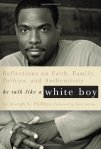
 I recently completed reading Joseph C. Phillips’s book, He Talk Like A White Boy. You may best remember Mr. Phillips as Lt. Martin Kendall, Denise’s husband, on The Cosby Show.
Now, I gotta be honest. I picked up the book for two reasons:
- He was one of few black men I always thought looked handsome (even as a kid!).
- The title.
I don’t remember how I initially happened upon it but a few years back, I stumbled across the book, saw the title, and thought to myself, This is on my must-read list before I die. I’m glad to say I wasn’t disappointed.
The title of He Talk Like A White Boy juxtaposed with the image of a black man resonated a chord with me. I instantly thought, I have got to read this. Black people have told me all my life that I talk like a white person. I can identify with this.
And identify I did.
Although 20 years of age separate us, it’s amazing how he was able to relate his experiences from things that occurred in the 60s and 70s, only for me to identify with much of it having grown up in the 80s and 90s.
The book seems to be a collection of essays that he’s written in the last decade (the book was published in 2006) so it was divided up into five primary sections:
- Character
- Family
- Faith
- Idealism
- Identity
But before I even cracked open the book, I read the book jacket. Apart from acting, Phillips also works as a conservative commentator and was a heavy supporter of George W. Bush. Knowing that made me cringe. (If I’m honest, I still do.) But I determined that I would give Phillips a chance to speak to me on politics. Even though I’m not wholly a conservative, I feel that black conservatives are some of the most disdained members in the political arena. Keeping this in mind, I decided to be, you know, tolerant.
While I enjoyed reading the first three sections, I most enjoyed the latter two. (Although, admittedly, the book got progressively better going through each section.)
Once I stumbled upon the essay Black Conservatism, Black Pride at the beginning of the Idealism section, I took a deep breath before I began. Be tolerant and open-minded, I told myself. You never know what you might learn.
I indeed learned quite a bit. Despite the fact that I am not a Dubya fan, I am willing to give credit where credit is due. Phillips pointed out that Bush II had the most racially diverse presidential administration in the nation’s history up until the Obama administration. And despite all cries that Dubya was a committed racist, he consistently had a black Secretary of State during each term he held. (He could have easily replaced a white person in Colin Powell’s spot after Mr. Powell resigned.) So I’ll give Dubya credit for having the most diverse administration of his day.
Phillips also goes on to speak about Dubya’s journey to Africa and the money he pledged to fight HIV/AIDS and terrorism in the country. For a president who many cried were racist (especially as a result of Katrina), Bush II appeared to be more of a friend to black people than he is given credit for.
*Discuss Black Conservatism, Black Pride – how he could not be a Republican back in the civil rights era, how it’s okay for blacks to believe whatever they want on the political spectrum (my view)
*Discuss Reparations, Affirmative Action, how he attacks inherent racism in Hollywood and liberals
*Then speak of identity – how it impacted me and how I was able to relate to it: Black & White, especially.

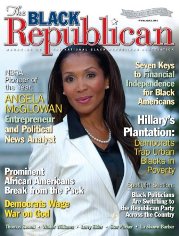 I will not be a Black Republican because I prefer the path of least resistance. I am not a trailblazer, and I don’t like going against the grain. However, I don’t like President Obama’s pro-abortion policies, and I do not think this country is better off after four years of having him as president. However, I do support the Democratic Party platform of marriage equality for gays. But I also don’t want to be told to vote for Obama.
 This Journey Is My Own