The American emergent movement and postmodernism: Introduction & Part I

http://www.smallfire.org/cota_ordo.html

I’ve written a series on the American emergent movement, its brief history, its lack of definition, its connection to postmodernism, and its effect on cultural Christianity in the United States. It’s possible to read up on the emergent movement and feel like you’re spinning your tires in a ditch. I’ve tried my best to avoid that in this series and provide some kind of clarity on the subject.

I tackle a multitude of things, which may or may not become clear through this series:

  1. My experience at a postmodern/emerging worship service
  2. The Emergent Church’s history & definition (or lack thereof)
  3. The unofficial buzzword of the movement: conversation
  4. The Emergent Church’s connection to postmodern philosophy
    • Definition of modernism
    • Definition of postmodernism
    • Definition and essence of postmodern philosophy
      • Rooted in criticism and critique
      • Rooted in a shift away from superiority and toward equality
    • Discarding the label “postmodern Christianity”
  5. The identical foundations between secular postmodernism and the emergent movement
    • Criticism and critique are at the heart of each movement
    • Neither movement has a clear, determinate meaning
    • Both movements seek deconstruction in some fashion
  6. The theme of Christianity as a running narrative or an unfolding story
  7. Distinguishing between emergent and emerging (according mainly to Mark Driscoll, pastor of Mars Hill Church in Seattle)
  8. How the emergent movement affects my life
    • My experience reading Rob Bell’s Velvet Elvis
  9. Impact of the emergent movement
    • Cultural relevancy in domestic missions
    • Expansion of faith post-legalism without it falling apart
    • Influence on Christian dress
    • Influence in Christian art
    • Its possible effect on long-term Christianity

This might as well become a Wikipedia entry in and of itself. My hopes are, however numerous or few of you, that you’ll be able to read through this series with some degree of ease in order to gain a fuller understanding of the emergent movement. My apologies in advance if I fall into emergent-speak that is at all unclear.

For the past day or two, I’ve been doing some research and reading on the Emergent Church and postmodernism. My husband, baffled by my sudden interest in the movement, asked why. I explained that the Emergent Church (which, by the way, isn’t really an institutional church, just a term assigned to the emergent movement) and its connection to postmodernism has become pervasive in Christian culture. I’ve seen it in the blogs and books I read, I see it in some cutting-edge, hip magazines, and I see it in some worship services. The emergent movement’s influence is one of those things that I’ve been able to see but have not been able to define. So, I’ve suddenly become filled with the desire to define it.

How is one able to “see” the emergent movement without being able to define it? Consider the following experience: Continue reading “The American emergent movement and postmodernism: Introduction & Part I”

Bible verse of the week

My husband and I visited a local church nearby and the verse the pastor preached on resonated me:

“Peace I leave with you, My peace I give to you; not as the world gives do I give to you. Do not let your heart be troubled, nor let it be fearful.” —John 14:27

The pastor went on to explain what kind of peace Jesus was talking about and how personal that peace had become to him, especially since the pastor’s mother had passed away at 5:45 this morning.

This resonated with me as well since peace has been something I have been praying about. The two non-sin issues I struggle with most in my Christian walk are joy and peace but especially peace. As a person who suffers from depression and anxiety, naturally joy and peace are what I would seek most.

It is comforting to know that there is peace in Jesus Christ: the peace of knowing him, and the peace of that final destination as a result of knowing him. It is not the peace that the world gives or hopes to give but that blessèd assurance that all is well with my soul.

I now know the peace Jesus speaks of and realized I’ve had it all along in my Christian walk but like the disciples, kept looking for the wrong kind of peace—the world’s peace. It’s possible to be a believer and never experience the peace that rests inside you because you are searching for the world’s peace and not the peace Jesus speaks of.

I can best describe this peace, not as a warm, fuzzy feeling or a moment of tranquility but rather an assurance that in the face of trials, tribulations, natural disasters, rampant disease, and death, I know what the end will be because I know Who I serve. It’s quite a different peace than the one I was seeking and not at all what I expected. And because I am a sinner, prone to being tossed to and fro in the waves of life, my peace will also be shaken—mainly because I will be seeking after that worldly peace. But if I keep my eyes on Jesus through this journey of life, my peace will remain sure and solid—moreso than the ground I stand on.

And that’s what I must remember: my faith is a journey. I will not be perfect all the time but if I challenge myself to tuck that verse away in my heart, perhaps I will remember a bit more often what true peace is.

Personal thoughts on Tim Keller’s book, Counterfeit Gods

I recently published a book review on Tim Keller’s book, Counterfeit Gods, but wanted to write a post that is a bit more personal in nature. I left off with this:

To dethrone any and all other idols apart from God, Jesus’ sacrificial death on the cross must be real. The heart of the matter can be summed up in this question:

What is operating in place of Jesus Christ as your real, functional salvation and Savior?

It is a question that Christians should not neglect to ask themselves every single day.

The cynic in me struggles with this. God knows how much I am very much a doubting Thomas, plagued with questions like:

  • “Jesus, were you real?”
  • “Are you really coming back?”
  • “How come you haven’t done anything for so long?”
  • “Can the compilation of what people claim to be Your word (the Bible) really be trusted?”

I’ve come to the realization that I am the very least, a Jew. (Yeah, go ahead and make a Sammy Davis, Jr. joke now.) I believe wholeheartedly in the Old Testament. But the more I think about it, the more the Old Testament constantly points back to Jesus. (The Book of Matthew is a great book for discovering how the Old Testament continuously points to Jesus.)

Now while the Pharisees were gathered together, Jesus asked them a question: “What do you think about the Christ, whose son is He?”
They said to Him, “The son of David.”
He said to them, “Then how does David in the Spirit call Him ‘Lord,’ saying,

‘THE LORD SAID TO MY LORD,
“SIT AT MY RIGHT HAND,
UNTIL I PUT YOUR ENEMIES BENEATH YOUR FEET”‘?”

If David then calls Him ‘Lord,’ how is He his son?”
No one was able to answer Him a word, nor did anyone dare from that day on to ask Him another question. ~ Matthew 22:41-46

A puzzling question to me as well.

So the basic hurdle that I am confronted with is whether I believe fully in Jesus Christ, who he is, and his purpose for being born on earth–his existence as fully human and fully God; that he is the Son of God, born to a virgin, lived, died on a cross bearing God’s wrath for the sins of humankind, was buried, and rose again three days later. If I accept this (and I do), then I also accept that the triune God alone is worthy of worship, leading me to adhere to the following commandment:

You shall love the Lord your God with all your heart, and with all your soul, and with all your mind. ~Matthew 22:37

This is not in conflict with the first commandment God issues (located in Exodus and Deuteronomy):

I am the LORD your God, who brought you out of the land of Egypt, out of the house of slavery. You shall have no other gods before Me.  ~Exodus 20:2-3 & Deuteronomy 5:6-7

Jesus reiterates that God must take the primary place in our heart, soul, and mind. He is to be the only One people worship. He must constantly occupy our daydreams and imaginations even. I quoted this passage from Keller’s book in my previous post but it strikes and convicts me so that I feel compelled to repost it:

Archbishop William Temple once said, “Your religion is what you do with your solitude.” In other words, the true god of your heart is what your thoughts effortlessly go to when there is nothing else demanding your attention. What do you enjoy daydreaming about? What occupies your mind when you have nothing else to think about? Do you develop potential scenarios about career advancement? Or material goods such as a dream home? Or a relationship with a particular person? One or two daydreams are no [sic] an indication of idolatry. Ask, rather, what do you habitually think about to get joy and comfort in the privacy of your heart?

If I’m honest, I must admit God does not constantly occupy my thoughts as He should. I also frequently fail to follow this directive from the apostle Paul as listed in Philippians 4:8:

Finally, brethren, whatever is true, whatever is honorable, whatever is right, whatever is pure, whatever is lovely, whatever is of good repute, if there is any excellence and if anything worthy of praise, dwell on these things.

How often do I dwell on the things that are false, dishonorable, wrong, impure, ugly, and bad repute, full of mediocrity and worthy of condemnation!

As a result, I’ve instantly created an idol. Keller writes:

Idolatry is not just a failure to obey God, it is a setting of the whole heart on something besides God.

In my previous post, I listed all the idols Keller identifies. While I’ve struggled with many of those idols at one time or another, these are the main idols that currently dethrone God in my life: Continue reading “Personal thoughts on Tim Keller’s book, Counterfeit Gods”

It’s Your Time Book Review: Dump this book, Discard much of what you learn, Desist reading

Inspired by this post from Matthew Paul Turner, basically making fun of Pastor Joel Osteen’s (NOT OLsteen, maybe LOLsteen) new book, It’s Your Time and a one-star review on Amazon in which the “reviewer” essentially wrote that Osteen was a fraud, he hadn’t read the book, and never intended to read the book (the review’s since been taken down), I felt prompted to go where most Biblical evangelical Christians choose not to go.

I decided to read Joel Osteen’s latest book to see if dollar signs would really begin flashing right before my eyes. However, I need to add a disclaimer of a sort:

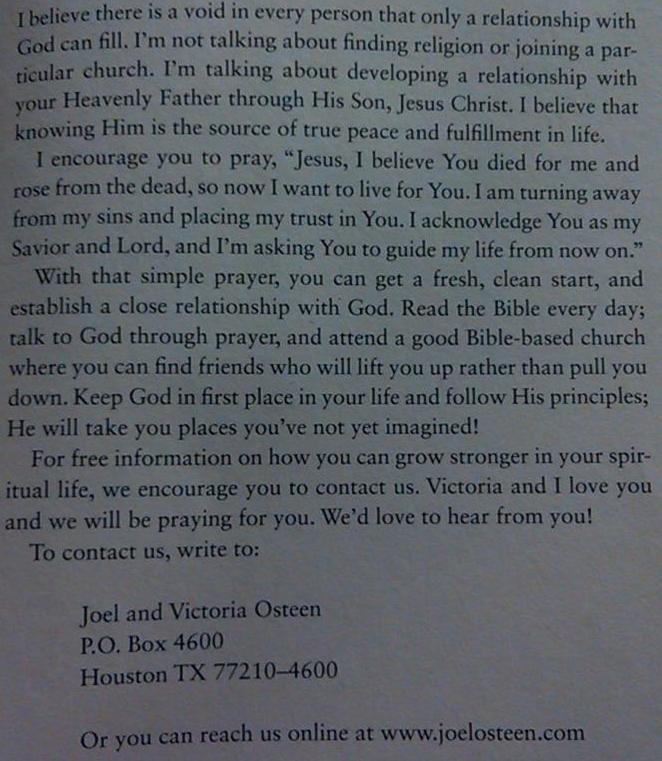
Last page with text in "It's Your Time"I am a little sensitive to Joel Osteen and his ministry and likely not as hard as I should be. Thank my mother. I believe that God used Pastor Osteen’s ministry to bring my mother to a saving knowledge of Jesus Christ. She was hesitant for many, many years but after watching Pastor Osteen regularly, softened up, accepted Jesus as her Lord and Savior, and now regularly attends a local Bible-believing church. I have seen Osteen’s telecast and at the end, he does give an invitation (though many Biblical evangelicals would consider it a weak one) to accept Jesus. Although the criticism is that Jesus is secondary to his preaching of the “health and wealth” gospel,” which we’ll get to later on in the review. (Click on the photo on the left to enlarge it and essentially read the “invitation” Joel Osteen provides.)

I wrote an unfinished review of It’s Your Time and was probably more favorable to it than most Biblical Christians would have been. So now that I’ve completed this book, how would I rate it overall?

Two stars.

What were the issues then that led me to give this book a rating comparable to “poor”? Quite a bit. Sit back and have a nice cup of coffee or tea as you review this list with sometimes lengthy explanations. Continue reading “It’s Your Time Book Review: Dump this book, Discard much of what you learn, Desist reading”

Still searching for an identity… part 4

Faith, religion, God.

I’m currently reading Joel Osteen‘s latest book, “It’s Your Time” and annoying the Twitter world with my #ItsYourTime-related tweets. I subscribe to a brand of Christianity that does not subscribe to Osteen’s brand of Christianity. So why am I reading this book if I don’t agree with him? Several reasons actually:

  1. Curiosity. It’s fun to make fun of what we know of the guy but has the message changed?
  2. Legitimate criticism. I tire of Christians panning books they’ve never read and never intend to read. I want to legitimately pan–or extol (unlikely, though)–Osteen’s book.
  3. Amusement. His optimism amuses me. He’s easy to make fun of and his anecdotes are sometimes hilarious.
  4. Thought-provoking. In a twisted mode of thought, I enjoy finding verses and passages that are distorted or examples that are taken out of context. Makes me feel like a mini-theologian. 🙂

The trouble with Osteen’s book, however, is that there’s a lot of truth in it but there’s enough wrong to make it bad.

I’ve been assuming the majority of my readers are Christians who know about Joel Osteen in some way. Maybe you’re not a Christian or you’re simply not familiar with Mr. Osteen. Well, let me introduce you.

Osteen, in a nutshell, is considered by his supporters as “America’s voice of hope and encouragement” while his critics deem him as a proponent of the prosperity “health and wealth” gospel. Indeed, I can see truth from both sides.

Osteen writes in a very personable way, which makes it feel as though he’s speaking specifically to each reader. If a person is feeling discouraged, no doubt, Osteen has the gift of encouragement. (Even renowned evangelical Mars Hill pastor Mark Driscoll has said such!) Osteen is the ultimate optimist. (Sometimes, he’s so optimistic, it’s sickening.) I’m very much a cynic and a pessimist. I really have no business reading this book.

But there are scriptural truths that he does point out that I, as a pessimist, tend (and prefer) to overlook. For example, God tells us to ask Him for anything. (Matt. 7:7-11) And Osteen can even legitimately use Matthew 21:22 (“And whatever things you ask in prayer, believing, you will receive”) if he so desires. I’d argue in favor of Osteen if someone tried to tell me Matthew 21:22 wasn’t a straightforward verse. (Even taken in its context.)

However, where Osteen errs is by leading readers to believe that God will “fulfill all the desires of your heart.” (Psalm 37:4) If we look at the entire verse, which says, “Delight yourself also in the LORD, and He shall give you the desires of your heart,” it implies first “delighting in God.” When believers delight themselves in God (and the things He’s after), the desires of their heart will align with the desires of God’s heart, not the desires of our sinful lusts. James 4:2-3 again confirms this by saying:

You lust and do not have. … You do not have because you do not ask. You ask and do not receive, because you ask amiss, that you may spend it on your pleasures.

Christians sometimes have this fallacious belief that God does not answer prayer. Not so! God does answer prayer with a yes or no. Sometimes he doesn’t always answer right away but he does eventually answer our requests. Often, some people take a “no” response to really mean “no answer” because we keep hoping He’ll say “yes.” I can pray my little heart out to be as rich as Bill Gates one day. It’s legitimate to ask for it since I can ask for anything. However, I must also realize it’s legitimate for God to flat-out–or take His time in saying no.

Has Osteen’s book helped me to dream a bit bigger? Well, yes–cautiously.

Osteen has a pretty big God and I think Osteen’s critics sometimes view through the lens of cynicism and try to make God so much smaller than He really is. Truth is, no one can contain God–not you, not me, not Osteen, and definitely not Osteen’s book or sermons. Can God bestow much wealth and restore full health upon you? He sure can; I believe that. Will He? I don’t know but the likelihood of obtaining exceptional wealth is slim. (When I mean “wealth” here, I’m referring to the Americanized definition of “massive accumulation of wealth,” which is the language Osteen uses.)

And that’s where I have a problem with Osteen. Can God do anything? Yes. Will He do anything and everything simply because I ask Him to? No. God is not a magic genie we must rub the right way. This becomes a works-based, legalistic theology. People must obey God simply because He is God. He created all things and therefore gets to make the rules whether we like it or not.

But Osteen tells his readers if they believe they’ll receive whatever they ask for and have enough faith, it will happen. He can support this with Matthew 21:22, remember? How do you refute that?

Osteen’s book so far has challenged me to have more faith in what I pray for. Not some lackadaisical half-hearted faith (“Well, I’ll pray for it, but it likely won’t happen.”) but a real, bold faith that could position me for embarrassment if it doesn’t happen (“I prayed for it and have NO DOUBT it’ll come to pass!”). I’m challenged to pray with confidence, not expecting disappointment but with a realistic mindset that my prayers may not be answered exactly the way I’d like them to be. (I prayed fervently for an Italian husband and got NOWHERE CLOSE to that. But I wouldn’t trade my husband of Anglo-Sax/German heritage for any other man.) God’s ways and wisdom are so much higher than mine. He’s a better judge of good things that I could ever be.

Relationship with God.

Lately, I’ve felt like a Christian in name only (CINO). I hear all these stories of how Christians are told by non-Christians that they “are different” and that “there’s something special” about them they’d like to also have. That has never, ever happened to me. I’ve never been able to “lead” one person to the Lord. Does that make me a terrible Christian?

I know Christians are supposed to be “in the world and not of it.” I always got the impression that the life of a Christian would look different than that of a non-Christian–in a positive way. However, when I evaluate my life, I’m troubled that I can’t tell a marked difference than that of my neighbor who doesn’t go to church. And I don’t mean simply n a public level; I also take my private life into consideration. I don’t get on my knees by my bed to pray every night. In fact, my prayers are sometimes quick requests made in passing throughout the day. I don’t have consistent devotions daily. (There’s that lack of consistency thing again.) I can sometimes go days without talking to God or reading His word. I know my eternal salvation doesn’t depend on me (and thank God it doesn’t because I’m doing a lousy job right now) but James emphasizes “faith without works is dead” (2:17, 26). What good is the salvation I have if I don’t put it into action? My life in Christ needs to be alive and vibrant–and I’m at a total loss as to how to do that. (Remember my little problem with consistency and regularity?)

I want to be different for God. I want to be a God-honoring Christian. I want to put my faith in action. I want to have a close, personal relationship with God. I want to revere God better than I revere any celebrity but I also want to be comfortable with Him like He’s my “homie.” So comfortable I can cry, “Abba, Father, Daddy” (Rom. 8:15, Gal. 4:6) in the most personal and familiar of terms.

Until then, I feel as though I am back at square one like when I was Catholic 12 years ago–CINO. I am hungry and desperate for a savior. I want–perhaps need–to accept Jesus all over again. Maybe daily.

Isn’t consistency key?
—————-
Now playing: Sara Groves – Maybe There’s A Loving God
via FoxyTunes

A masterful, descriptive definition for Biblical Counseling

Biblical counseling involves identifying our original design, diagnosing how we fall short of that design, and dispensing God’s grace to empower people to mature into the dignified likeness of Christ, the image of the invisible God.

Read more at Grace Dependent.