“All I Want Is You”

You say you’ll give me eyes in the moon of blindness / A river in a time of dryness /A harbour in the tempest / All the promises we make / From the cradle to the grave / When all I need is you
~ U2, “All I Want Is You” ~

The past few days have been a bit strange. I’ve gotten the sense that even though I’ve tried to turn my back on God and walk away from Him, it’s like I’m in His hand and if I run to jump off the edge, He simply cups the other hand underneath to catch me when I fall so I’m still securely within His grasp.

Rinse and repeat.

I’ve been angry, indifferent, frustrated… a variety of emotions that have me “shaking my fist at God,” so to speak. I try to say, “Look, God, don’t want You, don’t need You, go away” as He’s patiently listening, letting me think I’m escaping for a bit when I suddenly realize that He’s still there, right behind me. In a sense, it’s frustrating.

But on the other hand, rather liberating.

Because as I struggle through this spiritual depression, He’s made it very clear to me that He’s still near. In this odd time of feeling faithless and reading the Bible on and off, I’ve got the oddest assurance of salvation through Jesus Christ. (Considering that assurance of salvation is something I struggle with, this is no small feat.)

My pastor, counselor, and friends have challenged me in my faith and through this struggle, for which I am very thankful. I am still stressed and overwhelmed, but am very much getting the sense that God is here—somewhere—with me.

Thanks to all who have prayed/are praying.

“Enjoying God” Series on Hiatus; Focus on Christian Atheism Begins

Image from http://www.livingbueno.com

For at least a week.

During the week, I intend to live as (demi-)atheistically as I can. I’ll probably fail since some knowledge of God has always been a part of my life, and intensive knowledge of God has been a habit for 12 years. What will change?

Unfortunately, not that much.

  • I won’t be going to church this Sunday. I am not planning on oversleeping to miss it; I just will make a purposeful decision not to go.
  • I will still be reading the devotional plans on my iPhone, courteously provided for free through YouVersion. But since I’m spiritually struggling, they’ve been nothing but words on a page.
  • Not actively praying. My prayer life is minimal at best (maybe a formal prayer once a week?) so it looks like I’m not changing my habits much. Besides, I’ve been praying for various things (and for various people) for a while now and none of those prayers have been answered. Why bother?

Why?

Insight into this decision can probably be gleaned from my last post, “Day 32 of Enjoying God: Faith (or lack thereof).” But I do have a few more reasons as to why I’m making a conscious decision to (kind of) stray away from my faith for a week. Continue reading ““Enjoying God” Series on Hiatus; Focus on Christian Atheism Begins”

Day 24 of Enjoying God: Transcendent

Andromeda Galaxy image from apod.nasa.gov

As humans, people are capable of reason and understanding. But I also believe that people are finite and incapable of understanding everything.

Which is why I’m always amused by some atheists or people who believe that humans can perfectly know and understand everything. (I’m also amused by Christians who act similarly as God does not reveal everything through the Bible.) Did the Big Bang really happen? Maybe. But why couldn’t God have been behind the cataclysmic event? Why do science and religion need to constantly be at odds? Why can they not compliment one another?

I enjoyed reading Evolution, Me, & Other Freaks of Nature by Robin Brande. A teenage girl, who used to be part of a fundamental Christian church, is challenged by the theory of evolution in her science class. Her faith is challenged by science and she discovers that science and her faith do not need to contradict each other, but rather that Biblical text can even support scientists’ theories and assertions.

But does everything need to agree? Do humans need to know and understand everything there is to know and understand? I don’t believe so, and I believe it’s rather arrogant for humans to think that it’s possible to know all and understand all.

From a Christian point of view, I have always thought it very odd for finite beings to try and decipher an Infinite Being. It doesn’t make sense to me that something with limits would be able to fully grasp knowledge of something that is limitless.

God has revealed a portion of Himself to us through holy words, through some dreams and visions, through prophets, and most importantly, through His son Jesus. But if there’s more to God that He hasn’t revealed to us, is it absolutely essential that we know what that is? The transcendence of God means that He is beyond (human) comprehension. So instead of constantly trying to figure out who He is and what He’s up to beyond what He’s already told us, let’s simply enjoy Him as He has made Himself known to us.

Here, There, and Everywhere

“To lead a better life, I need my love to be here.”


I have a bunch of things I feel like writing about but they’re not topically related so here’s my mishmashed post.

Music.

I am enjoying listening to Danger Mouse’s new group, The Broken Bells. Hat tip to Derek Webb on that one.

Theology.

Up on The Resurgence blog this week:

Question 74 – Should infants, too, be baptized?
Answer – Yes. Infants as well as adults belong to God’s covenant and congregation. (Gen. 17:7; Matt. 19:14) Through Christ’s blood the redemption from sin and the Holy Spirit, who works faith, are promised to them no less than to adults. (Ps. 22:11; Is. 44:1-3; Acts 2:38, 39; 16:31) Therefore, by baptism, as sign of the covenant, they must be grafted into the Christian church and distinguished from the children of unbelievers. (Acts 10:47; I Cor. 7:14) This was done in the old covenant by circumcision (Gen. 17:9-14), in place of which baptism was instituted in the new covenant. (Col. 2: 11-13)

I seriously struggle with the idea of infant baptism also known as paedobaptism. I am a member of the Presbyterian Church in America (PCA) and appreciate that I do not need to agree with the concept of paedobaptism to be a member of the covenant community. I’m not even fully convinced that I hold to covenant theology but that’s too broad of a matter to tackle within the subject of paedobaptism.

The best case I’ve seen for infant baptism has been presented by Greg Bahnsen here. But again, it’s not that I’m not open to viewing infant baptism as scriptural or that I am adamantly opposed to it per se but I find that there is a clearer Biblical case for believer’s (or as some have called it, “professor’s”) baptism.

Perhaps, however, if I fully subscribed to covenant theology and saw baptism as a replacement for circumcision, then infant baptism would make logical sense. As a Christian who previously subscribed to dispensational theology, the jump to covenant theology is not easy. (Here’s a chart for a comparison between the two. However, I did stumble upon this, and from a quick glance, it would seem like I agree more with New Covenant Theology.)

Scripture.

Relevant Magazine had an article on the most misused verse in the Bible:

Jeremiah 29:11 that says, “‘For I know the plans that I have for you,’ declares the LORD, ‘plans for welfare and not for calamity to give you a future and a hope.”

I thought the article had great insight, especially given that as humans, we have a tendency to look at God as a vending machine: pop our prayer request in the coin slot and wait for our requested result. The author expounds on the context surrounding this oft-quoted verse which shows this verse is not telling readers that God will give us whatever we desire.

Stay-at-home dads.

Matthew Paul Turner at JesusNeedsNewPR tweeted a link to Nicole Wick’s post about Mark Driscoll who bashed stay-at-home dads.

The video is a little old but I was surprised to hear this view from Driscoll given the fact that I usually agree with him. The fact that he was only willing to make “rare exceptions” for men to stay at home to take care of the family was rather appalling to me. In this economic climate and culture, it’s possible for wives to have a better-paying and steadier job than their husbands. In that case, the right way for a husband and father to provide for his family is to let his wife bring in the necessary income for them so that he can be at home rearing the children. (We are assuming in this scenario that the parents have decided they will live off of one income so that one of the parents can be home to raise the children.) An ideal situation would be for a mom to be at home with her children (should she choose to do so) but that is not always the case and I don’t believe that it must always be the case. Driscoll is way off the mark here.

Miscellaneous.

I think there’s more a-brewin’ in my head but the words are all jumbled and I can’t get them out coherently. Some other things going on:

  • I’ll begin editing on my novel soon so that will be quite a challenge. (See hard copy mess in right photo.)
  • I’ll be leading the women’s weekday Bible study during the summer so that’s another exciting thing on the horizon.
  • I’ll also be part of a book club in which we’ll we reading Ed Welch’s When People Are Big and God Is Small. I read through it for the third time last year but highly enjoy the book and find that it’s chock full of wisdom to the point where I don’t mind reading through it again.
  • My husband and I may be going on a trip to Cancun during the summer with my paternal cousins, which I’m highly looking forward to so that I can establish solid relationships with them.

Perhaps you didn’t care to know all that but it made me feel better to type it out.

Food for thought #6: A New Kind of Christianity

The God Question

McLaren starts out this section by—what seems to me—as apologies for God’s atrocities:

Now, I am in no way interested in excusing or defending divine smiting, genocidal conquest, or global quasi-geocidal flooding; I’m just saying that even if these are the crimes of Elohim/LORD, they are far less serious crimes than those of Theos. (p. 99)

Then McLaren starts in on explaining how God isn’t actually violent but since people see God as violent, they act out how they see God. (Conversely, if we all saw God as loving, we’d all be loving to one another.) He uses an analogy of math concepts revealed in textbooks during the course of a person’s schooling as an example of how humans understand God: at first we learn very basic concepts since we are so immature but then we learn very complex concepts because humans have matured in their understanding of God. And as icing on the cake, McLaren takes a cheap (and distasteful) potshot at Christians who eat meat, subscribe to a just-war theory, and use fossil fuels. (For someone who talks a lot about being humble and mild-mannered, his snark and disdain for Christians who think differently than him is quite apparent in this book. I’ll admit, however, I am guilty of the same toward him now.)

The more I read McLaren’s theories, the more I cringe. The God of the Bible is loving, merciful, gracious, and slow to anger. But the God of the Bible is also a just, righteous, and jealous God. He is not McLaren’s caricature of a bloodthirsty “Theos” but McLaren’s happy-go-lucky description of Elohim is neither the full picture. McLaren often attacks Christians in his book, painting them as fundamental extremists or right-wing Republicans. It’s like saying all Democrats are treehuggers. It’s tough to be open-minded to other people’s opinions or “new” ideas when they brand you with a scarlet letter just for identifying yourself with the same religious group. I am neither a fundamental extremist nor a right-wing Republican yet McLaren often makes me feel as though my view of the Bible makes me part of that group. He couldn’t be more wrong.

I’m easily getting tired of McLaren now. He worries that Christians will use the story of the flood (Noah) to justify genocide [insert eyeroll here] then comes up with this:

Yes, I find a character named God who sends a flood that destroys all humanity except for Noah’s family, but that’s trivial compared to a deity who tortures the greater part of humanity forever in infinite eternal conscious torment, three words that need to be read slowly and thoughtfully to feel their full import. (Endnote: For this reason, I would grimly prefer atheism to be true than for the Greco-Roman Theos narrative to be true. And for this reason, I joyfully celebrate the narrative centered in Jesus as a better alternative to both.) (p. 99, 272)

[insert facepalm here] The ironic thing about the “narrative centered in Jesus” was that Jesus is the one who introduced the concept of hell, or “eternal conscious torment,” as we know it today. What Bible is McLaren reading? (Is he reading one at all?) Continue reading “Food for thought #6: A New Kind of Christianity”

Food for thought #5: A New Kind of Christianity

The Bible Authority Question

Not too long ago, I wrote this:

I’m excited about reading through A New Kind of Christianity. I have an open mind about this and am totally willing to transform my Christian faith and live it in a new way with only one caveat: it must remain true to the Bible. If McLaren argues something that goes against what the Bible says, I’ll point it out. We know very little about Jesus apart from the Bible. And we would know nothing about Jesus’ teachings without the Bible. So holding McLaren and his questions and responses to a Biblical standard is neither unreasonable nor unfair since he is talking about the the Christian faith.

In Part II of McLaren’s book, he attempts to address the kind of authority the Bible should have in people’s lives. Considering the Bible is the standard I’m holding him to, I wanted to see how he’d address this issue. First, he addresses how the Bible has been misused. He lists three problem areas:

1. Scientific Mess

Fundamentalism… again and again paints itself into a corner by requiring the Bible be treated as a divinely dictated science textbook providing us true information in all areas of life, including when and how the earth was created, what the shape of the earth is, what revolves around what in space, and so on. (p. 68)

He goes on to say Christians constantly end up “on the wrong side of truth” because of this and talks about how Christians who use the Bible as their scientific standard were wrong in Galileo’s time (heliocentric theory), were wrong in Darwin’s time (evolution), and are even wrong now (climate change/”ecological crisis”). [Note: In a sense, I agree with McLaren—the Bible was never designed as a science textbook and to treat it as such, I think is wrong. I believe what the Bible says on how everything was created but beyond that, the Bible doesn’t get into scientific specifics and to try to deduce things that aren’t there isn’t wise.]

    2. Ethical quandaries

    The Bible, when taken as an ethical rule book, offers no clear categories for many of our most significant and vexing socioethical quandaries. We find no explicit mention, for example, of abortion, capitalism, communism, socialism, schizophrenia, bipolar disorder, obsessive-compulsive disorder, autism, systemic racism, affirmative action, human rights, nationalism, sexual orientation, pornography, global climate change, imprisonment, extinction of species, energy efficiency, environmental sustainability, genetic engineering, space travel, and so on—not to mention nuclear weapons, biological warfare, and just-war theory. (p. 68-69)

    He goes on to say that Christians have misused the Bible to support unethical positions such as segregation and preventing interracial relationships. [Note: The Bible is not a socioethical rulebook nor I do believe it is intended for that purpose. However, the Bible is very much a moral book—it gives people basic rules to live, clearly saying what should and should not be done. Moral standards influence ethical decisions, hence, why some people refuse to tell even a “white” lie (because God says “do not bear false witness”).]

    3. Trouble relating to peace

    Basically, McLaren paints a broad brush of Christians generally being more hawkish and too eager for war. [Note: I’d actually agree with him here.]

    We must find new approaches to our sacred texts, approaches that sanely, critically, and fairly engage with honest scientific inquiry, approaches that help us derive constructive and relevant guidance in dealing with pressing personal and social problems, and approaches that lead us in the sweet pathway of peacemaking rather than the broad, deep rut of mutually assured destruction. (p. 70)

    In an attempt to show how Christians have radically misused the Bible to support unethical positions, McLaren takes his readers through a historical account of slavery quoting sections of pro-slavery books defending the practice of slavery. While my heritage is not directly tied to American slavery, I found the quotes McLaren used to be painful to read. One or two passages might have sufficed to prove his point, but he devotes more than FIVE pages to pro-slavery writing—something I found needlessly excessive. Why does McLaren have to search so hard to justify his points by quoting idiots? I’m sure there were abolitionist books that quoted the Bible too but that would weaken McLaren’s argument so there’s none of that here.

    Then in Chapter 8, readers discover how McLaren really views the Bible:

    At every turn, we approach the biblical text as if it were an annotated code instead of what it actually is: a portable library of poems, prophecies, histories, fables, parables, letters, sage sayings, quarrels, and so on. (p. 79)

    There can be no argument with McLaren here—he’s made up his mind about how he views the Bible. To him, the Bible is nothing more than a beautiful piece of literary text. He thinks that the Bible should not be seen as an inflexible constitution or rule of law but rather as “a library of culture and community.” (p. 81) Continue reading “Food for thought #5: A New Kind of Christianity”

    New Steps

    Bonnie Gray, who serves up daily shots of faith over at Faith Barista, issued an invitation for bloggers to write about the hamburger of renewal and new steps. I gladly accepted.

    The challenge to write about new steps is based on Ephesians 4:22-24 in which Paul writes:

    lay aside the old selfbe renewed in the spirit of your mind and put on the new self

    So I’m sitting here, wondering what aspect of my old self I should discuss casting off, what renewal would look like, and how to put on the new self and what that would look like. So here’s an aspect I’ve chosen to address:

    Perseverance. Continue reading “New Steps”

    Food for Thought #4: A New Kind of Christianity

    The Narrative Question

    I’m particularly amused by McLaren’s quote about not taking the Bible literally but then he proceeds to take the Bible… literally. Here’s an example:

    It is patently obvious to me that these stories aren’t intended to be taken literally, although it didn’t used to be so obvious, and I know it won’t be so now for some of my readers. It is also powerfully clear to me that these nonliteral stories are still to be taken seriously and mined for their rich meaning, because they distill time-tested, multilayered wisdom—through deep mythic language—about how our world came to be what it has become. They’re intended, as all sacred creation narratives are, to situate and orient us in a story, so we will know how to live. (p. 48)

    Then:

    Scene 1. God tells Adam and Eve they are free (this is a primary condition of their existence, 2:16) with one exception. If they eat of one specific tree, on the day they eat, they will die. Notice, the text does not say they will be condemned to hell, be “spiritually separated from God,” be pronounced “fallen” or “condemned,” or be tainted with something called “original sin” that will be passed on to their children. There is only one consequence indicated by the text: they will die—not spiritually die, not relationally die, not ontologically die, but simply die. And not die eventually, but on the day they eat. (p. 49)

    McLaren argues that there is no literal fall—a term he argues we’ve been “brainwashed” into believing through our reading of the Bible from a Greco-Roman perspective. In fact, he asserts Genesis recounts a story initially of ascents:

    It is a first stage of ascent as human beings progress from the life of hunter-gatherers to the life of agriculturalists and beyond. Their journey could be pictured like this:
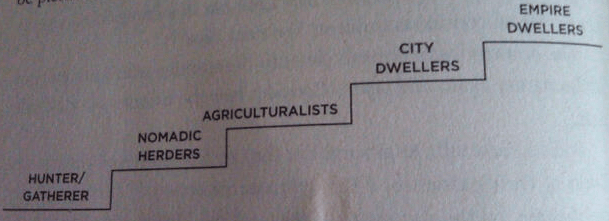
    But also of a descent:

    But the ascent is ironic, because with each gain, humans also descend into loss. They descent (or fall—there’s nothing wrong with the word itself, just the unrecognized baggage that may come with it) from the primal innocence of being naked without shame in one another’s presence.
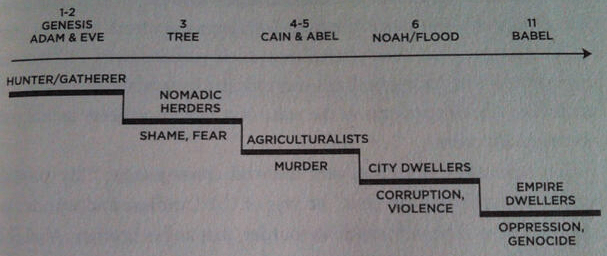
    Each step of socioeconomic and technological ascent thus makes possible new depths of moral evil and social injustice. (p. 50-51)

    As humans, with progress (implication of ascent) there is also loss (which in turn puts humans on a descent). Thereby, we now lose the vertical pattern of Platonic perfection-ideal as expressed through the Greco-Roman view of Eden but have a more progressive view of the Bible—a stepping stone, if you will.

    If Genesis sets the stage for the biblical narrative, this much is unmistakably clear: God’s unfolding drama is not a narrative shaped by the six lines in the Greco-Roman scheme of perfection, fall, condemnation, salvation, and heavenly perfection or eternal perdition. It has a different story line entirely. It’s a story about the downside of “progress”—a story of human foolishness and God’s faithfulness, the human turn toward rebellion and God’s turn toward reconciliation, the human intention toward evil and God’s intention to overcome evil with good. It begins with God creating a good world, continues with human beings creating evil, and concludes with God creating good outcomes that overcome human evil. We might say it is the story of goodness being created and re-created: God creates a good world, which humans damage and savage, but though humans have evil intent, God still creates good, and God’s good prevails. Good has the first word, and good has the last. (p. 54)

    If this view sets the stage for how to read the Bible, we are certainly in for a very interesting (and bumpy) ride.

    In Chapter 6, McLaren argues that the beginning of his quest to view Christianity through a new lens was shaped by his liberal arts education and bolstered by a lack of formal theology training. I found this quote interesting:

    Deconstruction is not destruction, as many erroneously assume, but rather careful and loving attention to the construction of ideas, beliefs, systems, values, and cultures.

    Merriam-Webster defines deconstruction this way:

    1 : a philosophical or critical method which asserts that meanings, metaphysical constructs, and hierarchical oppositions (as between key terms in a philosophical or literary work) are always rendered unstable by their dependence on ultimately arbitrary signifiers
    2 : the analytic examination of something (as a theory) often in order to reveal its inadequacy

    Deconstruction is not careful and loving attention to construction, no matter what McLaren says. Deconstruction is critical assessment performed in order to reveal inadequacies.

    But McLaren is openly stating that he’s reading the Bible through a literary lens where he can identify protagonists, antagonists, plot, tension, conflict, resolution, and character development.

    So as we head into Exodus, we read of a God who “sides with the oppressed, and God confronts oppressors with intensifying negative consequences until they change their ways, and in the end the oppressors are humbled and the oppressed are liberated.”

    I can’t help but comment that McLaren is back to nonliteralism now as he says God sends a “firm but gentle” plague on the Nile River that “turns red like blood.” But let’s read what Exodus 7:14-21 says. In fact, let’s use The Message version, Eugene Peterson’s paraphrase of what the Bible says:

    God said to Moses: “Pharaoh is a stubborn man. He refuses to release the people. First thing in the morning, go and meet Pharaoh as he goes down to the river. At the shore of the Nile take the staff that turned into a snake and say to him, ‘God, the God of the Hebrews, sent me to you with this message, “Release my people so that they can worship me in the wilderness.” So far you haven’t listened. This is how you’ll know that I am God. I am going to take this staff that I’m holding and strike this Nile River water: The water will turn to blood; the fish in the Nile will die; the Nile will stink; and the Egyptians won’t be able to drink the Nile water.'”

    God said to Moses, “Tell Aaron, ‘Take your staff and wave it over the waters of Egypt—over its rivers, its canals, its ponds, all its bodies of water—so that they turn to blood.’ There’ll be blood everywhere in Egypt—even in the pots and pans.”

    Moses and Aaron did exactly as God commanded them. Aaron raised his staff and hit the water in the Nile with Pharaoh and his servants watching. All the water in the Nile turned into blood. The fish in the Nile died; the Nile stank; and the Egyptians couldn’t drink the Nile water. The blood was everywhere in Egypt.

    The quote above is simply a paraphrase—someone’s interpretation of what is occurring in the Bible. I’m amazed that McLaren is so intent on reading the Bible non-literally that he tries to explain away what’s happening in the Bible through literal means: “Ironically, perhaps through a red tide, the Nile turns red like blood.” As a result of McLaren’s literary reading of Biblical passages, he begins to make literal assumptions about these passages that aren’t there.

    On page 58, McLaren says “God never works directly, only indirectly” and reduces the plagues often seen as something extraordinary and supernatural into nothing more than ordinary and natural. He diminishes the work of God.

    McLaren argues the Bible presents three narratives:

    1. God as creator
    2. God as liberator from external and internal oppression
    3. God as reconciler

    After reading beautiful literary passages from Hosea, Joel, and Isaiah, McLaren encourages his readers to see the future as something that “is not fatalistically predetermined” but rather see history as “live”—“unscripted, unrehearsed reality, happening now—really happening.” (p. 62-63) Here, McLaren rejects the premise of a predetermined, foreknown future by God (Jeremiah 29:11; Acts 2:22-23; Romans 8:28-30; I Corinthians 2:7; Ephesians 1:5,11).

    Then McLaren attempts to literalize Scripture within a modern framework despite saying, “As this approach relieves of literalistic interpretations, it frees us to let the poetry work as poetry is supposed to”:

    Swords into plowshares. Today that would mean dreaming about tanks being melted down into playground jungle gyms and machine guns being recast as swing sets. (p. 63)

    That’s just one example. It’s a clever reading of the passage but the fact of the matter is, McLaren is trying to take the literal, make it literary, and then convert the literary as the literal he wants to see. To put it bluntly, McLaren is reading things in the Bible that simply aren’t there.

    McLaren is very good at igniting passion and hope for a better tomorrow that seems as if it can occur today.

    If the Genesis story sets the stage by giving us a sacred vision of the past, and if the Exodus story situates us in the sacred present on a pilgrimage toward external and internal liberation, then the story of the peace-making kingdom ignites our faith with a sacred vision of the future, a vision of hope, a vision of love. It represents a new creation, and a new exodus—a new promised land that isn’t one patch of ground held by one elite group, but that encompasses the whole earth. It acknowledges that whatever we have become or ruined, there is hope for a better tomorrow; whatever we have achieved or destroyed, new possibilities await us; no matter how far we have come or backslidden, there are new and more glorious adventures ahead. And, the prophets aver, this is not just a human pipe dream, wishful thinking, whistling in the dark; this hope is the very word of the lord, the firm promise of the living God.

    Perhaps I’m not as optimistic or those darn Greco-Roman glasses keep getting in the way.

    Again, I appreciate McLaren’s attempt to read the Bible with a new perspective but there needs to be a balance between the literal and literary interpretations. I understand that some people Bible see the Bible as purely a literal work of God; others see the Bible as nothing more than a beautiful piece of literature. McLaren looks as the Bible as a beautiful piece of literature and then tries to recast it into a literal work with explanations that are a stretch. Frankly, McLaren’s attempt at a new kind of Christianity appears headed extremely off-course as I go into reading Chapter 7.

    Food for thought #3: A New Kind of Christianity

    What is the overarching story line of the Bible?” McLaren asks. His response, which really comes across as more of an authoritative answer in some areas, is that current Christianity reads the Bible through the lens of an Aristotelian-Platonic universe. He calls it a Greco-Roman story line where Christians see God as something akin to Zeus or Jupiter—a perfect heavenly being that is ready to strike down flawed creatures on a whim—and if certain creatures never reach the Platonic ideal of heaven then they are sent down to a Greek Hades, a hell, “imagery misappropriated from Jesus’ parables and sermons.” (p. 44)

    McLaren may have a point. Perhaps Christians read the Bible through the lens of this Greco-Roman narrative, but it’s worth pointing out that Jesus’ story developed within a Roman context. (Pilate? Caesar, anyone?) And that the New Testament was written in Greek. As a result, I disagree with McLaren that this Greco-Roman narrative is necessarily bad. Instead, I argue that the Greco-Roman narrative provides a form of context as a result of being influenced by the Roman Empire and the original language of the New Testament. This influence is inescapable.

    McLaren also makes the point that we should read the Bible for the Judaic narrative that it is—as Jesus would have read it. That is a fair and valid point as well. Therein lies the challenge: reading the Bible for what it is without inserting a post-Jesus historical lens (ie, reading the Bible through a post-Reformation lens or a post-Council of Trent lens).

    Food for thought #2: Brian McLaren’s A New Kind of Christianity

    I have a slight problem with Brian McLaren’s graph from p. 34 of A New Kind of Christianity. His graph is shown above in the picture; my revised version is shown below.

    McLaren places Eden on the level of Heaven which basically equals perfection. That might bother some but it doesn’t bother me. The only difference between my graph and his is the direction of the “Hell/Damnation” arrow. While nitpicky, I have a fundamental disagreement with McLaren on this one.

    From a theological perspective, what bothers me is the downward direction of the arrow. Perhaps he drew it that way because we always think of heaven as existing above and hell existing below. I redrew it to make it a continuous straight line not only because I have semi-OCD tendencies but also because the destination as a result of condemnation is hell/damnation. It’s not a downward trajectory from condemnation but rather, a continuous path that is not separate from it. According to the Bible, this is the spiritual path that all souls are on as a result of the fall (Romans 5:17-19).

    I’d also like to add that I’m interested in reading McLaren’s response to the pluralism question: “How should followers of Jesus relate to people of other religions?” On page 21, he briefly summarizes what he’ll try to address:

    So we ask: Is Jesus the only way? The only way to what? How can a belief in the uniqueness and universality of Christ be held without implying the religious supremacy and exclusivity of the Christian religion?

    I think it’s an interesting question to posit and answer, oops, I mean “respond to.” (There are no answers according to McLaren, only responses in an effort to stimulate and continue conversation. For a great Biblical counseling perspective on this conversation, check out Bob Kellermen’s series in which he provides responses to McLaren’s questions.)

    So here are my initial responses before reading the chapter in which McLaren expounds on the pluralism question:

    • Is Jesus the only way? “I am the way, and the truth, and the life; no one comes to the Father but through Me.” — John 14:6
    • The only way to what? God the Father and His house. Thomas specifically asks about this. See all of John 14.
    • How can a belief in the uniqueness and universality of Christ be held without implying the religious supremacy and exclusivity of the Christian religion? While I appreciate McLaren’s question here, I’d rather “lob back” in response, as he’d say, that there’s a supremacy and exclusivity that’s inherent in Christ rather than the Christian religion. I don’t think any system of belief is foolproof. I believe only Christ is. Religion muddies waters (how many Christian denominations are there?); Jesus Christ is crystal clear. That being said, I believe there is a uniqueness and universality of Christ that transcends all beliefs and religions but there is a supremacy and exclusivity that is inherent in the God/man rather than the religion. (I’m sure this is something I will clarify and elaborate on as I progress within McLaren’s book.)

    I’m excited about reading through A New Kind of Christianity. I have an open mind about this and am totally willing to transform my Christian faith and live it in a new way with only one caveat: it must remain true to the Bible. If McLaren argues something that goes against what the Bible says, I’ll point it out. We know very little about Jesus apart from the Bible. And we would know nothing about Jesus’ teachings without the Bible. So holding McLaren and his questions and responses to a Biblical standard is neither unreasonable nor unfair since he is talking about the the Christian faith.

    I hope you’ll join me in my journey through this book. If you don’t know who Brian McLaren is or what a little bit of background on what part of the Christian faith he comes from, please check out my series on the emergent movement.

      Final thoughts in the emergent movement series

      People not directly involved in the emergent movement likely think that it’s something that doesn’t affect them. Not true.

      The emergent movement and its connection to postmodern philosophy is having a vital effect on the way Christians and non-Christians alike think.

      I, for one, find myself constantly questioning things in Christianity. I’m very open and honest about my struggles in this respect. I used to live under the veil of pretending to have it all together. I’d rather err on the side of being too broken than being too pretentious. (“A broken and a contrite heart, O God, thou will not despise.” —Psalm 51:17)

      Questioning one’s faith is typical within emerging Christianity. Question and reasoning can be helpful to the health of someone’s Christian life. It challenges a person’s faith and forces them to understand, reconcile, and know what he or she believes.

      Where emergent Christianity takes things too far is that it can get too deconstructivist and undermine things that, as a believer, should not be undermined (eg, the deity of Christ, the necessity of his finished work on the cross). Those things should not persist as constant questions but rather, should be resolved and the topic should move on.

      Emergent Christianity also tends to go in circles on questions. Those in the “conversation” contend that questions are healthy. Yes, to a point. Questions should be asked in the quest for answers. To simply throw questions out for the sake of engaging in constant conversation is ultimately fruitless because it accomplishes nothing.

      Rob Bell, in Velvet Elvis, offers the Jewish culture of answering a question with a question as proof that it’s okay to go around and around with questions. I counter that answering a question with a question in Jewish culture is meant to be an end within itself. The answer (in the form of a question) is not meant to lead to endless conversation but as a way of stating a point of finality while leading the inquisitor to muse further on the answer in his or her own mind.

      So when it comes to questioning things within Christianity, I have accepted this as part of postmodern and emerging thought. Where I stop, however, is that I seek answers and definitions to my questions.

      Along with postmodern thought is the idea that everything is relative. This idea of relativity can be found in the emergent movement. However, within the framework of Biblical Christianity, there are absolutes. (I believe absolutes exist outside of the Bible but I’ll stick to my topic of Christianity.) Since Jesus was absolute and authoritative with many of this statements (“I am the way, the truth, and the life, no man comes to the Father except by me” —John 14:6), there is no room for relativity. Again, believers of the Bible should not be questioning whether Jesus really meant what he said. While Jesus was figurative with many of his statements, he was also very literal. To take his literal meanings, distort them, and teach those distortions as valid Christian thought is dangerous.

      Please don’t misunderstand me. Most believers go through times in their lives when they questions the basics and fundamentals of Christianity. The problem is when people in leadership begin teaching these doubts, assisting in undermining Christianity in their own congregations. If a person chooses not to believe in Christianity, questions it, and tries to point out its weaknesses, that’s one thing. To do the same while claiming to be a believer and teach others to do the same is wrong.

      So while I understand there are many areas in life that are full of grey, Christians should not deny that some things are plainly black and white (figuratively speaking). Emergent Christians can seek to blur the lines, giving the illusion that black and white is or can be grey.

      Emerging church excels, however, in taking Christianity to the 21st century. I get frustrated when I hear Christians knocking other Christians’ choice of worship. A common complaint I’ve heard is that churches have become a type of theater: things are done with video, multimedia slides, and lighting effects. These things are dismissed as unnecessary and purposeless. I view these things as a valid and appropriate means of reaching postmodern American society. While some people may enjoy that “old time religion,” for others, it does not reach them. I am with Paul when he says “I became all things to all men that I might by all means save some.” (I Corinthians 9:22) There is nothing sinful in using video, slides, overhead projectors, and the like. Simply because it’s not a person’s style of worship doesn’t mean it’s wrong.

      The argument along with that is that good gospel preaching can stand on its own and there is no need for visual anything. While that may be true, visuals are a supplement, not a replacement. I am baffled by Christians who are willing to embrace technology in every other aspect of their lives but insist on keeping it out of the church. To reach a 21st century generation, Christianity cannot continue to function in 19th century mode. It is possible to adapt to the culture without sinning in order to evangelize. This is the area where the emerging church has challenged the ecclesial institution and can help make it better. Some Christians call it becoming “worldly,” however, I see it as taking Christ’s message and making it practical and relevant.

      And that’s how the emerging church challenges me: how do I make 1st century concepts and teachings from a Middle Eastern culture practical and relevant 20 centuries later in a postmodern American society? It’s a question I don’t have an answer to but hope to discover that answer someday. (Even if the answer comes in the form of a question.)

      —-
      Note: I typed this entire post on my BlackBerry so please excuse any spelling or grammatical errors.

      The emergent movement & postmodernism: Part V

      Impact of the emergent movement

      There’s a lot of criticism of the emergent stream. And much of it is valid. If taken too far, the emergent movement could possess the ability to completely deconstruct Christianity in an attempt to demolish it.

      But on the flip side, the emergent movement can be used to challenge the missional arm of the church in a postmodern culture. I like the way Driscoll put it in a Desiring God video I recently watched. In essence, Driscoll asked what missions would look like if Christianity were foreign to the U.S.? How would foreigners assimilate American culture and adopt the tools to best reach those who do not know God or Jesus Christ in a mission field? Because Christianity has been so pervasive and long-standing in American culture, American Christians take their backyard missions field for granted and assume that current American culture will bow to its old way of doing things when in reality, American Christians would never expect that in traveling to any other nation. The emerging movement enables American Christians to see the United States with fresh eyes from a missional standpoint.

      The Emergent Church has also served as a rubber band for those who have escaped from the sharp talons of legalistic Christianity. The movement has enabled many Christians to retain certain core truths but make their faith flexible and pliable—when exercised, this faith can be tested and stretched without breaking and completely falling apart. Bell, in Velvet Elvis, refers to legalistic faith as a brick wall: pull one brick out and the rest of the wall crumbles because its support hinges on that one brick.
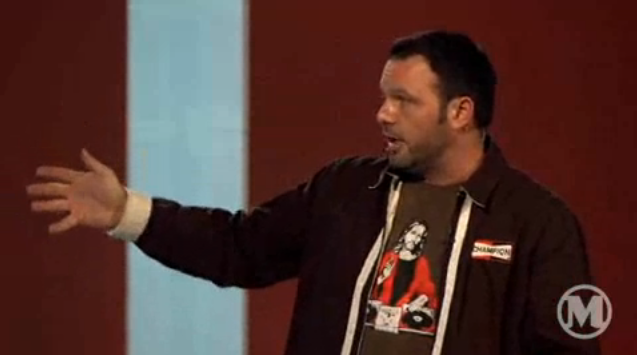
      I’ve found emergent influence in dress. Older, more traditional Christians will complain that they can’t tell the difference between a young believer and a young non-believer because they simply look and act too much alike. Emergent influence in dress assists in blurring this distinction. Emerging Christians tend to dress down, and as some Christians complain, “look like the world.”  Emerging Christians will defend their choice of dress as part of cultural relevancy. Here’s a snapshot of Driscoll wearing a shirt of Jesus as a DJ while preaching.

      There’s emergent influence in contemporary Christian art. Since I’m not an artist, I can’t define it very well but a look at the Mars Hill website (Rob Bell’s church in Grand Rapids, Michigan) will tell you all you need to know. I’ve provided a current snapshot of the website. (I don’t know if it changes.)

      www.marshill.org

      Is the emergent movement harmful to long-term Christianity?

      Perhaps I’m an optimist in this area but I believe God is so much bigger than any one movement. If Judeo-Christianity has weathered all sorts of sects, migrations, movements, and off-shoots in the past 5,000+ years, it is likely to weather this one. God has promised to sustain and protect his church—not any one particular denomination but his “holy, catholic (universal) church.” The Emergent Church does not threaten or thwart God’s plans nor will it move God’s plans along any faster than He wants it to. The emergent movement can only be assessed in a Christian’s personal walk with God. How does that affect him or her? Has the emergent conversation added to or detracted from a person’s belief in the triune God? For some, the emergent movement has served to draw people closer to God in an effort to more fully “glorify Him and enjoy Him forever.” For others, the emergent movement is a distraction—a nuisance that must be eliminated in order to preserve the organized institution of Christianity. And there is yet another group who finds that while the emergent movement possesses many flaws, many of the questions and challenges it raises can prompt individuals to change their lives—and the lives of those around them—to better glorify, love, and serve God and others. This last group is the group I most identify with. To use another worn-out cliché, I am not willing to throw the baby out with the bathwater. (Even if the bathwater is very, very stinky and murky at times.) If that was the case, I would have walked away from Christianity the moment I left legalism.

      The emergent movement & postmodernism: Part IV

      Emergent and emerging

      Some people, when speaking of the emergent movement, will use the words “emergent” and “emerging” interchangeably. However, Mark Driscoll takes good care to note that his Mars Hill church in Seattle is an emerging church (and part of an emerging conversation) rather than emergent. Driscoll’s distinction would be notable as he started out as part of the original emergent conversation and has since distanced himself from it. The reference to emerging is noted in Wikipedia as a “wider, informal, church-based, global movement” rather than the term emergent, which would specifically refer to those associated with the Emergent Village community (essentially the Emergent Church). Driscoll, in the following YouTube video, lists and defines four types of emerging voices:

      1. Emerging evangelicals: not trying to change Christianity, just trying to make it more applicable and more relevant
      2. House church evangelicals: Get rid of big church and meet in small groups like homes and coffee shops
      3. Emerging reformers: Believe in the reformed distinctives but try to make the church culturally relevant
      4. Emergent liberals: Calls everything into question including Christian orthodoxy without wanting to arrive at any answers

      Note that Driscoll only uses the word emergent in connection the voices associated with the Emergent Village. This is the group Driscoll has publicly distanced himself from.

      How does the emergent movement affect me?

      The influence of the emergent church is pervasive in mainstream American Christianity. The main venue many of these emergent voices get their message out—apart from Internet-based distribution—is through their books. Don Miller is known for his New York Times bestseller Blue Like Jazz, Rob Bell has written a thought-provoking book titled Velvet Elvis, and Brian McLaren has recently released a book called A New Kind of Christianity that has unleashed a furor of criticism. While I find that many pastors eschew the emergent movement, many Christians are drawn to it. Perhaps it’s because the emergent movement has succeeded in making itself culturally relevant and practically applicable to those who do not hold theology degrees or work in Christian ministry for a living. Christians and non-Christians alike are taking notice of these works and this movement, even if they can’t quite define it.

      Some time last year, my best friend [forever] (BFF) read Rob Bell’s book, Velvet Elvis, and insisted that I needed to read it. She promised it would help challenge my conventional notions and that it had helped her break some of the legalistic mindset she’d carried with her since graduating from a college that centered around a legalistic (and Pharisaical) lifestyle. I reluctantly borrowed her copy with a promise to read it only because she was my BFF. Here’s a short analysis I wrote last May:

      When I was going through my “spiritual crisis” recently, my best friend handed me this book. She said, “You have to read it; it’ll change your outlook on Christianity.”I glanced down and read the title: Velvet Elvis. With a name like Velvet Elvis, how could this book be any good?

      I opened the book up and began reading skeptically and with a critical eye. Bell starts out by discussing how he came a cross a paining of Velvet Elvis and then delves into this discussion of how there’s a big movement in history—something greater than ourselves happening. Standard fare from Rob Bell. After reading Bell’s response on Twittering the gospel, I was disillusioned with his outlook on Christianity. His answer seemed so vague… so unsatisfactory. His book couldn’t possibly offer anything better. Yet I made a promise to my friend and continued to push through the book.

      To my surprise, Bell’s book isn’t as shallow as I’d thought.

      While he repeats the rhetoric about a movement in history greater than ourselves, he explained Bible passages in a way that I’d never understood before. He draws heavily on Jewish culture to shed new light on Bible passages that once seemed so mundane. Never before had I known that the reference to “yoke” in Matthew 11:30 had deeper meaning than what oxen carry. And I never understood that the disciples functioned as Jesus’ talmidim. Bell’s writing style is clear but his message actually runs deep. …

      Bell does seem to have a good grasp on the gospel but presents it in quite a different light. He acknowledges Jesus as the Son of God and “the way, the truth, and the life”–the only way to get to heaven. He also posits that truth can be found outside of the Bible. And since God is truth then anywhere truth is found, there God is. He uses Paul citing one of the Cretan prophets as an example of this.

      He says that some Christians see their faith as a brick wall–pull out one brick and the structure of their faith begins to fall apart. He says that we need to be flexible. If something in our faith is wrong or proven as false, will we stray from the faith altogether?

      A major problem I do have with this book is that nothing is absolute. He encourages Christians to question everything, including his book. Take nothing at face value. In fact, he asserts that God likes it when we ask questions. Turns out in Jewish culture, when rabbis ask students a question, students respond with… a question. According to Bell, straight answers are not standard. I don’t agree with this. There are absolutes in life and Bell doesn’t acknowledge or accept that.

      While I’m not a fan of how Bell runs his church or the way he presents theology, Velvet Elvis is a book worth reading. I initially said I wouldn’t recommend it; I’ve since changed my mind. I’ve ordered my own copy and plan on rereading it, highlighting it, and marking it up. He makes some very many good points and I’m pleasantly surprised at how much I like this book. I’m afraid to pick up Sex God or his latest Jesus Wants to Save Christians but Velvet Elvis isn’t a bad read at all.

      I have since returned my BFF’s copy to her and have my own copy with plans to re-read and highlight it. Velvet Elvis impacted me that much. And Velvet Elvis is indeed reflective of emergent conversation even if I wasn’t fully aware of it nearly a year ago.

      The emergent movement & postmodernism: Part III

      http://www.postmodern-art.com/postmodern_art_11.html

      Postmodern background

      From what I can gather, the emergent movement is part of a conversation that asks how Christians can minister in a postmodern (largely, secular) world.

      Postmodernism developed as a reaction to the modernist movement. According to Wikipedia’s entry on the modernist movement, the term modernism “encompasses the activities and output of those who felt the ‘traditional’ forms of art, architecture, literature, religious faith, social organization and daily life were becoming outdated in the new economic, social and political conditions of an emerging fully industrialized world.” Interestingly, the wiki entry also notes that modernism rejected “the existence of a compassionate, all-powerful Creator.”

      So postmodernism gets past all that modernist stuff, right? Not necessarily. In fact, some people see modernism and postmodernism as two sides of the same coin. Here are two definitions:

      (1) A style and concept in the arts characterized by distrust of theories and ideologies and by the drawing of attention to conventions. (The Compact Oxford English Dictionary)

      (2) Of, relating to, or being any of various movements in reaction to modernism that are typically characterized by a return to traditional materials and forms (as in architecture) or by ironic self-reference and absurdity (as in literature), or

      of, relating to, or being a theory that involves a radical reappraisal of modern assumptions about culture, identity, history, or language. (Merriam-Webster)

      Merriam-Webster’s latter definition (as opposed to its former) seems most appropriate to when referring to the Emergent Church.

      At the risk of beating my readers over the head with more definitions, I’ll also refer to a Wikipedia entry that defines postmodern philosophy:

      Postmodern philosophy is skeptical or nihilistic toward many of the values and assumptions of philosophy that derive from modernity, such as humanity having an essence which distinguishes humans from animals, or the assumption that one form of government is demonstrably better than another.

      The wiki entry adds:

      Postmodern philosophy has strong relations with the substantial literature of critical theory.

      When you boil it down, the essence of postmodernism and its philosophy is rooted in criticism and critique. Question everything; take nothing at face value. Postmodern thought also moves away from superiority and toward equality (eg, humans aren’t superior to animals, capitalism isn’t better than communism). Postmodern thought has its place in society (eg, whites are not superior to blacks) but like all things, can be bad if taken too far.

      So when I stumbled onto the Wikipedia entry about Postmodern Christianity, I found it interesting to read the following:

      Many people eschew the label “postmodern Christianity” because the idea of postmodernity has almost no determinate meaning and, in the United States, serves largely to symbolize an emotionally charged battle of ideologies.

      Today’s Emergent Church stresses a friendly conversation and an amiable exchange of ideas. But the identical foundations of secular postmodernism and the Emergent Church cannot be overlooked.

      Criticism and critique. For example, consider how the Emergent Church began: by a group of friends who felt “disillusioned and disenfranchised” by 20th century Christianity. In other words, they became critical and sought to challenge the status quo. (Which I don’t have an issue with.) The critique of 20th century Christianity, however, never rose above just that—a critique. The critiques merely evolved into conversation, which leaders of the emergent stream want to keep amiable so as not to offend anybody within all sects and denominations of the Christian realm. My issue here is that constant talk doesn’t rectify wrongs or things that need to desperately be addressed in 21st century Christianity. There is a time for talk and a time for action. (Ecclesiastes 3:1-8)

      No determinate meaning. Like postmodernism, the emergent movement also has “no determinate meaning.” As I mentioned earlier, its leaders want it kept that way. One will find varying definitions of the Emergent Church (aka the emergent movement aka the Emerging Church aka the emergent stream, etc.) all over the Internet. I can’t help but think of Challies’s earlier reference of trying to nail Jello to the wall when trying to define the Emergent Church. My attempt here is only as skewed as my personal view. Perhaps the Emergent Church leaders also intended that as well—a lack of objectivity to define the emergent movement only fuels further discussion and conversation.

      Deconstructionism. Also very much like postmodernism, the Emergent Church seeks deconstruction. Where postmodernism was deconstructivist in the sense that it sought to undermine the foundations of the subjects it would challenge, the Emergent Church seeks to deconstruct the organized and institutionalized church. The three main areas of deconstruction the Emergent Church addresses are:

      1. modern Christian worship,
      2. modern evangelism, and
      3. the nature of modern Christian community

      Followers of the emergent movement can be found worshiping with others in homes rather than a church building and talking openly about their faith with others in a non-traditional setting such as a bar.

      (L-R) Rob Bell, Brian McLaren, and Donald Miller

      Leading emergent voices also stress that Christianity is just one big story that’s unfolding. Bell spoke about this in his books Velvet Elvis and Jesus Wants to Save Christians and discussed it in an April 2009 Christianity Today interview. Brian McLaren, during the Washington National Cathedral’s Sunday Forum in February 2008, declared that “the Christian faith is [best] understood as a story by a postmodern generation that sees itself as part of the developing storyline,” according to the Christian Post. McLaren also went on to say that postmodern believers viewed Bible stories as part of a “bigger picture and larger story.” And finally, a close friend of mine has been challenged by Don Miller’s latest book, A Million Miles in a Thousand Years, to write a better story in her own life. A story, I can only assume, that is a small part of a bigger picture within the large framework of Christianity.

      The emergent movement & postmodernism: Part II

      Emergent history & definition (or lack thereof)

      Now, to define the Emergent Church, as noted blogger Tim Challies says in reviewing the book Why We’re Not Emergent (By Two Guys Who Should Be):

      “To borrow a tired cliche… is much like trying to nail Jello to the wall.”

      Indeed. In a Google search for “emergent church” or “emerging church,” does not yield anything concrete. The terms “Emergent Church,” “emerging church,” “emergent movement,” and “emergent stream” are all used interchangeably by many people to refer to the same thing. (However, a distinction between “emergent” and “emerging” will be noted later.) One will likely stumble across someone’s attempts to define the Emergent Church, usually with a significant bias either for or against. Even the Emerging Church entry in wikipedia contains various citations for “weasel words,” vague phrasing, unverified claims, and lack of references. The Wikipedia entry complaints are actually ironic: the complaints actually perform a great job of describing the emergent movement. I don’t say that necessarily as a criticism. The founders of the emergent movement do not want it to be defined. So for the wiki entry to use weasel words and vague phrasing is the best that any writer of that wikipedia entry can do. There is no clear-cut, textbook definition.

      When I speak of the Emergent Church, I refer only to the American aspect of it. (The emergent movement outside of the U.S. is long and varied.) A few core people at the foundation of this movement in the United States are Brian McLaren, Spencer Burke, Doug Pagitt, Rob Bell, Don Miller, and Mark Driscoll. (However, Driscoll has since disassociated himself and his ministry with this movement.) McLaren especially seems to be the driving figure of the Emergent Church and the community website Emergent Village, which loosely defines itself as “a growing, generative friendship among missional Christians seeking to love our world in the Spirit of Jesus Christ.”

      Based on the Emergent Village About page, the emergent movement appears to have been born in the late 1990s by a group friends who felt “disillusioned and disenfranchised by the conventional ecclesial institutions of the late 20th century.” By 2001, this group of friends official declared themselves and their beliefs as “emergent.” Here’s a statement from the website explaining why the word emergent was chosen:

      In English, the word “emergent” is normally an adjective meaning coming into view, arising from, occurring unexpectedly, requiring immediate action (hence its relation to “emergency”), characterized by evolutionary emergence, or crossing a boundary (as between water and air).

      As intended, the Emergent Church is now a burgeoning movement within 21st century Christianity.

      Unofficial buzzword: conversation

      The Emergent Village site lists four buzzwords that are thrown around in its community: growing, generative, friendship, and missional. I believe it failed to list a very important fifth: conversation.

      The word “conversation” is as foundational to the emergent movement as the word “triage” is to the business world. On various websites I’ve read, in an attempt to gain a better understanding of the Emergent Church, the word conversation is thrown around like water at a baptism. Leaders of the movement stress that it’s all about conversation. (Also note that the leaders of this movement do choose their words carefully.) Here’s Merriam-Webster’s definition of what a conversation is (as it relates to our current usage):

      2 a (1) : oral exchange of sentiments, observations, opinions, or ideas
      (2) : an instance of such exchange : talk <a quiet conversation>
      b : an informal discussion of an issue by representatives of governments, institutions, or groups
      c : an exchange similar to conversation

      This is exactly what the leaders of the Emergent Church want: an exchange and an informal discussion.

      Back in seventh grade, I used to participate in something called “rap sessions.” The point was to air our grievances and discuss any issues weighing on our minds. But nothing was ever resolved. It was simply an outlet for talking. The emergent movement (also referred to as the “emergent stream” to represent the continuous flow of conversation), in essence, is nothing more than just a Christian rap session on a grand scale. We all have our problems with Christianity but the emergent movement allows Christians to simply engage in conversation and air their observations without ever really rectifying any issues that might be plaguing them.