Establishing the Discipline of Daily Prayer (aka Relearning How to Pray)

Image from learntochangelives.blogspot.com

I’m trying to institute the discipline of praying consciously every evening. I really suck at regularly praying: praying for myself and for others so I’ve reverted to the basics—“Our Father” also known as the Lord’s Prayer.

Our Father in heaven, hallowed be your name. Your kingdom come, your will be done, on earth as it is in heaven. Give us this day our daily bread, and forgive us our debts, as we also have forgiven our debtors. And lead us not into temptation, but deliver us from evil. —Matthew 6:9-13

I grew up in the Catholic Church for the majority of my youth and I attended Roman Catholic school from K through 12 so the ending phrase, “For Yours is the kingdom and the power and the glory forever” is not easy for me to remember or natural to me since it was not taught. Depending on what feels comfortable and genuine, I either give the addition to the Lord’s Prayer a shot (which I inevitably screw up) or leave it out.

But the Our Father is so second nature to me (and many others with a Christian background), it could be vain repetition. I could easily recite this prayer without putting any thought into it. But I’m trying really hard not to. I’m doing my best to consciously say the Our Father while thinking through what I’m saying. Another good way to do this is to paraphrase a few lines (without the Message Bible!).

And Jesus says to “pray like this,” not necessarily “this is the definitive answer on what you should pray.” He encourages us to pray along these lines addressing the following:

  • To whom we are praying
  • Where this God is
  • An important attribute of this God
  • A promise from this God
  • Something that prevailsfrom this God over us as humans
  • Where this God’s kingdom extends
  • Request to provide for our daily needs (not wants)
  • Repentance with God
  • Repentance with others
  • Request to exhibit one of God’s attributes (such as remaining holy and pure)
  • Request to avoid Satan or evil deeds

I’m confident there’s more to the Lord’s Prayer than that, but I’m not a Bible commentator. I’m just a layperson trying to force myself to first establish the discipline of speaking to God daily with words I can speak subconsciously before moving on to crafting thoughtful, original prayers. Daily prayer goes against my nature, but especially when engaging in spiritual battle, it’s extremely necessary.

  • I am able to active think about what I pray even though it could be rote.
  • I do this task at least once a day. (Usually before sleep for me.)
  • I pause with each phrase to let the words fully sink in and make sure I understand what I’m saying to God before continuing on with my prayer.
  • At the end, I will tack on requests for others that I remember. Maybe even include a request for myself.

Establishing discipline is not easy, especially when it comes to prayer—a habit that is not natural to most people. But for many people, mindful, daily recitation of the Our Father is a good place to start.

I’d love to hear other people’s thoughts on establishing the discipline of daily prayer, especially for those new to the faith or uncomfortable with prayer.

Establishing the Discipline of Daily Bible Reading

Image from http://www.therockchurchranch.com

I am ADHD central. If you check out my sidebar, you’ll see I’m reading several books at once. I’ll read a few pages in one book then read a few pages in another before jumping to another book. It takes me a long time to finish books this way but it satisfies the variety of information my attention span craves. (I suppose that says I have little to no attention span.)

So I’m not up for reading particularly long Bible passages on most days. In fact, I’m usually averse to it. (The Bible can be so dry and dull in some areas!) But what I do each day—and any Christian can do this—is read one Bible verse. A full sentence. I use YouVersion’s Top Verses to Memorize reading schedule plan for this. Or you can flip open to any book in the Bible. Or go chronologically. Your choice.

I usually find that I’ll read a few more verses to get a proper context and then be done. Some chapters are very long and that often discourages me. But one Bible verse, one simple nugget from God’s word counts as Bible reading and don’t let anyone tell you any different.

If people can read five chapters in a day or the Bible in a year, good for them. Maybe you’re like me—you’re lucky to even crack the holy book open. But just one verse can do it.

But don’t do it mindlessly either. Make that verse count. Read it and think about it. If it’s an odd verse about dashing your enemy in pieces or so-and-so begat so-and-so that doesn’t resonate with you, flip to another verse that makes sense to you. (The Psalms and Proverbs are always good for this.)

Image from my.opera.com (user: yulenka)

When you read about the heavens declaring the glory of God (Ps. 19:1), think about how awe-inspiring it is to see the heavens from the cabin of an airplane. Or the rays of sun floating above the clouds at 40,000 feet above ground. When you read Jonah, see if you find yourself needlessly angry (as he did) or neglectful of any duties you’ve been assigned to. The Bible isn’t mindless and a brief reading of it doesn’t need to be either.

One way I’ve been able to get Biblical truth is by reading books based on Scriptural truth. It’s nice and it’s helpful, but it’s not the Bible. Reading snippets of Charlie Sheen’s recent crazy quotes are comical and (yes, even) awesome, but when you watch the context those snippets came from, the quotes are actually sad. Original context changes everything so one really needs to go straight to the source instead of relying on quotes elsewhere that have the potential to change the meaning.

Just one verse a day: available on BibleGateway.com, Bible.com, Christianity.com, and a whole host of other Bible-based sites. Make a conscious effort to get into the daily habit of reading one verse. You may read more but read at least one verse actively and meditate on it afterwards.

Just like savoring a really delicious, decadent dessert can be more satisfying than scarfing down a burger and fries on the fly, understanding one Bible verse is better than mindlessly flying through the Bible in a year.

Again, to belabor my point:

  • read one verse,
  • meditate on it,
  • then digest it (allow it to affect your life somehow).

Daily.

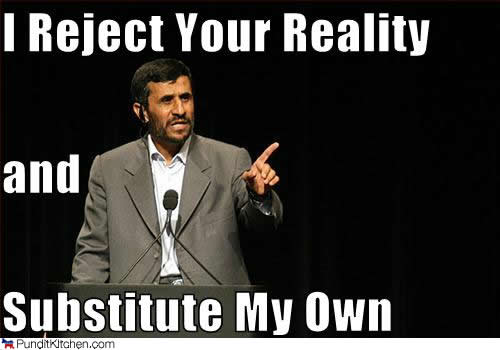
I’ve Been Rejecting God’s Reality and Substituting My Own

Because in Ahmadinejad’s anti-Semitic world, the Holocaust didn’t happen.

I’ve often thought of myself as being able to relate to the Biblical character Job, but lately I find myself falling in line with Jonah.

A (not very) brief synopsis of the Book of Jonah:

God commissions Jonah to preach repentance from sin to the town of Nineveh (or else God will bring calamity upon the town). Jonah, an Israelite, hates the Ninevites who are enemies of Israelites. Jonah’s not really happy about this commission from God because He knows God won’t act ruthlessly against these people so he runs.

He flees. He does all he can to get away from God and the mission he’s been sent to do.

After causing grief in the lives of some sea men who are caught in a tempest, they throw him into the water where he gets swallowed up by a whale for three days and three nights. Jonah repents of his attempt to escape God and his mission and the whale vomits him out on to land.

Jonah, eager to get his mission over with, completes a three-day journey to Nineveh in one day. He walks into the city crying, “Yet forty days and Nineveh will be overthrown.” From what readers can tell, Jonah does not elaborate on this statement; he only repeats that Nineveh’s doomed in 40 days.

And what Jonah expected to happen happens. The Ninevites repent and turn to the God of Israel, asking for forgiveness from their wicked ways.

How frustrating for Jonah. This turn of events makes God spare the lives of these people.

In the last chapter of the book, Jonah sits outside of the city waiting for what he knows will not happen: the destruction and complete annihilation of Nineveh. He rants at God angrily for having the following attributes:

  • Being gracious
  • Being merciful
  • Being slow to anger
  • Abounding in steadfast love
  • Relenting from disaster

Jonah hates the fact that God extends these attributes to people he can’t stand and begs for death. God answers him and challenges him:

“Do you have good reason to be angry?”

At first, Jonah doesn’t answer. God leaves it alone.

Then the sun and scorching heat bear down on Jonah and God allows a plant to grow over him to give him some relief. This makes Jonah happy.

Then God allows a worm to kill the plant overnight, leaving Jonah back in the sun and heat again. Again, Jonah puts his life back on the table, begging to die. God calmly asks:

“Do you have good reason to be angry about the plant?”

Jonah rages now: “Yeah, I got good reason to be angry. So angry I want to die!”

God declares checkmate against Jonah, challenging Jonah’s care of a dead plant that he did not labor to produce against God’s care for the people and animals of a big city that He created.

That’s the end of the chapter. No further response from Jonah. My supposition is that either Jonah was probably too pissed off to continue writing what occurred after or that Jonah was too embarrassed by his subsequent reaction that he didn’t record it. Perhaps God, in His loving compassion, didn’t require him to.

In the reading of this chapter, I discover that I am very much like Jonah. I run and flee from God. I don’t like the tasks He’s put before me and I’d rather do something else. And Tuesday night, I was angry—angry unto death.

Like Jonah, I need to accept what God’s mission is for me (job) rather than the mission I want to create for myself (motherhood). To quote Adam Savage from the hit TV show “Mythbusters,” I’ve been telling God:

“I reject your reality and substitute my own!”

It is clear in a variety of ways that God’s mission for me right now is to focus on my job. He is blessing in me in that realm through agent interest, independent contracting, further education, increased job responsibilities, and possibly a new position. I’ve been a complete fool to overlook the ways that God is blessing me in this area.

And while I’d love to become a mother, it’s clear that’s not what God wants for me right now. While it makes me sad and it’s okay for me to grieve over the death of this dream monthly, I need to press forward with the mission God has charged me with rather than trying to run away in an opposite direction, causing grief to those around me. Am as I happy about my mission as Jonah? Probably, since I’ve been hoping for my mission to come to fruition for a while. But I’ll try to accept where God has me and what He wants me to do before I become a mother (should that ever happen).

Okay, God, so here’s what I’ll try my best to do:

I reject my reality and substitute Your own.

Full Christian Repentance is Gradual, Not Immediate


Image from godisgood.info

“Growth in character and changes in behavior occur in a gradual process after a person becomes a Christian. The mistaken belief that a person must “clean up” his or her own life in order to merit God’s presence is not Christianity. This means, though, that the church will be filled with immature and broken people who still have a long way to go emotionally, morally, and spiritually. As the saying has it: ‘The church is a hospital for sinners, not a museum for saints.'” —Tim Keller, “The Church is Responsible for So Much Injustice” from The Reason for God, p. 55

This quote really spoke to me when I read it. It was one of those quotes in which I sat back and thought, Wow. This is revolutionary. This is why Redeemer Presbyterian in New York City has been so successful. This statement is virtually contrary to what I experienced when I became a born-again Christian.

I entered Christian fundamentalism at 16. One of the key things stressed upon my conversion was repentance. I needed to immediately turn away from my sins and turn to God.

And I think this is one of the key things about Christianity that keeps many people away: not only do they not see a need to turn away from their sins, but even if they did, fundamental Christians capitalize on emotional momentum and force them to “make a decision.”

What I like about what Mr. Keller says here is that full repentance—turning away from sin and to God—is a gradual process. Is it a requirement to be sorry for one’s sins and living in disobedience against God upon conversion? Absolutely. But to expect instantaneous change from a new believer is wrong. If instant change happens, that’s nice but no expectation of immediate change should be placed upon the new believer (which is something that happens all too often). The new believer should be discipled and bathed in the words of the Bible to be able to come to an understanding on his or her own of what God requires. Out of that understanding, through God’s love, and the leading of the Holy Spirit, will a new believer be able to gain ground to turn away from sin. While mature believers should counsel younger ones in the faith in love and according to Scripture, no one likes to be told what to do from someone with a smug and judgmental attitude.

Overall, Mr. Keller’s chapter on “The Church is Responsible for So Much Injustice” in The Reason for God gives great insight into why Christians seem to suffer from gross moral failings opposed to their irreligious counterparts. (A trend I’ve noticed but have always wondered about.)

American Christians Don’t Know How to Suffer for Christ

On Twitter, there’s a semi-joke in which someone will mention a problem (usually trivial) in his or her life followed by the hashtag, #firstworldproblems, meaning that the problem is most likely to occur in a Westernized country, ie, “Ran out of coffee grounds; Gonna be a rough morning. #firstworldproblems.” I’d like to propose the idea, however, that Westernized Christians, typically Americans (as I am one), deal with #firstworldXtianproblems.
During the past few months, I’ve been mulling over the idea that American Christians do not face the same problems as early Christians, Christians in other parts of the world, or even American Christians of yesteryear. The challenges American Christians—who I’ll refer to as ACs from now on—face are unique to this era and country. In fact, the problem for ACs is that… there’s no problem at all. We are much too comfortable.

As I sit comfortably in my bed in the cushy suburbs of Philadelphia, I think of people suffering in growing Christian churches in places like China or Iran. The suffering they experience so much more real than wondering whether I should go to church today because I’m so tired. By admitting Christ and him resurrected, they put their lives on the line for their beliefs. (And their belief in Christ is so real that many of them are martyred for their faith.) I highly believe that 90% of ACs would crack under that pressure if put into the same situation. How real is our suffering? How real is our faith?

When Jesus calls his followers to suffer for him, to give up their lives for him, to follow him, American Christians often think back to the Christians of the early church who were martyred, became fugitives, or met together secretly. ACs (except foreign missionaries) know nothing about fearing for their lives because of their faith, needing to hide their faith from their neighbor or government due to physical repercussions, or meeting in secret because of widespread federal and/or societal persecution. Here are some of the problems ACs typically face:

  • I don’t like this pastor. I think I’ll find a new church.
  • No one talks to me here. I could go in and out of church on a Sunday unnoticed.
  • This church is too big; I want to find one smaller.
  • There’s not enough activities for my children here.
  • It’s a dying congregation! Everyone’s old.
  • No women pastors for me. I’ll find something else.
  • I don’t like praise and worship bands. This place is too contemporary.
  • I don’t like that boring piano and organ. Those hymns make me sleepy. I need to find something upbeat!
  • Ew! They use the NIV [or Bible translation said person doesn’t like] here!

Granted, there are some legitimate concerns ACs may have with churches, ie, if a church isn’t using a Bible as its main source text for the service and sermon, it’s not a real (or good) Christian church. But most of the issues ACs have are trivial.

So what does it mean to forsake all and follow Jesus as ACs? Does it mean not investing in 401(k)s (for future security) in order to donate to a charitable organization that will help others in the here and now? Does it mean giving up the dream of owning a home in order to adopt a child and transform that kid’s life?

As ACs, we face many trivial problems that in the grand scheme of things, aren’t really a big deal. What we consider to be suffering, in many ways, is really just our way of complaining that we’re no longer comfortable. (First-world response: “The heater broke in our church! I’m not going to go to church to freeze my ass off.” A better response: “The heater’s broken at church so we need to bundle up a bit more to ensure that we can stay warm during the service.”)

Any ideas on what true suffering for American Christians looks like? Or do ACs not know what suffering for the sake of Christ really is?

“All I Want Is You”

You say you’ll give me eyes in the moon of blindness / A river in a time of dryness /A harbour in the tempest / All the promises we make / From the cradle to the grave / When all I need is you
~ U2, “All I Want Is You” ~

The past few days have been a bit strange. I’ve gotten the sense that even though I’ve tried to turn my back on God and walk away from Him, it’s like I’m in His hand and if I run to jump off the edge, He simply cups the other hand underneath to catch me when I fall so I’m still securely within His grasp.

Rinse and repeat.

I’ve been angry, indifferent, frustrated… a variety of emotions that have me “shaking my fist at God,” so to speak. I try to say, “Look, God, don’t want You, don’t need You, go away” as He’s patiently listening, letting me think I’m escaping for a bit when I suddenly realize that He’s still there, right behind me. In a sense, it’s frustrating.

But on the other hand, rather liberating.

Because as I struggle through this spiritual depression, He’s made it very clear to me that He’s still near. In this odd time of feeling faithless and reading the Bible on and off, I’ve got the oddest assurance of salvation through Jesus Christ. (Considering that assurance of salvation is something I struggle with, this is no small feat.)

My pastor, counselor, and friends have challenged me in my faith and through this struggle, for which I am very thankful. I am still stressed and overwhelmed, but am very much getting the sense that God is here—somewhere—with me.

Thanks to all who have prayed/are praying.

Day 5 (and veritable ending) in the Life of a Christian Atheist

I haven’t blogged for two days because other pressing matters took my attention on Thursday and then Friday, I was simply too exhausted. But my atheism pretty much ended on Thursday after I nearly got into accident and went into “Thank You, Jesus” mode for being spared. (Mini Coopers should NOT be on the roads!)

In any event, my atheism ended that day, and I decided that I’d probably slowly get back into Christianity. The odd thing is, once I decided that, I haven’t done my devotions or prayed since because I stopped actively thinking about how to avoid God and became a passive Christian again.

My faith in practice is rather frustrating.

Day 4 in the Life of a Christian Atheist

I grew no closer to atheism today. Perhaps my life is fully entrenched in Christianity. Tomorrow certainly won’t be any better as I start off my morning by meeting with my church pastor.

  • Talked to a Christian friend who I haven’t spoken to in AGES, which really blessed me and lifted my spirits for a bit
  • Spoke to a good friend from church who I consider my sister-in-Christ/accountability buddy and she always—and I mean ALWAYS—sets me straight when I’m feeling lousy and sorry for myself
  • Still listened to that Solo Piano Pandora station that plays hymns
  • Received encouragement from an online friend through comments and email
  • Promised to pray for continued success for a friend NEXT WEEK (somehow this strikes me as funny—delayed prayer)
  • Said “Praise the Lord” again when a slowpoke driver finally got off the one-lane road

I could go on and on about the things I didn’t do but since I’m supposed to be an “atheist” this week; it doesn’t matter, right? For this week, no, it doesn’t.

If only I could cut myself this much slack as a Christian. While a Christian should care about the things he or she does for God each day, something’s wrong if that Christian obsesses about it. (Something I tend to do.) More of Mary and less of Martha.

Maybe I should be a Christian atheist for a little bit longer… but I can’t resist thanking God for a somewhat enjoyable birthday.

Day 3 in the Life of a Christian Atheist

So far, atheism FAIL for me. Seriously. The em-phah-sis has decidedly been put on the Christian aspect so far. (Also, I have no issues splitting infinitives in case you didn’t know.)

The ironic thing about trying to live as if God doesn’t exist is that my mind has decidedly shifted to constantly thinking about God. For example, I catch myself doing “Christian” things when I don’t want to:

These certainly are not the actions of someone who wants to be an atheist or even thinks atheistically.

One could argue that I’m just following habits and that habits, including Christian ones, are hard to break. But why am I developing Christian habits once I’ve decided to try and abandon my faith for a week?

Or perhaps, a likelier scenario: these habits have been here all along and I’ve been so consumed with perfectionism in the Christian life (trying to “do” things on my own) that I’ve never noticed them.

One of my struggles as a Christian has always not been doing enough for God. I’m always frustrated by how I’m not doing the MAJOR things in life, ie, converting masses of degenerates to the praise and glory of God!!!  (Sorry, I couldn’t resist the fundy Baptist term “degenerates.”)

On a more realistic, practical level, I am frustrated that I haven’t accomplished the following:

  • Organizing seminars and workshops through my church that ministers to the practical needs of women in the community, ie, shortcuts and tips to navigating a computer; 30-minute meals (or 15 for when the kids are screaming); audiobooks & e-readers: why use them and how?
  • Setting up a breakfast/soup table on a Saturday in a poorer area to minister to the people of that community
  • Spearheading events for women who need monthly fellowship to relax, unwind, or discuss issues that are weighing on their hearts (à la “Mental Health Anonymous”)

Those are a few practical ideas I have in mind (inspired by library events) that I think could be a good part of church outreach. Perhaps they’re middle-class-ish, but I don’t think too many women would be put off by prayer at the beginning and end of a seminar if they can walk away with some useful and valuable tips that make their lives easier or more enjoyable.

These are things I haven’t done and want to do. As a result, I constantly count my missteps rather than my steps:

  • Didn’t do devotions today!
  • Didn’t pray today!
  • Didn’t bless a Shih Tzu today!
  • Didn’t do the sign of the cross while driving past St. Katherine’s today! (Oops, wrong denomination.)

You get the point. I’m so busy focusing on all the things that I don’t do as a Christian that I begin overlooking the things that are good and right and noble and all those nice things that are somewhere in the Bible. (And because I’m a demi-atheist, I am not looking up the chapter and verse which is probably somewhere in Philippians 4:8.)

And perhaps—just maybe—some Christians trying to live as atheists for a day may improve their relationship with God (as mine seems to be slowly doing; ugh!). Maybe by actively avoiding God, some Christians will be drawn closer to Him instead of trying to passively grow closer to Him.

What think ye?

Day 2 in the Life of a Christian Atheist

So far, I’m not very good at the atheist part of my day. I’m not actually trying to change anything I do; I’m just believing in God but living as though He doesn’t exist (as I usually do). But again, somehow Christianity crept up on me in different ways:

  • Spent 2 hours talking to my Christian counselor about God and what He does in our lives
  • Sat through a prayer before I ate at dinner
  • Said “Lord, have mercy” after a long and tiring day (hey, it wasn’t “Big Bang!, have mercy”)
  • A kind person on Twitter promised to pray for me today
  • Still listening to that Pandora Solo Piano station I keep mentioning (I have Pandora One so I listen to it, er, 24/7)

To celebrate my Christian Atheism, I am going to read my daily devotional plans and keep plugging away at the Bonhoeffer book. I’m a better Christian when I try NOT to be. Go figure.

I’m still mad at God though.

Day 1 in the Life of a Christian Atheist

Image from axle_foley00 on flickr

Not so good on the atheism front, akshully.

While I didn’t go to church or pray today, I failed in my so-called atheism by:

I also had a lot of discussion with my husband about the catholic church, things that frustrate me about it, and things I don’t understand about it. My husband also admitted to me today that he did not want to be an atheist. Scaredy-cat. (Ha.)

“Enjoying God” Series on Hiatus; Focus on Christian Atheism Begins

Image from http://www.livingbueno.com

For at least a week.

During the week, I intend to live as (demi-)atheistically as I can. I’ll probably fail since some knowledge of God has always been a part of my life, and intensive knowledge of God has been a habit for 12 years. What will change?

Unfortunately, not that much.

  • I won’t be going to church this Sunday. I am not planning on oversleeping to miss it; I just will make a purposeful decision not to go.
  • I will still be reading the devotional plans on my iPhone, courteously provided for free through YouVersion. But since I’m spiritually struggling, they’ve been nothing but words on a page.
  • Not actively praying. My prayer life is minimal at best (maybe a formal prayer once a week?) so it looks like I’m not changing my habits much. Besides, I’ve been praying for various things (and for various people) for a while now and none of those prayers have been answered. Why bother?

Why?

Insight into this decision can probably be gleaned from my last post, “Day 32 of Enjoying God: Faith (or lack thereof).” But I do have a few more reasons as to why I’m making a conscious decision to (kind of) stray away from my faith for a week. Continue reading ““Enjoying God” Series on Hiatus; Focus on Christian Atheism Begins”

Day 32 of Enjoying God: Faith (or lack thereof)

If you’re reading this, you probably have no idea how difficult it has been for me to write this series during the past two weeks. I’m contemplating changing the title to “Not Enjoying God.” (Not really, but that’s how I’ve been feeling recently.)

My faith right now is a little shaky. When it rains, it pours. For example, my husband and I are in the midst of being financially drained with this car (and soon, a new[er] one). My husband feels upset, angry, and isolated as if God doesn’t really care. I keep trying to have faith, keep trying to defend that God really is there but really… I’m starting to lose hope myself. There are other issues that pile on top of this that begin to make everything seem very overwhelming.

In the grand scheme of things, we’re not suffering from the worst afflictions in the world: my mother doesn’t have terminal cancer; I don’t have a 4-year-old daughter who drowned in a pool; and none of my immediate family members have been raped (to my knowledge), shot, or killed in a car accident.

But life is life. And there are various issues that I carry in my head and my heart that sometimes make me break down and cry about how unfair everything is. And I pray and pray, hoping that God will hear and rectify the situation but He doesn’t. It’s as if He gives me a polite pat on the back with an unsympathetic smile and tells me to “keep on’ keepin’ on.”

It’s tough to keep my eyes focused on the eternal when the temporal is so damn shitty. I have older friends who desire marriage but God hasn’t brought a potential spouse into their lives; it’s possible He never will. I have friends who desire children and He has repeatedly closed the door on their being able to conceive or adopt. I know people who are looking for a permanent job that will pay the bills and give them some decent health coverage but feel as though they are fighting against a riptide that will soon take them under.

These prayers are part of the mundane but they are ones that have gone on for years. God is God and He can do whatever He wants but it would be nice if He could just answer a few prayers:

  • Give a job with benefits to the woman who just had an emergency hysterectomy so she’s not on the hook for all those hospital bills.
  • Help the family keep their house from foreclosure because they were able to make their mortgage payments just fine until a round of pay cuts were doled out.
  • Make that fertility treatment work for the couple that’s been trying to have a child for 6 years so they’ll finally be able to realize their dream of expanding their family.

I’ve seen God answer my minor prayers. Something as trivial as catching a subway train so I don’t stand out in the cold for an extra 5-10 minutes. Why is He holding out on the bigger ones? I can’t help feel like I’m just a dumb pawn in God’s big chess game:

“Move here, move there. Oops, you shouldn’t have gone there. Here, let me kill you off. In fact, let me just exterminate the whole lot of you.”

“Haha, you! Miserable down there? Want to die? No, I think I’ll just keep you alive and torture you for a bit.”

I believe there’s a God all right, but I’m starting to think He’s really damn cruel no matter what the Bible says.

Day 31 of Enjoying God: Communion

Image from canbelievable.com

I’m not talking about Holy Eucharist or Lord’s Supper communion. I’m talking about all that sweet fellowship pious Christians like to go on and on about. When was the last time you had communion with the Lord?

Merriam-Webster defines “communion” as “an act or instance of sharing.” Communion is also defined as “intimate fellowship or rapport.” (M-W suggests also looking up communication.) I can’t remember any recent time when I’ve been consistent in my communion with God other than, oh, 10 years ago?

I’m currently in the process of revising my novel to make my main character more complex. She is challenged to have communion with God by another character, but she is in a place of deep hurt, anger, and resentment against God. She rails on the Lord:

I’m feeling angry. I’m feeling hurt, and I’m feeling abandoned. God is love, God is just, blah, blah, blah. God doesn’t give a shit about me or my family. … He hated José, he hates me, and he hates my family. If He really cared, José would’ve lived. If God really cared about me or what I think, He would’ve answered the countless prayers I have made in the past three years. God doesn’t listen. God doesn’t care.

My character doesn’t realize it, but that still counts as communion with God. She is not only telling other people in the room how she feels, but she’s expressing her angst and frustration to God.

In writing my novel, I am reminded that communion with God doesn’t need to come from a light, fluffy place. God doesn’t need a fake “oh, thou dear heavenly Father that created the sun, moon, and stars to shine”; God wants to hear where I genuinely am right now. And if I’m angry, hurt, upset, or frustrated with Him or at life in general, that’s what I should share with Him.

Communion with God can be very sweet fellowship with words of praise or gratitude. But communion with God can be a time of pouring out your heart to Him in a way that you would never express to anyone else. This is true intimate fellowship.