Sharp edges of the past

From Donald Miller’s Blue Like Jazz:

Penny has painful memories of her mother slipping into delusion, first believing John Kennedy was her lover, then claiming she was being hunted by the FBI. Her mother was diagnosed as a paranoid schizophrenic when Penny was a child. Today Penny’s mother lives on the streets of Seattle where she adamantly refuses help from anyone, including Penny.

Penny once told me that no matter how gingerly she put the puzzle of her past together, she was always cut by the sharp edges: the fact that her mother was stoned while giving birth, the enticing but deceptive delusions presented to her as a child, and the breakup, not only of her mother from her father, but her mother from all reality. When I talk to Penny about driving up to Seattle to meet her mother, she tells me that I wouldn’t enjoy the experience, that her mother will hate me.

“She hates everybody, Don. She thinks people are out to get her. If I call her on the phone in the shelter, she will come to the phone and hang it up. She doesn’t answer my letters. She probably doesn’t even open them.”

“But she was normal at one time, right?” I once asked.

“Yes, she was beautiful and fun. I loved my mom, Don, and I still do. But I hate that her mind has been taken. I hate that I can’t have normal interaction with her.”

Penny is not alone in her sentiments; I felt the same way about my father before he died.

Following Jesus: the best illustration I’ve ever read

From Donald Miller’s Blue Like Jazz:

A long time ago I went to a concert with my friend Rebecca. … I heard this folksinger was coming to town, and I thought she might like to see him because she was a singer too. … Between songs, though, he told a story that helped me resolve some things about God. The story was about his friend who is a Navy SEAL. He told it like it was true, so I guess it was true, although it could have been a lie.

The folksinger said his friend was performing a covert operation, freeing hostages from a building in some dark part of the world. His friend’s team flew in by helicopter, made their way to the compound and stormed into the room where the hostages had been imprisoned for months. The room, the folksinger said, was filthy and dark. The hostages were curled up in a corner, terrified. When the SEALs entered the room, they heard the gasps of the hostages. They stood at the door and called to the prisoners, telling them they were Americans. The SEALs asked the hostages to follow them, but the hostages wouldn’t. They sat there on the floor and hid their eyes in fear. They were not of healthy mind and didn’t believe their rescuers were really Americans.

The SEALs stood there, not knowing what to do. They couldn’t possibly carry everybody out. One of the SEALs, the folksinger’s friend, got an idea. He put down his weapon, took off his helmet, and curled up tightly next to the other hostages, getting so close his body was touching some of theirs. He softened the look on his face and put his arms around them. He was trying to show them he was one of them. None of the prison guards would have done this. He stayed there for a little while until some of the hostages started to look at him, finally meeting his eyes. The Navy SEAL whispered that they were American and were there to rescue them. Will you follow us? he said. The hero stood to his feet and one of the hostages did the same, then another, until all of them were willing to go. The story ends with all the hostages safe on an American aircraft carrier.

I never liked it when the preachers said we had to follow Jesus. Sometimes they would make Him sound angry. But I liked the story the folksinger told. I liked the idea of Jesus becoming man, so that we would be able to trust Him, and I like that He healed people and loved them and cared deeply about how people were feeling.

When I understood that the decision to follow Jesus was very much like the decision the hostages had to make to follow their rescuer, I knew then that I needed to decide whether or not I would follow Him. The decision was simple once I asked myself,

  • Is Jesus the Son of God,
  • are we being held captive in a world run by Satan, a world filled with brokenness, and
  • do I believe Jesus can rescue me from this condition?

I like that story about the Navy SEAL, true or not. I like to think of Jesus as my rescuer becoming like me, crouching beside me in my brokenness, putting his arm around my shoulder, and asking me to follow Him.

I like that very much. Thank you for that illustration, Mr. Miller.

Food for Thought #4: A New Kind of Christianity

The Narrative Question

I’m particularly amused by McLaren’s quote about not taking the Bible literally but then he proceeds to take the Bible… literally. Here’s an example:

It is patently obvious to me that these stories aren’t intended to be taken literally, although it didn’t used to be so obvious, and I know it won’t be so now for some of my readers. It is also powerfully clear to me that these nonliteral stories are still to be taken seriously and mined for their rich meaning, because they distill time-tested, multilayered wisdom—through deep mythic language—about how our world came to be what it has become. They’re intended, as all sacred creation narratives are, to situate and orient us in a story, so we will know how to live. (p. 48)

Then:

Scene 1. God tells Adam and Eve they are free (this is a primary condition of their existence, 2:16) with one exception. If they eat of one specific tree, on the day they eat, they will die. Notice, the text does not say they will be condemned to hell, be “spiritually separated from God,” be pronounced “fallen” or “condemned,” or be tainted with something called “original sin” that will be passed on to their children. There is only one consequence indicated by the text: they will die—not spiritually die, not relationally die, not ontologically die, but simply die. And not die eventually, but on the day they eat. (p. 49)

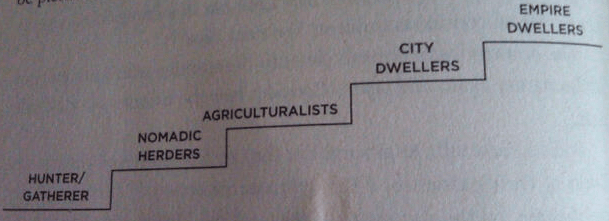
McLaren argues that there is no literal fall—a term he argues we’ve been “brainwashed” into believing through our reading of the Bible from a Greco-Roman perspective. In fact, he asserts Genesis recounts a story initially of ascents:

It is a first stage of ascent as human beings progress from the life of hunter-gatherers to the life of agriculturalists and beyond. Their journey could be pictured like this:
But also of a descent:

But the ascent is ironic, because with each gain, humans also descend into loss. They descent (or fall—there’s nothing wrong with the word itself, just the unrecognized baggage that may come with it) from the primal innocence of being naked without shame in one another’s presence.
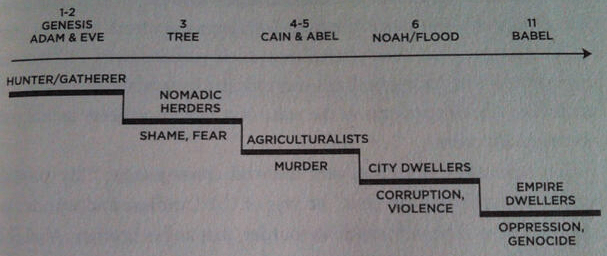
Each step of socioeconomic and technological ascent thus makes possible new depths of moral evil and social injustice. (p. 50-51)

As humans, with progress (implication of ascent) there is also loss (which in turn puts humans on a descent). Thereby, we now lose the vertical pattern of Platonic perfection-ideal as expressed through the Greco-Roman view of Eden but have a more progressive view of the Bible—a stepping stone, if you will.

If Genesis sets the stage for the biblical narrative, this much is unmistakably clear: God’s unfolding drama is not a narrative shaped by the six lines in the Greco-Roman scheme of perfection, fall, condemnation, salvation, and heavenly perfection or eternal perdition. It has a different story line entirely. It’s a story about the downside of “progress”—a story of human foolishness and God’s faithfulness, the human turn toward rebellion and God’s turn toward reconciliation, the human intention toward evil and God’s intention to overcome evil with good. It begins with God creating a good world, continues with human beings creating evil, and concludes with God creating good outcomes that overcome human evil. We might say it is the story of goodness being created and re-created: God creates a good world, which humans damage and savage, but though humans have evil intent, God still creates good, and God’s good prevails. Good has the first word, and good has the last. (p. 54)

If this view sets the stage for how to read the Bible, we are certainly in for a very interesting (and bumpy) ride.

In Chapter 6, McLaren argues that the beginning of his quest to view Christianity through a new lens was shaped by his liberal arts education and bolstered by a lack of formal theology training. I found this quote interesting:

Deconstruction is not destruction, as many erroneously assume, but rather careful and loving attention to the construction of ideas, beliefs, systems, values, and cultures.

Merriam-Webster defines deconstruction this way:

1 : a philosophical or critical method which asserts that meanings, metaphysical constructs, and hierarchical oppositions (as between key terms in a philosophical or literary work) are always rendered unstable by their dependence on ultimately arbitrary signifiers
2 : the analytic examination of something (as a theory) often in order to reveal its inadequacy

Deconstruction is not careful and loving attention to construction, no matter what McLaren says. Deconstruction is critical assessment performed in order to reveal inadequacies.

But McLaren is openly stating that he’s reading the Bible through a literary lens where he can identify protagonists, antagonists, plot, tension, conflict, resolution, and character development.

So as we head into Exodus, we read of a God who “sides with the oppressed, and God confronts oppressors with intensifying negative consequences until they change their ways, and in the end the oppressors are humbled and the oppressed are liberated.”

I can’t help but comment that McLaren is back to nonliteralism now as he says God sends a “firm but gentle” plague on the Nile River that “turns red like blood.” But let’s read what Exodus 7:14-21 says. In fact, let’s use The Message version, Eugene Peterson’s paraphrase of what the Bible says:

God said to Moses: “Pharaoh is a stubborn man. He refuses to release the people. First thing in the morning, go and meet Pharaoh as he goes down to the river. At the shore of the Nile take the staff that turned into a snake and say to him, ‘God, the God of the Hebrews, sent me to you with this message, “Release my people so that they can worship me in the wilderness.” So far you haven’t listened. This is how you’ll know that I am God. I am going to take this staff that I’m holding and strike this Nile River water: The water will turn to blood; the fish in the Nile will die; the Nile will stink; and the Egyptians won’t be able to drink the Nile water.'”

God said to Moses, “Tell Aaron, ‘Take your staff and wave it over the waters of Egypt—over its rivers, its canals, its ponds, all its bodies of water—so that they turn to blood.’ There’ll be blood everywhere in Egypt—even in the pots and pans.”

Moses and Aaron did exactly as God commanded them. Aaron raised his staff and hit the water in the Nile with Pharaoh and his servants watching. All the water in the Nile turned into blood. The fish in the Nile died; the Nile stank; and the Egyptians couldn’t drink the Nile water. The blood was everywhere in Egypt.

The quote above is simply a paraphrase—someone’s interpretation of what is occurring in the Bible. I’m amazed that McLaren is so intent on reading the Bible non-literally that he tries to explain away what’s happening in the Bible through literal means: “Ironically, perhaps through a red tide, the Nile turns red like blood.” As a result of McLaren’s literary reading of Biblical passages, he begins to make literal assumptions about these passages that aren’t there.

On page 58, McLaren says “God never works directly, only indirectly” and reduces the plagues often seen as something extraordinary and supernatural into nothing more than ordinary and natural. He diminishes the work of God.

McLaren argues the Bible presents three narratives:

  1. God as creator
  2. God as liberator from external and internal oppression
  3. God as reconciler

After reading beautiful literary passages from Hosea, Joel, and Isaiah, McLaren encourages his readers to see the future as something that “is not fatalistically predetermined” but rather see history as “live”—“unscripted, unrehearsed reality, happening now—really happening.” (p. 62-63) Here, McLaren rejects the premise of a predetermined, foreknown future by God (Jeremiah 29:11; Acts 2:22-23; Romans 8:28-30; I Corinthians 2:7; Ephesians 1:5,11).

Then McLaren attempts to literalize Scripture within a modern framework despite saying, “As this approach relieves of literalistic interpretations, it frees us to let the poetry work as poetry is supposed to”:

Swords into plowshares. Today that would mean dreaming about tanks being melted down into playground jungle gyms and machine guns being recast as swing sets. (p. 63)

That’s just one example. It’s a clever reading of the passage but the fact of the matter is, McLaren is trying to take the literal, make it literary, and then convert the literary as the literal he wants to see. To put it bluntly, McLaren is reading things in the Bible that simply aren’t there.

McLaren is very good at igniting passion and hope for a better tomorrow that seems as if it can occur today.

If the Genesis story sets the stage by giving us a sacred vision of the past, and if the Exodus story situates us in the sacred present on a pilgrimage toward external and internal liberation, then the story of the peace-making kingdom ignites our faith with a sacred vision of the future, a vision of hope, a vision of love. It represents a new creation, and a new exodus—a new promised land that isn’t one patch of ground held by one elite group, but that encompasses the whole earth. It acknowledges that whatever we have become or ruined, there is hope for a better tomorrow; whatever we have achieved or destroyed, new possibilities await us; no matter how far we have come or backslidden, there are new and more glorious adventures ahead. And, the prophets aver, this is not just a human pipe dream, wishful thinking, whistling in the dark; this hope is the very word of the lord, the firm promise of the living God.

Perhaps I’m not as optimistic or those darn Greco-Roman glasses keep getting in the way.

Again, I appreciate McLaren’s attempt to read the Bible with a new perspective but there needs to be a balance between the literal and literary interpretations. I understand that some people Bible see the Bible as purely a literal work of God; others see the Bible as nothing more than a beautiful piece of literature. McLaren looks as the Bible as a beautiful piece of literature and then tries to recast it into a literal work with explanations that are a stretch. Frankly, McLaren’s attempt at a new kind of Christianity appears headed extremely off-course as I go into reading Chapter 7.

Food for thought #3: A New Kind of Christianity

What is the overarching story line of the Bible?” McLaren asks. His response, which really comes across as more of an authoritative answer in some areas, is that current Christianity reads the Bible through the lens of an Aristotelian-Platonic universe. He calls it a Greco-Roman story line where Christians see God as something akin to Zeus or Jupiter—a perfect heavenly being that is ready to strike down flawed creatures on a whim—and if certain creatures never reach the Platonic ideal of heaven then they are sent down to a Greek Hades, a hell, “imagery misappropriated from Jesus’ parables and sermons.” (p. 44)

McLaren may have a point. Perhaps Christians read the Bible through the lens of this Greco-Roman narrative, but it’s worth pointing out that Jesus’ story developed within a Roman context. (Pilate? Caesar, anyone?) And that the New Testament was written in Greek. As a result, I disagree with McLaren that this Greco-Roman narrative is necessarily bad. Instead, I argue that the Greco-Roman narrative provides a form of context as a result of being influenced by the Roman Empire and the original language of the New Testament. This influence is inescapable.

McLaren also makes the point that we should read the Bible for the Judaic narrative that it is—as Jesus would have read it. That is a fair and valid point as well. Therein lies the challenge: reading the Bible for what it is without inserting a post-Jesus historical lens (ie, reading the Bible through a post-Reformation lens or a post-Council of Trent lens).

Food for thought #2: Brian McLaren’s A New Kind of Christianity

I have a slight problem with Brian McLaren’s graph from p. 34 of A New Kind of Christianity. His graph is shown above in the picture; my revised version is shown below.

McLaren places Eden on the level of Heaven which basically equals perfection. That might bother some but it doesn’t bother me. The only difference between my graph and his is the direction of the “Hell/Damnation” arrow. While nitpicky, I have a fundamental disagreement with McLaren on this one.

From a theological perspective, what bothers me is the downward direction of the arrow. Perhaps he drew it that way because we always think of heaven as existing above and hell existing below. I redrew it to make it a continuous straight line not only because I have semi-OCD tendencies but also because the destination as a result of condemnation is hell/damnation. It’s not a downward trajectory from condemnation but rather, a continuous path that is not separate from it. According to the Bible, this is the spiritual path that all souls are on as a result of the fall (Romans 5:17-19).

I’d also like to add that I’m interested in reading McLaren’s response to the pluralism question: “How should followers of Jesus relate to people of other religions?” On page 21, he briefly summarizes what he’ll try to address:

So we ask: Is Jesus the only way? The only way to what? How can a belief in the uniqueness and universality of Christ be held without implying the religious supremacy and exclusivity of the Christian religion?

I think it’s an interesting question to posit and answer, oops, I mean “respond to.” (There are no answers according to McLaren, only responses in an effort to stimulate and continue conversation. For a great Biblical counseling perspective on this conversation, check out Bob Kellermen’s series in which he provides responses to McLaren’s questions.)

So here are my initial responses before reading the chapter in which McLaren expounds on the pluralism question:

  • Is Jesus the only way? “I am the way, and the truth, and the life; no one comes to the Father but through Me.” — John 14:6
  • The only way to what? God the Father and His house. Thomas specifically asks about this. See all of John 14.
  • How can a belief in the uniqueness and universality of Christ be held without implying the religious supremacy and exclusivity of the Christian religion? While I appreciate McLaren’s question here, I’d rather “lob back” in response, as he’d say, that there’s a supremacy and exclusivity that’s inherent in Christ rather than the Christian religion. I don’t think any system of belief is foolproof. I believe only Christ is. Religion muddies waters (how many Christian denominations are there?); Jesus Christ is crystal clear. That being said, I believe there is a uniqueness and universality of Christ that transcends all beliefs and religions but there is a supremacy and exclusivity that is inherent in the God/man rather than the religion. (I’m sure this is something I will clarify and elaborate on as I progress within McLaren’s book.)

I’m excited about reading through A New Kind of Christianity. I have an open mind about this and am totally willing to transform my Christian faith and live it in a new way with only one caveat: it must remain true to the Bible. If McLaren argues something that goes against what the Bible says, I’ll point it out. We know very little about Jesus apart from the Bible. And we would know nothing about Jesus’ teachings without the Bible. So holding McLaren and his questions and responses to a Biblical standard is neither unreasonable nor unfair since he is talking about the the Christian faith.

I hope you’ll join me in my journey through this book. If you don’t know who Brian McLaren is or what a little bit of background on what part of the Christian faith he comes from, please check out my series on the emergent movement.

    Occasional posts on Brian McLaren’s A New Kind of Christianity

    I’m reading through Brian McLaren’s A New Kind of Christianity and will post my thoughts on my blog as they strike me. You can find the first one here: http://bit.ly/8YYns6. I am working on a second.

    For blog posts from a Biblical counseling perspective, please follow Bob Kellermen’s series.

    Food for thought: From Brian McLaren’s A New Kind of Christianity

    A quote I found interesting:

    When you talk to the people who walk down the aisle at a Billy Graham crusade to make a “first-time Christian commitment,” who say something called the “sinner’s prayer” in response to an evangelistic invitation, or who join a new church, you discover that over 90 percent of them are already lifelong churchgoers. That means that over 90 percent of the so-called new converts come from the 40 percent of the population who are already “in the choir,” and less than 10 percent come from the “unchurched majority.” So we have a lot of Baptists becoming Pentecostals, and Catholics becoming Episcopalians, and so on, but surprisingly few “unchurched people” getting connected with the church. (p. 4)

    McLaren’s point is interesting in light of this piece from the Huffington Post, “Listen Up, Evangelicals: What Non-Christians Want You To Hear”: http://is.gd/aaCCI. An observation from this piece that struck me:

    “I have no problem whatsoever with God or Jesus – only Christians.”

    Sad. I have heard this from other Christians as well.

    Thoughts on “Hear No Evil” by Matthew Paul Turner

    I’m not writing a book review on Hear No Evil because I wasn’t planning on it. But as I read through Matthew Paul Turner’s book, I wanted to offer a few thoughts. (Thanks to Jezamama for sending the book to me after winning her book giveaway contest!) I found some choice quotes that seemed especially insightful to me:

    “The odd thing about Christians pursuing fame is that they do it while pretending not to be interested in fame. Their goal, most say, is not to bring fame and fortune to themselves. Their only interest is to make Jesus known. But in the process of making Jesus better known than he already is, a lot of Christian musicians find fame and fortune for themselves too.”

    This thought gets to the heart of two main things about Christians:

    1. We want to do good things for God but because we’re sinful, our motives are always tainted and impure.
    2. We want glory and honor for ourselves under the cover of doing great things for God.

    Turner does an especially great job at illustrating this through his encounter with Jeff and Jack. (Btw, the section where he describes meeting Poppa Gladstone and going to his concert was HILARIOUS to me.)

    Another quote that jumped out at me:

    “I liked being Calvinist because it made me feel controversial and edgy to believe something different than what my parents believed.  … I think that’s why people like Josiah and me sometimes turned into Calvinists. We could be passive-aggressive toward our parents and our past lives without being considered unchristian. Reformed doctrine offered a different way to think about God. And sometimes different, even when it really isn’t that different, is all we need to make us feel alive, creative, and in control of our own destiny.”

    I’m part of a Christian message board in which the Calvinism vs. Arminianism debate is as worn out as a pair of sandals on a Middle Easterner. But a recent debate I engaged in questioned whether young people adopt Calvinism to buck responsibility. Turner sums the adoption of Calvinistic thought among young adults much better than I could have ever thought to put it.

    Overall, I found Hear No Evil to be a humorous and an amazingly well-written book.

    • My eyes nearly fell out of their sockets when I read about the naive Christian rocker who didn’t know the famous person sitting in the corner (end of Chapter 1);
    • I guffawed (and I mean, guffawed) at the names “Sandi Fatty and Sandi Cow Patty;”
    • I read in amusement as no Christian denomination gets out of Turner’s book unscathed (well, except for maybe the Roman Catholics);
    • I winced as Turner describes his encounter with a church member who attended Pensacola Christian College;
    • I wondered how a CCM editor ethically handles seeing a story with fabricated quotes of a Christian musician who was in the process of healing after a painful divorce;
    • And my heart broke as I read about a man who attended church after having been kicked out of his old one because he was gay.

    I didn’t grow up Independent Fundamental Baptist (IFB) but it is amazing how I was able to relate to many of Turner’s anecdotes despite my short stint in that realm in young adulthood. In a way, Hear No Evil is really Chicken Soup for the Recovering Independent Fundamental Baptist’s Music Soul. Turner’s book on his general IFB experience, Churched, is on my must-read list now. You can connect with Turner on his blog at http://jesusneedsnewpr.blogspot.com or through Twitter: http://www.twitter.com/jesusneedsnewpr.

    Apologies for not providing page numbers for the quotes. I’m already shipping the book off to a friend who lost a contest to win the book. This book is too good to keep to myself.

    Thoughts on He Talk Like A White Boy

    I recently completed reading Joseph C. Phillips’s book, He Talk Like A White Boy. You may best remember Mr. Phillips as Lt. Martin Kendall, Denise’s husband, on The Cosby Show.

    Now, I gotta be honest. I picked up the book for two reasons:

    1. He was one of few black men I always thought looked handsome (even as a kid!).
    2. The title.

    I don’t remember how I initially happened upon it but a few years back, I stumbled across the book, saw the title, and thought to myself, This is on my must-read list before I die. I’m glad to say I wasn’t disappointed.

    The title of He Talk Like A White Boy juxtaposed with the image of a black man resonated a chord with me. I instantly thought, I have got to read this. Black people have told me all my life that I talk like a white person. I can identify with this.

    And identify I did.

    Although 20 years of age separate us, it’s amazing how he was able to relate his experiences from things that occurred in the 60s and 70s, only for me to identify with much of it having grown up in the 80s and 90s.

    The book seems to be a collection of essays that he’s written in the last decade (the book was published in 2006) so it was divided up into five primary sections:

    1. Character
    2. Family
    3. Faith
    4. Idealism
    5. Identity

    But before I even cracked open the book, I read the book jacket. Apart from acting, Phillips also works as a conservative commentator and was a heavy supporter of George W. Bush. Knowing that made me cringe. (If I’m honest, I still do.) But I determined that I would give Phillips a chance to speak to me on politics. Even though I’m not wholly a conservative, I feel that black conservatives are some of the most disdained members in the political arena. Keeping this in mind, I decided to be, you know, tolerant.

    While I enjoyed reading the first three sections, I most enjoyed the latter two. (Although, admittedly, the book got progressively better going through each section.)

    Once I stumbled upon the essay Black Conservatism, Black Pride at the beginning of the Idealism section, I took a deep breath before I began. Be tolerant and open-minded, I told myself. You never know what you might learn.

    I indeed learned quite a bit. Despite the fact that I am not a Dubya fan, I am willing to give credit where credit is due. Phillips pointed out that Bush II had the most racially diverse presidential administration in the nation’s history up until the Obama administration. And despite all cries that Dubya was a committed racist, he consistently had a black Secretary of State during each term he held. (He could have easily replaced a white person in Colin Powell’s spot after Mr. Powell resigned.) So I’ll give Dubya credit for having the most diverse administration of his day.

    Phillips also goes on to speak about Dubya’s journey to Africa and the money he pledged to fight HIV/AIDS and terrorism in the country. For a president who many cried were racist (especially as a result of Katrina), Bush II appeared to be more of a friend to black people than he is given credit for.

    *Discuss Black Conservatism, Black Pride – how he could not be a Republican back in the civil rights era, how it’s okay for blacks to believe whatever they want on the political spectrum (my view)

    *Discuss Reparations, Affirmative Action, how he attacks inherent racism in Hollywood and liberals

    *Then speak of identity – how it impacted me and how I was able to relate to it: Black & White, especially.

    Personal thoughts on Tim Keller’s book, Counterfeit Gods

    I recently published a book review on Tim Keller’s book, Counterfeit Gods, but wanted to write a post that is a bit more personal in nature. I left off with this:

    To dethrone any and all other idols apart from God, Jesus’ sacrificial death on the cross must be real. The heart of the matter can be summed up in this question:

    What is operating in place of Jesus Christ as your real, functional salvation and Savior?

    It is a question that Christians should not neglect to ask themselves every single day.

    The cynic in me struggles with this. God knows how much I am very much a doubting Thomas, plagued with questions like:

    • “Jesus, were you real?”
    • “Are you really coming back?”
    • “How come you haven’t done anything for so long?”
    • “Can the compilation of what people claim to be Your word (the Bible) really be trusted?”

    I’ve come to the realization that I am the very least, a Jew. (Yeah, go ahead and make a Sammy Davis, Jr. joke now.) I believe wholeheartedly in the Old Testament. But the more I think about it, the more the Old Testament constantly points back to Jesus. (The Book of Matthew is a great book for discovering how the Old Testament continuously points to Jesus.)

    Now while the Pharisees were gathered together, Jesus asked them a question: “What do you think about the Christ, whose son is He?”
    They said to Him, “The son of David.”
    He said to them, “Then how does David in the Spirit call Him ‘Lord,’ saying,

    ‘THE LORD SAID TO MY LORD,
    “SIT AT MY RIGHT HAND,
    UNTIL I PUT YOUR ENEMIES BENEATH YOUR FEET”‘?”

    If David then calls Him ‘Lord,’ how is He his son?”
    No one was able to answer Him a word, nor did anyone dare from that day on to ask Him another question. ~ Matthew 22:41-46

    A puzzling question to me as well.

    So the basic hurdle that I am confronted with is whether I believe fully in Jesus Christ, who he is, and his purpose for being born on earth–his existence as fully human and fully God; that he is the Son of God, born to a virgin, lived, died on a cross bearing God’s wrath for the sins of humankind, was buried, and rose again three days later. If I accept this (and I do), then I also accept that the triune God alone is worthy of worship, leading me to adhere to the following commandment:

    You shall love the Lord your God with all your heart, and with all your soul, and with all your mind. ~Matthew 22:37

    This is not in conflict with the first commandment God issues (located in Exodus and Deuteronomy):

    I am the LORD your God, who brought you out of the land of Egypt, out of the house of slavery. You shall have no other gods before Me.  ~Exodus 20:2-3 & Deuteronomy 5:6-7

    Jesus reiterates that God must take the primary place in our heart, soul, and mind. He is to be the only One people worship. He must constantly occupy our daydreams and imaginations even. I quoted this passage from Keller’s book in my previous post but it strikes and convicts me so that I feel compelled to repost it:

    Archbishop William Temple once said, “Your religion is what you do with your solitude.” In other words, the true god of your heart is what your thoughts effortlessly go to when there is nothing else demanding your attention. What do you enjoy daydreaming about? What occupies your mind when you have nothing else to think about? Do you develop potential scenarios about career advancement? Or material goods such as a dream home? Or a relationship with a particular person? One or two daydreams are no [sic] an indication of idolatry. Ask, rather, what do you habitually think about to get joy and comfort in the privacy of your heart?

    If I’m honest, I must admit God does not constantly occupy my thoughts as He should. I also frequently fail to follow this directive from the apostle Paul as listed in Philippians 4:8:

    Finally, brethren, whatever is true, whatever is honorable, whatever is right, whatever is pure, whatever is lovely, whatever is of good repute, if there is any excellence and if anything worthy of praise, dwell on these things.

    How often do I dwell on the things that are false, dishonorable, wrong, impure, ugly, and bad repute, full of mediocrity and worthy of condemnation!

    As a result, I’ve instantly created an idol. Keller writes:

    Idolatry is not just a failure to obey God, it is a setting of the whole heart on something besides God.

    In my previous post, I listed all the idols Keller identifies. While I’ve struggled with many of those idols at one time or another, these are the main idols that currently dethrone God in my life: Continue reading “Personal thoughts on Tim Keller’s book, Counterfeit Gods”

    Tim Keller’s Counterfeit Gods (Book Review)

    My church recently distributed Tim Keller’s book, Counterfeit Gods, for Christmas to whomever wanted it. I’ve heard people sing Tim Keller’s praises but have never read his books or visited his church or church plants. Therefore, I decided to pick this book up first before picking up Keller’s other bestsellers that have piqued my interest: The Reason for God and The Prodigal God. And besides, it was FREE. How can you beat a FREE book?

    I made a goal to finish reading the book before the clock struck midnight for 2010 and achieved that goal. The hardcover book, barely larger than 5 x 7 inches, is just under a 200-page read (including the Introduction but not including Notes, Bibliography, or Acknowledgments). I’m a bit of a slow reader so I was able to complete the book in about three days (of dedicated reading). A fast reader could easily complete this book in a day–it’s that small.

    Upon completion of the book, I was pleasantly surprised to discover how much I enjoyed it. And it stood in marked contrast to a book I most recently finished, It’s Your Time by Joel Osteen, that touts health and wealth as proof of God’s favor upon an individual. Usually, I take a couple of days and allow my mind to fully absorb the contents from the book before making a full judgment, however, Counterfeit Gods impacted me so much, I view it as a life-changing book.

    Perhaps life-changing seems like an exaggeration but for me it is not. I operate on a five-star rating scale, basically using the Amazon system:

    * (one star) – I hated it
    ** (two stars) – I didn’t like it
    *** (three stars) – It’s OK
    **** (four stars) – I liked it
    ***** (five stars) – I loved it

    Counterfeit Gods gets FIVE stars from me. It’s not easy for a book to garner that high a rating from me but I personally can’t find any fault with it. (Perhaps a pastor or some high-falutin’ theologian would.) Keller is clear, concise, uses modern-day and Biblical examples to support his points, and instructs readers on how to identify and replace any idols in their lives.

    Keller leaves no graven image unturned in this book. This book, aptly titled Counterfeit Gods, could also have been titled If You’re Breathing, You’re Probably Breaking the First Commandment. Keller posits that anything that dethrones Jesus Christ as the sole object of worship in our lives is an idol. He also asserts that the remaining nine commandments are basically elaborations on the first:

    I am the LORD your God, who brought you out of the land of Egypt, out of the house of slavery. You shall have no other gods before Me.  ~Exodus 20:2-3 & Deuteronomy 5:6-7

    Since Counterfeit Gods is a relatively recent book, he begins by addressing the economic fallout of 2008-2009 that led the United States into a recession. He refers to wealthy investors who made money their sole god. So when the bottom dropped out of the economy and those investors lost millions upon millions of dollars, they had nothing left to turn to. As a result, many of them committed suicide. Except for one bright shining hope in an investor named Bill who gave his life to Christ in 2005. Bill testifies:

    If this economic meltdown had happened more than three years ago, well, I don’t know how I could have faced it, how I would have even kept going. Today, I can tell you honestly, I’ve never been happier in my life.

    Don’t get the idea that Keller is saying becoming a follower of Jesus Christ leads to a life of butterflies and sunshine. Quite the contrary, he implies Christians have a tougher road ahead of them because they are called to a higher standard. As a result, Keller points out that today’s (mainly Western) Christians often don’t look much different from non-Christians.

    Contemporary observers have often noted that modern Christians are just as materialistic as everyone else in our culture. Could this be because our preaching of the gospel does not, like Saint Paul’s, include the exposure of our culture’s counterfeit gods?

    Harsh words. It certainly convicted me.

    For starters, it would be good to define what an idol is. Here is the basic definition Keller provides:

    It is anything more important to you than God, anything that absorbs your heart and imagination more than God, anything you seek to give you what only God can give.

    Despite the book’s subtitle, The Empty Promises of Money, Sex, and Power, and the Only Hope That Matters, Keller does not limit his discussion of idols to money, sex, and power. Not at all. Here’s a full list of the idols he identifies (located in the Notes section) with brief descriptions: Continue reading “Tim Keller’s Counterfeit Gods (Book Review)”

    Books I’ve Read in 2009

    Here’s a list of books I’ve read in 2009. More a list for myself than for the rest of the world but feel free to offer comments if you’re so inclined.

    1. Transforming Grace by Jerry Bridges
    2. When People Are Big and God Is Small by Ed Welch (3rd read)
    3. God’s Plans For You by J. I. Packer
    4. Relationships by Tim Lane & Paul Tripp
    5. The Book Thief by Markus Zusak
    6. Holy Ground: Walking With Jesus as a Former Catholic by Chris Castaldo
    7. It’s Your Time by Joel Osteen
    8. Velvet Elvis by Rob Bell
    9. Jesus, Keep Me Near the Cross by Nancy Guthrie
    10. Come, Thou Long-Expected Jesus by Nancy Guthrie 
    11. Sacred Marriage by Gary Thomas
    12. Pride and Prejudice and Zombies by Jane Austen and Seth Grahame-Smith
    13. Counterfeit Gods by Tim Keller

    I actually think I’ve read more than that but that’s what I’ve got off the top of my head for now. I’m actually surprised at how much I’ve read this year. I usually start a lot of books but never finish them but with the exceptions of those noted “in progress,” I’ve completed the reading of all those other books this year in their entireties. Also, I most recently enjoyed Holy Ground (which is the book I’ve most recently completed). Here’s a brief commentary: Continue reading “Books I’ve Read in 2009”

    It’s Your Time Book Review: Dump this book, Discard much of what you learn, Desist reading

    Inspired by this post from Matthew Paul Turner, basically making fun of Pastor Joel Osteen’s (NOT OLsteen, maybe LOLsteen) new book, It’s Your Time and a one-star review on Amazon in which the “reviewer” essentially wrote that Osteen was a fraud, he hadn’t read the book, and never intended to read the book (the review’s since been taken down), I felt prompted to go where most Biblical evangelical Christians choose not to go.

    I decided to read Joel Osteen’s latest book to see if dollar signs would really begin flashing right before my eyes. However, I need to add a disclaimer of a sort:

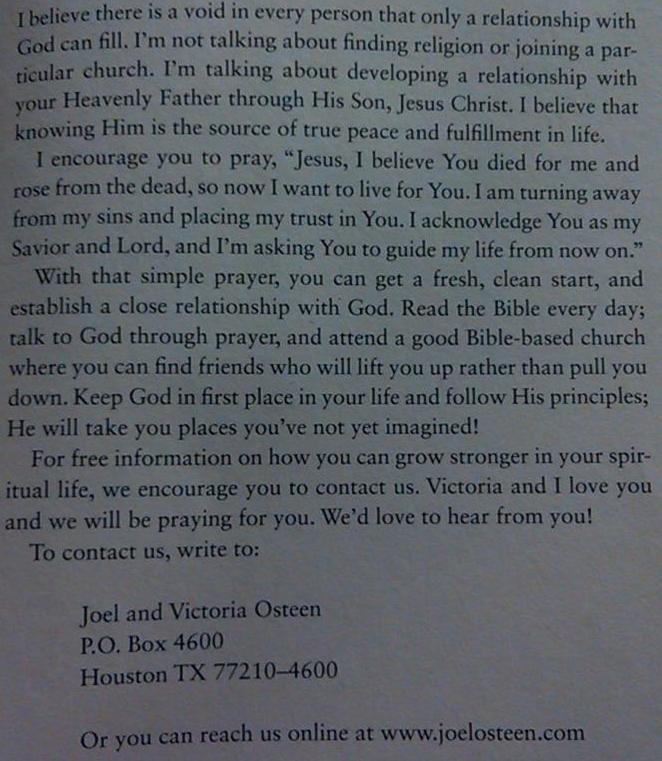
    Last page with text in "It's Your Time"I am a little sensitive to Joel Osteen and his ministry and likely not as hard as I should be. Thank my mother. I believe that God used Pastor Osteen’s ministry to bring my mother to a saving knowledge of Jesus Christ. She was hesitant for many, many years but after watching Pastor Osteen regularly, softened up, accepted Jesus as her Lord and Savior, and now regularly attends a local Bible-believing church. I have seen Osteen’s telecast and at the end, he does give an invitation (though many Biblical evangelicals would consider it a weak one) to accept Jesus. Although the criticism is that Jesus is secondary to his preaching of the “health and wealth” gospel,” which we’ll get to later on in the review. (Click on the photo on the left to enlarge it and essentially read the “invitation” Joel Osteen provides.)

    I wrote an unfinished review of It’s Your Time and was probably more favorable to it than most Biblical Christians would have been. So now that I’ve completed this book, how would I rate it overall?

    Two stars.

    What were the issues then that led me to give this book a rating comparable to “poor”? Quite a bit. Sit back and have a nice cup of coffee or tea as you review this list with sometimes lengthy explanations. Continue reading “It’s Your Time Book Review: Dump this book, Discard much of what you learn, Desist reading”