Book Review: His Majesty’s Hope

HMHDisclaimer: I received an advance reader copy from Random House.

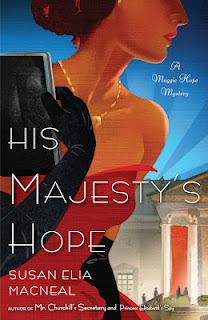
Suspenseful and riveting, His Majesty’s Hope by Susan Elia MacNeal is the best installment in the Maggie Hope series yet.

Without giving away spoilers, Maggie’s next mission plunges her into the heart of Germany—Berlin—during the height of World War II. Maggie has a few secrets under her belt that she must keep to herself (other than the fact that she’s a British spy).

The stakes are high and the action takes off from the get-go. The book can be read as a standalone for newcomers to the series, but I see the thrilling novel as a reward for fans and longtime readers of the series to see a side of their heroine that they’ve never seen before. Readers of mystery, thriller, and suspense will enjoy the edge-of-your-seat ride that His Majesty’s Hope provides.

Reading 8 Books at One Time

For someone who reads as much as I do, I have a blank brain for writing my own story. I am reading 8 books at one time:

  1. The 7 Habits of Highly Effective People
  2. The Chronicles of Narnia: The Magician’s Nephew
  3. Wicked Girls
  4. Princess Elizabeth’s Spy
  5. I’d Like to Apologize to Every Teacher I Ever Had
  6. The Art of War for Writers
  7. The Essential Rumi
  8. Grace (Eventually): Thoughts on Faith

Continue reading “Reading 8 Books at One Time”

My Favorite Authors

Here’s a list of my favorite authors:

  1. Gail Carriger: Her books are clever and funny and don’t take themselves too seriously.
  2. John Grisham: If I want a good, fast-paced, suspenseful story, I always know where to turn.
  3. Anne Lamott: I’ve only read her nonfiction work, but I love her style of writing.
  4. Tess Gerritsen: The Rizzoli & Isles books have a voice that are all their own.
  5. Susan Elia MacNeal: Her mystery series on Maggie Hope is adventurous, quick-paced, and interspersed with real figures such as Winston Churchill and Princess Elizabeth.

5 Books I’m Looking Forward to Reading in 2013

The year 2013 promises some good books. Here’s a list of books I am looking forward to reading this year:

  1. His Majesty’s Hope: A continuation of the Maggie Hope mystery series that is filled with charm and cleverness.
  2. Untitled #3 (Divergent series): Yet another dystopian book that has action and romance.
  3. Shadow of Night (All Souls Trilogy #2): A hefty book with paranormal romance that details the story between a witch and a vampire.
  4. Untitled #3 (All Souls Trilogy): A likely hefty book, but it will be the final installment in the All Souls Trilogy.
  5. Etiquette & Espionage: A young adult book by one of my favorite paranormal/steampunk authors, Gail Carriger.

A Year of Biblical Womanhood Leads Me to Question the Bible

AYoBW

I read A Year of Biblical Womanhood by Rachel Held Evans. It got to me in a way that no other book has. I began questioning such verses as I Timothy 2:9-15, Ephesians 5:22-24, Colossians 3:18, and I Peter 3:1-2. I will quote those verses for you because I hate seeing a string of verses without seeing the actual words.

I Timothy 2:9-15

…likewise also that women should adorn themselves in respectable apparel, with modesty and self-control, not with braided hair and gold or pearls or costly attire, but with what is proper for women who profess godliness—with good works. Let a woman learn quietly with all submissiveness. I do not permit a woman to teach or to exercise authority over a man; rather, she is to remain quiet. For Adam was formed first, then Eve; 14 and Adam was not deceived, but the woman was deceived and became a transgressor. Yet she will be saved through childbearing—if they continue in faith and love and holiness, with self-control.

Ephesians 5:22-24

Wives, submit to your own husbands, as to the Lord. For the husband is the head of the wife even as Christ is the head of the church, his body, and is himself its Savior. Now as the church submits to Christ, so also wives should submit in everything to their husbands.

Colossians 3:18

Wives, submit to your husbands, as is fitting in the Lord.

I Peter 3:1-2

Likewise, wives, be subject to your own husbands, so that even if some do not obey the word, they may be won without a word by the conduct of their wives, when they see your respectful and pure conduct.

It’s tough for a married woman to believe the Bible, especially when you’ve got verses like that. Evans quotes Sharyn Dowd who says:

…the apostles ‘advocated this system not because God had revealed it as the divine will for Christian homes, but because it was the only stable and respectable system anyone knew about. It was the best culture had to offer.

So this led me to wonder: Are these verses cultural to the time and period these women lived in, or are they prescriptive for millenniums later?

It’s a question I still haven’t fully answered. Evans came to the conclusion of “mutual submission” based upon Ephesians 5:21 that says “submit to one another.” But then I feel like she’s picking and choosing which verses to adhere to and which verses she wants to throw out. But Evans admits to picking and choosing:

For those who count the Bible as sacred, interpretation is not a matter of whether to pick and choose, but how to pick and choose. We are all selective. We wrestle with how to interpret and apply the Bible to our lives. We all go to the text looking for something, and we all have a tendency to find it.

Evans has come to the conclusion that picking and choosing is what people who hold the Bible as sacred do. I tend to agree with her. I wrestle with the following text, for example I Corinthians 11:4-10:

Every man who prays or prophesies with his head covered dishonors his head, but every wife who prays or prophesies with her head uncovered dishonors her head, since it is the same as if her head were shaven. For if a wife will not cover her head, then she should cut her hair short. But since it is disgraceful for a wife to cut off her hair or shave her head, let her cover her head. For a man ought not to cover his head, since he is the image and glory of God, but woman is the glory of man. For man was not made from woman, but woman from man. Neither was man created for woman, but woman for man. That is why a wife ought to have a symbol of authority on her head, because of the angels.

As far as I’m aware, the only Christian denominations that require head coverings for women are the Amish and Mennonites. Most Christian denominations do not require head coverings and take the tact of Christian liberty upon this passage. So why not Christian liberty with the passages regarding wives submitting to husbands?

The verse that I feel like was elevated above every other was the following one from Galatians 3:28:

There is neither Jew nor Greek, there is neither slave nor free, there is no male and female, for you are all one in Christ Jesus.

I read the endorsements at the beginning of the book and became quite skeptical when I saw a blurb from Brian McLaren whose book I couldn’t even finish because it was so riddled with theological error. (I didn’t have to go to seminary to understand that McLaren was doing mental gymnastics in his book, A New Kind of Christianity.) I became even more skeptical when I saw an endorsement from Gretchen Rubin, author of The Happiness Project, who (to my knowledge) isn’t even a professing Christian. Then for the month of June, she used Debi Pearl’s book (of No Greater Joy Ministries), Created to Be His Help Meet, as her rulebook for submission. This really threw me for a loop as Pearl’s book is another text filled with theological gymnastics and riddled with error. (Who can forget or forgive the passage in which Pearl tells a young woman who is physically abused and threatened by her husband to stop “‘blabbing about his sins’ and win him back by showing him more respect”?)

When I told my husband that Evans’s book had been featured on Oprah’s website and NPR, he did further investigating and found that Evans and her book had also been featured on “The Today Show” and “The View.” Then he asked me, “Do you really want to take your cues from someone who’s been featured on Oprah and has an NPR endorsement? I’m highly skeptical of anything that was featured on morning talk show circuits.”

Kathy Keller, wife of famed pastor Timothy Keller of Redeemer Presbyterian Church in Manhattan, criticizes Evans’s hermeneutics and biblical interpretation. (Did Rachel go to seminary like Ms. Keller? I don’t know many women who have a keep grasp of hermeneutics that haven’t attended seminary.) Trillia Newbell who wrote for the Desiring God website took a different tack:

As I read the book, it became increasingly clear to me of one theme: God’s word was on trial. It was the court of Rachel Held Evans. She was the prosecution, judge, and jury. The verdict was out. And with authority and confidence, she would have the final word on womanhood.

Did she? According to Evans, she was looking for a “good story” when she first embarked on her year of biblical womanhood, but in the end:

I think I was looking for permission—permission to lead, permission to speak, permission to find my identity in something other than my roles, permission to be myself, permission to be a woman.

What a surprise to reach the end of the year with the quiet and liberating certainty that I never had to ask for it. It had already been given.

Evans found what she was looking for, but she leaves a lot of evangelical female readers like me bereft of where to go from here. Should we pick and choose as she has done or should we accept that “All Scripture is breathed out by God and profitable for teaching, for reproof, for correction, and for training in righteousness, that the man of God may be competent, equipped for every good work” as it says in II Timothy 3:16-17?

This is a long post, I know, but I’m really trying to think out the implications of Evans’s book. My husband and I were discussing the roles of men and women in marriage, and I simply couldn’t help but feel that women are marginalized in certain denominations of modern Christianity.

When Jackie Roese delivered her first sermon at Irving Bible Church near Dallas, Texas, in 2008, she had to have a bodyguard for protection.

“I think the strangest thing I heard was that a woman preaching on a Sunday morning would inevitably lead to the acceptance of bestiality,” Jackie said with a laugh.

Even before I read Evans’s book I wondered what would be so wrong with a female preacher? As Evans pointed out, Mary Magdalene was sent to tell the disciples part of the gospel—that Jesus had risen from the dead! Isn’t a woman preacher better than no one at all? I know some people would argue no, but I think “I have become all things to all people, that by all means I might save some” (I Corinthians 9:22).

And I think that’s the point of Evans’s book. The Bible is confusing, contradictory, and culture-based. Do I still believe this sacred text? Yes. Do I think people pick and choose which text to adhere to? Yes. And do I think the ultimate goal is God, Jesus, and the gospel? Heck, yes!

My Top 10 Books of 2012

It’s no surprise that as a person who works at a library that I love to read. And I’ve read more than 80 books this year. Here’s a list of the top 10 books (in no particular order) that I absolutely loved and would recommend to others:

  1. Knuffle Bunny (children’s book): A heartwarming book by Mo Willems about a toddler who loves her stuffed bunny.
  2. Help, Thanks, Wow (non-fiction/religious): Anne Lamott (my new favorite writer) discusses three words she believes comprise essential prayers. Although Ms. Lamott is a Christian, the book is not limited to Christian thought.
  3. We Are in a Book! (children’s book): Another book by Mo Willems about an elephant and a pig who discover they are in a book! It’s clever, well-written, and funny.
  4. A Discovery of Witches (paranormal romance): Liked Fifty Shades of Grey and Twilight? Then A Discovery of Witches is for you. I thought it was a Harry Potter-like story for women.
  5. Jack 1939 (mystery): An alternate historical fiction reality set in 1939, this book explores what might have happened if FDR sent out JFK as a spy during the rise of the Third Reich.
  6. Mr. Churchill’s Secretary (mystery): The World War II era is my favorite time period in history to study (hence my recommendation of book #5), and Mr. Churchill’s Secretary does not disappoint with the main character, Maggie Hope, interacting with Winston Churchill.
  7. The Immortal Life of Henrietta Lacks (non-fiction): A gripping true story about Henrietta Lacks and her family, and what became of the HeLa cells that were taken without Lacks’s permission.
  8. Man in the Music: The Creative Life and Work of Michael Jackson (non-fiction): This book explored Michael Jackson beyond the media circus and the allegations of child molestation—it explored his life as it should have been about: his music.
  9. The Search for Significance (non-fiction/Christian): This book emphasizes finding worth and significance in God rather than in people.
  10. A Praying Life (non-fiction/Christian): A down-to-earth book about prayer the includes personal anecdotes by the author and helpful tips on establishing an effective prayer life.

Reading Material for 2013

I’m a member of the social networking site Goodreads (I’d probably watch more movies if there were a site called Goodwatch or something) and each December, I plan the books I’m going to read for the next year. So for 2013, I currently have 58 books on my list. (This list will grow as books are published and I see must-read bestsellers at the library.) Thirty-six of those books are non-fiction books. I do not have them in order of books I plan to read, but here’s my goal for the year:

January
Wicked Girls (begun in December 2012)
The Art of War for Writers (begun in December 2012)
Princess Elizabeth’s Spy (begun in December 2012)
I’d Like to Apologize to Every Teacher I Ever Had (begun in December 2012)
The Darkest Minds
The Sacred Romance
A Year of Biblical Womanhood (begun in December 2012)

February
Shadow of Night
Generous Justice
Successful Women Think Differently
In the Garden of Beasts
Uglies
The Paris Wife

March
The Beautiful and the Damned
What Good Is God?
Matched (#1)
The Silent Girl
Paranormalcy
I’m Down

April
The Happiness Project
Crazy Love
Olive Kitteridge
Operating Instructions
The Girl Who Became a Beatle
Blame It on the Brain

May
His Majesty’s Hope (Maggie Hope #3)
Forgotten God
You Lost Me
The Tiger’s Wife
Porn Again Christian

June
The 7 Habits of Highly Effective People
Putting Amazing Back into Grace
The Selection (#1)
A Tale of Two Cities

July
Why Are All the Black Kids Sitting Together in the Cafeteria?
The Myth of Multitasking
Nickel and Dimed
Vienna Prelude (#1)
Jane Slayre

August
The Nazi Officer’s Wife
The Alchemist
CrossTalk
Running Scared

September
Untitled (Divergent #3)
Untitled (All Souls Trilogy #3)
The Paradox of Choice
Battle Hymn of the Tiger Mother

October
The Purpose Driven Life
The Artist’s Way
Having a Mary Heart in a Martha World
Time Management for Unmanageable People

November
Suffering and the Sovereignty of God
The Bluest Eye
Bittersweet
The Total Money Makeover
The Money Book for the Young, Fabulous & Broke

December
The Lion, the Witch, and the Wardrobe
Plot & Structure
Three Cups of Tea
When God Weeps
Ape House

I tend to read more at the beginning of the year and at the end of the year as I try to play catch up. It’s a lot to read, but I know I can do it as long as I pace myself! And Tim Keller will probably publish a book in 2013 so just add that to my list too.

Watching and Reading

Recently, I watched a documentary on President Bill Clinton called American Experience: Clinton that I found simply fascinating. It’s amazing how much Clinton’s legacy would have changed had he not gotten involved in the whole Monica Lewinsky affair. I found Clinton to be a fascinating president who, no matter how much experience he had, could have not possibly been prepared for the demands of the office, but still somehow found a way to make tough decisions that weren’t really popular with either party.

I have been reading Eat, Pray, Love and find the book to be dreadful. This isn’t the first memoir that I’ve read (Mennonite in a Little Black Dress was better) so I’m surprised by how much I dislike the author who left her husband, engaged in an extramarital affair during the divorce process, and proceeded to bribe a customs official during her stay in Bali, Indonesia. I’m surprised the book was as popular as it was given that the author seems to be self-absorbed (more so in the first third of the book rather than toward the end). Although reading Ms. Gilbert’s tripe make me want to write tripe of my own.

On the other hand, I just finished Man in the Music about Michael Jackson’s music and artistry and found that to be insightful and intriguing. I’d recommend that book for anyone who is interested in Michael Jackson and his work. It’s a five-star book.

Do you remember your favorite book from childhood?

My favorite series of books were the Sweet Valley Twins/High series. To be honest, I liked the Twins (middle grade) series better than the High series. I think I maybe touched one SVU book and didn’t find it particularly intriguing.

Top 10 Favorite Books Read in 2011 So Far

Cover images from Goodreads.com

Here’s a list of my top 10 favorite books read in 2011 so far.

1. Unlimited by Jillian Michaels

2. Soulless by Gail Carriger

3. Changeless by Gail Carriger

4. Blameless by Gail Carriger

5. Heartless by Gail Carriger

6. Organized Simplicity by Tsh Oxenreider

7. Bonhoeffer by Eric Metaxas

8. Go the F**k to Sleep by Adam Mansbach

9. From the Mixed-Up Files of Mrs. Basil E. Frankweiler by E. L. Konigsburg

10. The Surgeon by Tess Gerritsen


“The Help”: In Defense of a White Woman Writing about Black Women

Apparently there was an uproar about Kathryn Stockett’s best-selling novel, The Help, about black maids oppressed by their white employees. Now that the movie’s out, the uproar is even louder. Tons of people (both white and black) have claimed the book is racist and historically inaccurate. Ms. Stockett isn’t doing too bad in spite of this—at a nearby speaking engagement, she was charging $65 for admission.

I pose the question, then, that my husband posed to me last night: why is it racist if a white woman writes about black women experiencing racism but not racist if a black woman writes about how white women treated black woman during a time of racism?

As a writer, I say Ms. Stockett is free to express her mind about her “fictionalized” book. (I’ve heard that The Help is really a fictionalized version of true stories from Mississippi.) It’s a novel which means that it’s fiction which means that it doesn’t need to be the most historically accurate book ever.

As a black woman, did The Help offend me? A little. I bristled during the first hundred pages of the book. Then I jumped to the end to see if the author had some kind of Afterword, which she did. I’m not sure I would have continued reading the book had I not read the Afterword. It makes me wonder whether Stockett was a little girl influenced by a black maid who just suddenly disappeared because her racist momma might have fired her and was atoning for her parents’ sins.

There is nothing Sambo-ish or overtly racist about this book. (Maybe the movie is different?) The main black women, Aibileen and Minny, are not idiots. I think Stockett happened to do a very good job of portraying black women who lived in the mundane: they were maids beholden to white employers who didn’t physically abuse them but still mistreated them. So these black women got back at them in a mundane way.

People complain that Skeeter is the white woman who “rescues” these black women. I see Skeeter as part of the majority ruling system that helped to make things right (again) in the a somewhat mundane way. She didn’t lobby Congress or hold hands with Minny and walk down the street in a march. She turned a racist institution upside down by publishing a book about black maids dishing on what it’s like to work in white households. Skeeter would have been nothing without the black maids who shared this information with her so no, they weren’t necessarily beholden to the “white woman” to “rescue” them.

America is a free country last I checked, and Stockett is free to write about black women as she imagines them just as Alice Walker is free to write about white women as she imagines them without being racist. Was there a lot about the civil rights movement that was left out? Heck yes! It’s very much (as Melissa Harris Perry argued against) Real Housewives of Jackson, Mississippi with a definite focus on the white women in the households. But there’s a lens that focuses in on the maids in those households too.

Black people are rarely (if ever) satisfied when white people write about racially sensitive times such as the early 1960s. White people don’t ever seem to get it right because they don’t seem to “understand” the plight of black people from those eras. But that’s what imaginations are for. And with the millions of black women in America during the 1960s, it leaves a world of possibilities.

Living Life Intentionally

This weekend I tried (although did a rather lousy job) of taking a personal retreat in which I spent time alone, focusing on developing a full life plan, which resulted in an outline of my priorities and goals in life. As a result of completing this, I had to say no to many of the things I was considering pursuing.

Image from michaelhyatt.com/life-plan

The idea of a personal retreat comes from Michael Hyatt, former CEO (and current Chairman) at Thomas Nelson. He developed a free e-book called Creating Your Personal Life Plan, adapted from Building Champions, in which he discusses the following:

  1. The Outcome of Your Life (how you want to be remembered)
  2. The Priorities in Your Life (what is important to me?)
  3. The Action Plan for Each Priority (outlining where you are and where you want to be)
    1. Purpose Statement (your purpose with each priority)
    2. Envisioned Future (how you ideally see yourself with interacting with each priority)
    3. Supporting Verse (if applicable, or perhaps a quote that motivates and inspires you)
    4. Current Reality (how does what is happening now stack up to your envisioned future?)
    5. Specific Commitments (developing a practical plan to move from current reality to envisioned future)

Hyatt recommends reviewing your life plan quarterly but following up on your specific commitments weekly to make sure that you are accomplishing what you need to accomplish toward your envisioned future.

When I think of Jesus, I think of a man who lived his life on earth intentionally and with a purpose. He didn’t do things haphazardly or “nilly willy.” If this is the example that Jesus has set for his followers, why do we as Christians simply bumble along in life simply trying to survive?

Love Wins: Book Review (aka Cliff Notes Analysis)

On Goodreads, I gave Rob Bell’s book Love Wins three stars. I might have given it 2.5 if I had the option.

I went through a detailed chapter-by-chapter analysis (but not as thorough as I would’ve liked to be!) outlining some of the issues I had in the book. Let’s see if it’s possible to recap:

Preface: Raises more questions than it answers, book has no notes, footnotes, endnotes, or bibliography. Further reading doesn’t cut it.

Chapter 1: Questions about heaven and hell that are set-up for the rest of the book.

Chapter 2: Heaven is a place on earth. God will eventually redeem and restore this broken world.

Chapter 3: Bell says Gehenna was really the city dump in Jesus’ day. Not a spiritual place of eternal torment. Bell says people can still reject God in the afterlife but leaves the door open for eventual repentance. He introduces an idea similar to purgatory in Catholicism. Then he says everyone will eventually be reconciled to God.

Chapter 4: Bell asks: Does God get what God wants?  What is it that God wants? “‘God wants all people to be saved and to come to a knowledge of the truth’ (1 Tim. 2).” Bell says contradicts himself in this chapter by saying that yes, some people believe God gets what He wants through eventual universal reconciliation and restoration but that God’s love allows for the freedom to reject him if someone wishes to do so. He adds that people don’t need to believe in the traditional doctrine of hell to be a Christian and that people can assume there’s a chance for repentance in the future.

Chapter 5: Bell tells his readers that Jesus dying on the cross and rising again the third day was a very beautiful thing. Don’t mar this beauty with nasty talk of eternal exclusivity via the traditional view of hell.

Chapter 6: Bell says that (since Paul says that) Jesus was present in the rock that Moses struck to give water to the Israelities, so Jesus is present in anywhere or anything. He also puts forward the odd idea of reverse universalism which posits that Jesus is present in all paths (ie, Jesus can be Mohammad for Muslims, Vishnu for Hindus, or nirvana for Buddhists).

Chapter 7: Using the template of the parable of the prodigal son (or the two sons), Bell says that we will all be at a party/celebration (heaven) and we can choose to exhibit negative attitudes and vices (hell) during the party if we want to. We can reject the Father’s love.

Chapter 8: Bell reminds his readers that people can miss out on rewards, celebrations, and opportunities and that love wins.

(And no, I would not have been able to do the summary above had I not done the analyses first.)

Love Wins Quotes

A few quotes from Rob Bell’s book, Love Wins, that resonated with me on some level.

“So when people say they don’t believe in hell and they don’t like the word ‘sin,’ my first response is to ask, ‘Have you sat and talked with a family who just found out their child has been molested? Repeatedly? Over a number of years? By a relative?’

Some words are strong for a reason. We need those words to be that intense, loaded, complex, and offensive, because they need to reflect the realities they describe.” (p. 72)

“Often the people most concerned about others going to hell when they die seem less concerned with the hells on earth right now, while the people most concerned with the hells on earth right now seem the least concerned about hell after death.” (p. 79)

“I have sat with many Christian leaders over the years who are burned out, washed up, fried, whose marriages are barely hanging on, whose kids are home while the parents are out at church meetings, who haven’t taken a vacation in forever—all because, like the older brother, they have seen themselves as ‘slaving all these years.’ They believe that they believe the right things and so they’re ‘saved,’ but it hasn’t delivered the full life that it was supposed to, and so they’re bitter. Deep down, they believe God has let them down. Which is often something they can’t share with those around them, because they are the leaders who are supposed to have it all together. And so they quietly suffer, thinking this is the good news.

It is the gospel of the goats,
and it is lethal.

God is not a slave driver.
The good news is better than that.”  (p. 181)

Love Wins Analysis: Chapter 8: The End Is Here

[This is the FINAL part of a multi-part series on Rob Bell’s book, Love Wins.]

Indeed, the end is here! And I know you and I are probably both glad for it.

Bell gives his testimony of how he came to know God’s love and invites his readers to trust God and that “the love we fear is too good to be true is actually good enough to be true.” Bell reminds his readers that the decisions they make today will impact the future, the hereafter.

This invitation to trust asks for nothing more than this moment, and yet it is infinitely urgent. Jesus told a number of stories about this urgency in which things did not turn out well for the people involved. One man buries the treasure he’s been entrusted with instead of doing something with it and as a result he’s “thrown outside into the darkness.” Five foolish wedding attendants are unprepared for the late arrival of the groom and then end up turned away from the wedding with the chilling words “Truly, I tell you, I don’t know you.” Goats are sent “away” to a different place than the sheep, tenants of a vineyard have it taken from them, and weeds that grew alongside wheat are eventually harvested and “tied in bundles to be burned.”

This paragraph begs for an explanation, begs for elaboration because of all the images and stories presented here. But Bell only offers this:

These are strong, shocking images of judgment and separation in which people miss out on rewards and celebrations and opportunities.

Bell glosses over the striking imagery presented in each of the parables he quickly presents, completely ignoring the deeper meaning and symbolism that lies in each because the explanation wouldn’t support his purpose in writing the book. It’s a shame because that large paragraph (not typical for Bell; I’ve done my best to adhere to his short line breaks) prompts more questions than Bell will ever be inclined to answer.

Love is why I’ve written this book, and
love is what I want to leave you with.

I walked away from this book with more frustration and unanswered questions rather than love and peace the fills the soul.