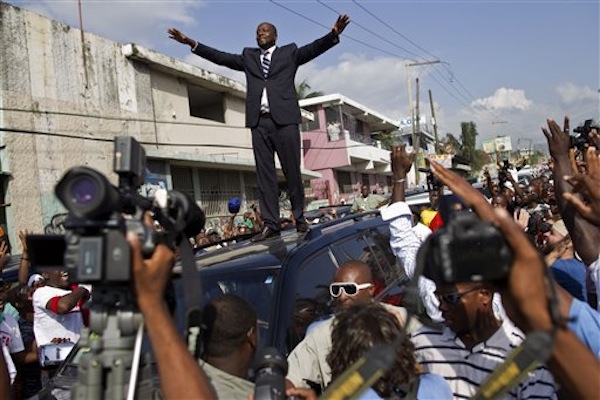
Obama on the defensive for Democrats

AP headline today: “Obama: GOP hasn’t been honest with Americans”

Sorry, Mr. President, but it’s the Democrats who haven’t been honest with Americans this time around. You control BOTH houses in Congress and can’t get the job done. Time to shift balance of power so you stop taking advantage of your voting bloc and realize you actually need to get things done and work for US.

(Not that the Republicans will fare much better but voting Democrats out will give you guys the wake-up call you need.)

Read more about this.

Keep the pressure on Barack around the Clock

Article from the AP:

Black caucus members have been staunch backers of the first African-American president. But they’ve also voiced concern that he hasn’t done enough to help struggling black families.

They point to persistent high inner-city unemployment and a new census report showing a jump in poverty on Obama’s watch. The poverty rate was 14.3 percent, with the ranks of working-age poor at the highest since the 1960s. For blacks, the rate was 25.8 percent and for Hispanics it was 25.3 percent.

Obama told [radio host Tom] Joyner he knows unemployment has been “brutal,” especially among African-Americans, but he compared the economy to a patient recovering from an accident. “It can’t run yet, but it’s walking,” he said.

The president told the Hispanic group he is committed to an immigration overhaul, even though it has stalled in [a Democratic-controlled] Congress. He blamed GOP opposition and said Hispanic voters should keep that in mind.

“You have every right to keep the heat on me and keep the heat on the Democrats,” he said. “But don’t forget who is standing with you, and who is standing against you. … Your voice can make the difference.”

The Absence of Blogging & Regular Writing

I miss blogging regularly like I used to 4 years ago. Sometimes I have things to say. Sometimes I don’t. I like to write about semi-profound things on this blog rather than ramble about my kids and my dog.

Oh wait, I don’t have either of those things.

[awkward pause]

Currently the things taking up my time include:

– A new job (I’m a librarian! Whee!)
– Novel revisions (A 22-week self-paced course in which I’m already 5 weeks behind! Whee!)
– Preparations for my grandmother’s centenarian celebration (I’m sending out the invitations 7 weeks before the event and asking people to RSVP in no later than 5 weeks! Whee!)

Some sarcasm present but honestly, I’m very fortunate to have a job I love to pieces, a novel with a story I love (even if it’s poorly written), and a dear grandmother who is nearing 100 years.

My fingers have been itching to write but now that I’m sitting at a computer and typing, my mind draws a blank. Perhaps I could rant about how poor I am with time management but I have no solutions to that. I’d like to write something a bit more serious (like how I support bipolar disorder being covered under the Americans with Disabilities Act) but I lack the brainpower for that right now. (And besides, it belongs on my rarely updated mental health blog, Depression Introspection.)

My life is busy but I can offer nothing of creative, social, political, or theological interest at the moment. Sure, there’s supposed mosques near Ground Zero, Koran burnings scheduled, and the New York Times conceding they’ll eventually stop printing hard copies of their paper soon, but these are only facts I can rattle off to you and I have little mental fortitude to offer any wit or commentary on any of these things. And I’m in no mood to rehash my already beaten-to-death topics on gay rights, infant baptism, and what dissatisfies me currently in life.

So all I’m trying to say is, I’m still alive, my fingers were itching to write (instead of edit, for once), and I have nothing of value to say.

5 High-Profile Women I Adore and Admire

Disclaimer: I recognize all of these women have significant flaws and foibles but for one reason or another, I have chosen to highlight the positive characteristics about each woman that inspires me.

1. Tina Turner
Since I was a toddler uttering “Tina Turn-ner-ner,” I have always adored Ms. Turner’s sass and sultry raspy singing. When I grew older, I dragged my mother to the movie theater to see “What’s Love Got to Do with It” a dramatized version of Ms. Turner’s biography. I watched how she rose to fame and fortune alongside her drug-addled husband Ike, battled against him, and fought poverty as a result of leaving him only to emerge successful on her own yet again. Her sheer inner strength and optimism inspired me as a teenager and continues to inspire me now.

2. Madonna
Back in the early 80s when American Bandstand’s Dick Clark asked a young Madonna what she wanted to do, she declared, “I want to rule the world.” Indeed, Ms. Ciccone has done pretty much that. People debate her talent but no one can debate her shrewdness and clever marketing ability. (Lady Gaga watched a master at work here.) Madonna, now well into her 50s, has shown consistent dedication and discipline in evolving, not only as a fashion and pop music icon, but also as a woman with staying power. She may not enjoy all the success she once enjoyed in her prime but she’s managed to remain relevant—something very few of her peers have been able to successfully do.

3. Hillary Clinton
During the early 90s, I remember Ms. Clinton taking tons of heat for trying to introduce universal health care legislation to Congress because it wasn’t what a First Lady was “supposed” to do. Republicans may have hated her from that point on, but the former First Lady garnered my respect ever since. I admired Ms. Clinton’s ability to use her high-profile position to lobby for health care reform and watched her become vilified and forced into the traditional meek First Lady role. During my brief internship, I was able to see what the former New York Senator did first-hand as she brought grants for firefighters and policemen to various towns in the state of New York (including my hometown!), fought to keep military bases open so that cities wouldn’t be shut down and hundreds of people would be put out of work, and championed hard for SCHIP (State Children’s Health Insurance Program). As Secretary of State, Ms. Clinton has represented America with a gentle yet firm hand, handling her mistakes with the grace befitting a former First Lady. Her strength and dedication to serve Americans inspires me again and again.

4. Michelle Obama
I’ll admit, I had my doubts about Barack Obama’s wife as she stood by his side on the campaign trail before he was elected president but she has pleasantly surprised me by stepping into her role as First Lady with grace and ease I never saw before. She has become a tireless champion in getting America to eat healthier, advocating for communities to eat fresh and eat local by way of connection with local farmers, and encouraging children to exercise more and eat right in the battle against obesity. While I don’t always agree with her stance on everything, she is encouraging Black communities to take ownership of their lives and their future—and I cannot begrudge that at all.

5. Tyra Banks
Ms. Banks has navigated the modeling arena with a down-to-earth attitude, incredible business savvy, and bright enthusiasm in a world that can be bleak with drugs and eating disorders. Her success is a generational mirror reflecting that of another female pioneer, Oprah Winfrey. Ms. Banks’s talk show, Tyra, has proven that she is not a dumb, air-headed woman—that she is, in fact, just like the rest of us with body insecurities, crazy moments, and tons of generosity. She has been beaten down for her fluctuating weight by tabloids and fought back by encouraging women to embrace their bodies and develop a positive body image.


Why I don’t read Black magazines

If you’ve been reading my blog for a while, you know I’m not the typical Black chick. I didn’t vote for the first Black (biracial, really) President of the United States, I’m married to a White guy, my close friends aren’t Black, and I’ve spent a good part of my childhood accused of being a sellout because I articulated myself well and listened primarily to music other than hip-hop and R&B.

Every now and then I really struggle with making the color of my skin connect with the person inside of it. I struggle with issues connected to my racial identity, often feeling insecure and overanalyzing why I don’t have any close Black friends.

But then there are other times when I realize I’m simply a Black woman who just doesn’t always see eye-to-eye with most of my Black peers.

A few years ago, I held a summer internship at a popular Black magazine. I felt fortunate in obtaining an internship and being part of the company’s history and legacy. I learned a lot during my 3 months there, but even as a temporary employee, knew I didn’t belong there. Most of the people I worked with possessed a certain amount of Black pride—I’m not talking about Blacks are the greatest race on earth or anything like that. My coworkers carried themselves with a sort of confidence and grace that seemed to announce, “I’m Black, I work for a prestigious Black magazine, and I’m honored to represent Black people in a way that encourages them to better themselves.” Not that that’s bad but I’ve never seen myself that way. I’ve always spent most of my life wishing to be someone else when it came to my personality; it should come as no surprise that it wasn’t any different when it came to my skin color.

After my internship ended, I subscribed to the magazine for 3 years (mostly with the hope that I’d write freelance articles for it; never did). At first, I read the magazine voraciously each month but then grew more and more disenchanted with it to the point where I began tossing it into the garbage for the last year of my subscription once it arrived in the mail.

And somehow a year ago, I was anonymously subscribed to Essence magazine, which is unfortunate as I’ve never cared for the magazine much at all and have taken to tossing it in the trash most months as well (or I’ll take it to the hair salon and leave it there).

The idea of exclusive racial magazines bothers me. I think there was once a time for Ebony, Jet, Essence, and other popular Black magazines, but I think that time has come and gone. (Although subscriptions, of course, contradict me.)

Many of these magazines arose during a time of racial tension. Ebony and Jet began publishing in the late 40s/early 50s of the 20th century while Essence started in 1968 and Black Enterprise began in 1970. Even after the Civil Rights Act, equality and integration still had a long way to go. Whites were reluctant to include any other race in their magazines so Blacks had to cater to their own demographic.

Forty years later, however, predominantly White magazines have made a concerted effort to include more diversity—not just Black people but also Hispanic, Asian, and other nationalities. (Although one could reasonably argue they still have a long way to go.) But Black magazines continue to cater strictly to Black people with little attempt at integration. Many of the articles infuriate me because they pit Black people against White people in various comparisons:

  • Black families earn less than White familes
  • Black women are less likely to be married than White women
  • Black men are more likely to be in debt than White men
  • Black children are less likely to get into Harvard than White kids

I’m being partially facetious with those bullet points but many of the comparisons run along those lines. These magazines rarely make comparisons against Hispanics (a race/nationality on track to overtake Whites/Caucasians as the majority).

I’m all for celebrating Black culture—not the color of our skin so much as many of the things common to American people of sub-Saharan African descent—but I just wish that Black people’s calls for equality and integration would ring true within our own community. I would love to see a magazine that caters to women of all skin colors, all hair types, all different backgrounds and nationalities. I would love to see a magazine in which you can’t predict the nationality of the person on the next page because it’s not all White or all Black. I want an magazine that’s not afraid to discuss the challenges of an integrated nation, the acceptance of interracial relationships, and the need for cultural sensitivity among different groups.

Do I need to start that too?

Secrets to a Successful Job Interview: Interview, End of Interview, & Post-interview

Interview

By the time the big day rolls around,

  • You’ve done your research on the company,
  • Discovered where you fit the job description and can play up your strengths where you don’t, and
  • Have rehearsed your answers to frequently asked questions that might be lobbed your way.

Doing these things may not make you less nervous but it has certainly made you more prepared than most of the other candidates. Continue reading “Secrets to a Successful Job Interview: Interview, End of Interview, & Post-interview”

Secrets to a Successful Job Interview: Why Me? & Interview Prep

Why Me?

After a job interview, I nearly always walk out of the building thinking, “Gee, I should teach a course on the secrets of a successful job interview.” When I told my husband about my idea, he challenged my qualifications. I couldn’t think of a better answer than, “Well, I almost always get a job offer after I’ve had the chance to interview.” I need to admit though: I’m attempting to be modest and offer myself a bit of leeway when it comes to “almost always.” I really can’t think of a time when I haven’t had a job offer after a round or two of job interviews. If I’m fortunate enough to get an offer to interview, I’m pretty much guaranteed a job offer eventually.

My interviewing experience has ranged from white collar jobs to service industry jobs. In the past 14 years, I’ve interviewed for a variety of job positions:

  • Library clerk
  • Waitress
  • Call center specialist
  • Mail sorter
  • Salesperson
  • Public relations intern (for a high-profile senator)
  • Editor
  • Editorial assistant

And that’s just the tip of the glacial island.

Five years ago, I had the opportunity to interview for three different full-time positions and all three gave me offers. This time around, I interviewed for two different part-time positions and may very well get my pick of the one which meets my availability. It’s a nice feeling to have several offers on the table and to decline rather than be declined.

Although I’ve never worked behind a Human Resources desk, I can walk into nearly any office and be the person they’re looking for despite what my recent work experience says. I want to share my job interviewing tips—namely, what’s worked for me—because the job interview stage, especially on a corporate level, is one of the most difficult and nerve-racking stages to endure. (I’ve been nervous on and off for a solid 8 days as I went through two rounds of interviews with two different organizations. Just because I’m good doesn’t mean I’m always confident. But after the interview’s over, I know I’ve nailed it. And you will too.) If God has gifted me with the ability to interview well as a potential employee, then there’s no reason why I should withhold what I’ve learned and what’s worked for me (since it’s worked so well).

I’ll provide general tips that you can find most anywhere but I’ll also give you a bit more detail than many overview sites. Again, these are the strategies that have worked for me, and if implemented correctly, could work for you as well. Be forewarned, however, they’re not all easy and you are required to do some work. But doing the right legwork pays off in the long run. (Job offer, anyone?) Continue reading “Secrets to a Successful Job Interview: Why Me? & Interview Prep”

I want my ad-free content back

This post is not brought to you by any sponsors like the ones pictured above.

For some bloggers, their content has evolved into nothing more than stealth advertising. Perhaps bloggers aren’t to blame so much as advertisers and marketers are—they’ve run a very slick marketing campaign. In the age of browser add-ons such as Ad Block and Ad Aware, companies have wizened up and now advertise around ad blockers: if ads can no longer be seen in sidebars, then it’s time to take advantage of the power of “word of mouth” and make it part of the content.

I know a lot of big events would never take place if it weren’t for sponsors, and I also know a lot of people would not be able to attend these big events without some kind of sponsorship. But if every time a blogger posts content I need to read that Southwest Air sponsored his trip to the LA Anti-Animal Cruelty Conference, that Hyatt is putting him up for a comfy three days, and that Kenneth Cole is dressing him from head to toe, I’m going to start feeling like I’m not reading the posts of a person but rather a mastermind behind a viral marketing campaign. Telling me once is enough. Telling me twice is sponsorship. Telling me three times is overkill.

I want my ad-free content back. I want someone to be able to genuinely say she loves Lands End clothing (which I do—no, I haven’t received a gift card from them and won’t be giving one away) without feeling like she was contacted by the marketing department to say it. If a guy wants to talk about how much he loves his Honda Accord or his Toyota Camry because it’s a reliable car and has lasted him 12 years, I don’t want it to appear as forced as a TV commercial. People drop name brands in their content from time to time but when a person starts gushing over how Lexapro is the greatest antidepressant ever because it relieves depression and has given them tons of joy back without any mention of side effects or negative aspects, I’ll know there’s something fishy going on.

If a person likes a brand and wants to tell the world about it, that’s fine. But if that person keeps pushing the brand repeatedly, I’m going to wonder whether he’s being paid and tune him out. The best kind of advertising is done in such a subtle way, a person has no idea he’s being marketed to; the worst kind of advertising is as repulsive as a pushy used car salesman.

I like reading what a lot of bloggers have to say. I don’t mind if ads appear in their sidebars, headers, or footers. But for heaven’s sake, keep the content AD-FREE.

Just another manic-depressive Monday

Perhaps. Not really. But I couldn’t think of anything else to title this blog post that’s a mélange of things swirling around in my head.

I may stop attending the women’s Bible study at my church. You’d think that with a Bible study, I’d attend to—what else?—learn about the Bible. However, every time I’ve walked into the Bible study, I’ve left feeling depressed, hopeless, and sometimes on the verge of despair. No one says anything rude to me or hurts my feelings. Perhaps it’s a spiritual battle that wages once I set foot in those doors but more often than not, I’ve walked in like sunshine and left as a gloomy raincloud. I know people can’t read minds but usually people are so busy with their own concerns, no one really knows it. To be fair, I also don’t stick around to give anyone the ability to detect it.

But for some reason, I’ve come to expect more from the Bible study. Not just learning about God’s word but also being able to connect what we read to who we are and what we’ve experienced. Most of the women in my Bible study do that but for some reason, I feel as though I have a muzzle on my mouth and can’t quite speak as though my experiences are inferior and my pain isn’t valid.

If I’m quite honest, the things that have shaped my experiences in life—apart from God—are my depression and bipolar disorder, two rather disturbing topics. I know not how to speak of much else and the way I look at life is framed primarily by those two lenses. The additional topic of not being able to conceive a child as soon as I hoped eats away at me like freshly laundered clothing surrounded by moths. Very few people know how deeply my pain runs on something that I’ve prayed for a year now.

But with reluctance, I’ve come to accept that even with nearly 5 years of marriage under my belt, God doesn’t want me to have kids at this juncture. However, he seems to be blessing my efforts in obtaining a part-time job, which I’ve seen as a mixed blessing. I submitted applications to four different employers for part-time positions and within 2 weeks, heard back from all of them—one outright rejection; one implied rejection; and two callbacks for scheduled interviews. In less than a month since I applied for a part-time job, I will have already gone through two rounds of interviews for two positions. (Determinations should be made this week.)

While God has been very gracious to me on the job front, I’m broken and dismayed at how he’s kept the door to childbearing solidly shut. I would have happily forgone a part-time job to stay at home and rear a child. The ease with which I’ve been able to interview for two different positions (I’ll likely have my pick when all is said and done) is something that can only come from God in an economy where unemployment is in the double-digits. But I must also acknowledge that the inability to have conceived a child as easily or quickly also comes from God. Based on the Old Testament, Bible readers know God opens wombs and closes them as well. (I’d start sobbing at my computer right now but I’m at a freelance job, fighting back the lump in the throat that precedes tears in my cubicle.) I suppose all I can do right now is redouble my efforts on revising my novel, focusing on making connections in the publishing world, and investing in the necessary tools and resources to help me reach my professional writing goals (the PT job is a step toward that). 

I’m amazed at how quickly God answered something I barely prayed for when He’s also chosen to not answer something I’ve been praying (and cried over) for much longer. Ah, only those who are list-ordering freaks and concerned with “first come, first served” fret over such trivialities. God hasn’t wiped my older prayer off the table; He’s just chosen to tackle the request at the very bottom of the list.

I still grieve, though. Every month. I know I’m not alone but I sure do feel like it once a month. An emotional pain so acute and so intense that it seems almost no one could possibly understand how you feel. I doubt I could survive the emotional turmoil of a miscarriage if the grief of not being able to conceive a child is so bad.

I’ve given up for now. The constant worrying and waiting and wondering each month has been too much of an emotional pendulum for me. And given my history with mental illness, it’s unlikely I’ll ever be cleared to adopt.


I’ve always fantasized of being part of a regular group of gals a la “Sex and the City.” Have a core group of women you trust, can share your life and problems with, and know that they’ll be there for you if you need them. But I’ve merely fantasized about it. Damn you, Hellywood, for making such unrealistic scenarios so attractive!

I’m friendly but I suppose I’m not a real friend-maker. I don’t watch reality TV or any of the popular TV shows that people bond over. At work, I engage people in conversation but keep most of my life and personal details to myself. There’s not much interesting about me beyond the fact that I’ve written a novel, maintain several blogs, like to surf the Internet, enjoy watching baseball, listen to music, and read. I cook but I don’t particularly enjoy it (although I will salivate over delicacies others have made or the stuff on Food Network… mmm…); I don’t garden and never will; and I don’t engage in any hobbies (except for taking pictures of state license plates, the weirdo that I am); and I’m not well traveled (never been west of the Mississippi, ya’ll!).

Yes, I’m a broken record because I’ve said this all before. (“There is nothing new under the sun,” ring a bell?) I love discussing theological topics, baseball scores and news, recommendations of new music, Harry Potter and other good books, and—perhaps—I may go back to engaging in political discussions. I don’t like to discuss celebrity news much (I don’t care what Lindsay Lohan wore to jail) and don’t care about fashion anymore (if the shirt fits, I’ll wear it!)—two examples of topics I view a bit shallow.


See? A mish-mash, rant-ramble on life and relationships. I don’t think I had a point to this post. May be another one of those posts that I take down because it’s gotten too teenage whiny emo and is fit, rather, for Livejournal.

Also unrelated: I am so good at interviews, I toy with the idea of sharing the secret to successful interviews on a community-scale (see FREE classes). What qualifies me to do this? The fact that I am almost always offered a position with any company I interview with. From an interviewee standpoint, I think that’s pretty darn good. Just something I toy with though.

Separation of church and state except regarding Proposition 8

Continuing to write about my opinion on recent political events, I turn my attention on international matters to a more domestic affair: the overturning of Proposition 8, California’s voter-approved ban on same-sex marriage. I have long held the view that:

  • Religious institutions have no right to impose their views into secular institutions while claiming separation of church and state, and
  • A majority group should not determine the lives of a minority group if it has no direct effect on the majority’s daily lives

I do know that it’s an uphill battle to keep the ruling overturned and that supporters of Prop 8 will do their damndest to “protect the institution of marriage” for as long as they possibly can.

Quite frankly, however, Prop 8, federal amendments banning same-sex marriage, and the prevention of even civil unions is bigotry, pure and simple. Members of the LGBT community are seen as inferior to heterosexuals and therefore, are made to suffer by not even granting them the simple right to legally marry.

The Equal Protection Clause in the Fourteenth Amendment states:

All persons born or naturalized in the United States, and subject to the jurisdiction thereof, are citizens of the United States and of the State wherein they reside. No State shall make or enforce any law which shall abridge the privileges or immunities of citizens of the United States; nor shall any State deprive any person of life, liberty, or property, without due process of law; nor deny to any person within its jurisdiction the equal protection of the laws.

Prop 8 and other same-sex marriage bans across the country (or conversely, the denial of allowing gays to legally marry) is in direct contradiction to this clause. Some might argue that this clause applies only to black people and is framed by the historicity of the post-Civil War era. However, this is the only explicit mention of equality granted for ALL citizens (born or naturalized) in the United States.

Judges who rule in favor of same-sex marriage aren’t necessarily playing favorites despite rumblings that Judge Vaughn Walker, who recently overturned Prop 8, is gay; it’s a matter of striking down any law that cuts a citizen off from a privilege of the United States—the privilege of being able to legally marry in a court of law—and forbidding the deprivation of the liberty to marry and receive all the benefits that come with marriage, in accordance with the second sentence of the Equal Protection Clause. Any judge who upholds bans on same-sex marriage is not acting in accordance with this clause and is, in fact, betraying his or her own bias in the ruling. No one is guaranteed the right to marry in the United States but all citizens are guaranteed the ability to enjoy the same privileges as one another. Denying that legal ability to any group is inequality, and under the U.S. Constitution as amended, an injustice.

So when I hear of organizations like the National Organization for Marriage that fight so desperately to maintain marriage between one woman and one man in a secular country (despite talk that it was founded on Christian principles—whatever—the U.S is not a theocracy), my blood begins to boil. If the sole purpose of organizations like this was to prevent religious institutions from having to perform gay marriages in an effort to maintain separation of church and state, then fine. But if the point is to lay some kind of hold on marriage in the secular realm as well then it’s promoting inequality—something I refuse to stand for as an American citizen and as a Christian.

Peut-Wyclef parler en français sans avoir à rechercher les mots? (Comme j’ai eu à faire)

Wyclef Jean ond yo sipòtè nan òf li pou prezidans lan ayisyen.

On Thursday, August 5, singer and entertainer Wyclef Jean filed the necessary paperwork and officially announced his foray into seeking the Haitian presidency on CNN’s Larry King Live hosted by Wolf Blitzer. The Haitian Constitution enumerates the following for a presidential candidate:

  1. Must be Haitian-born, never have renounced Haitian nationality (including the inability to hold dual citizenship)
  2. 35 years of age or older by election day
  3. Be a law-abiding citizen
  4. Own property in Haiti
  5. Hold residence in the country for 5 years before the date of the elections

While Mr. Jean may meet the first four requirements quite handily, that last one poses a problem. Mr. Jean, born in Haiti, moved to Brooklyn, NY at age 9 and has been a regular resident of the United States ever since. As I understand it, Mr. Jean may have maintained more frequent residency in Haiti during the past 3 years but he’s got 2 more years go if he wants to abide by the Haitian constitution. (And how reckless would it be to skirt around this set of laws then swear to uphold it afterward?)

But the big question on everyone’s minds, however, especially Haitians is: Is Wyclef Jean qualified, apart from what’s outlined in the Haitian constitution, to lead the Haitian nation?

The resounding answer is no. But then again, neither was Jean-Bertrand Aristide, Haiti’s first democratically elected president and former Roman Catholic priest. Continue reading “Peut-Wyclef parler en français sans avoir à rechercher les mots? (Comme j’ai eu à faire)”

Anne Rice and association with Christianity

On July 28, famed author Anne Rice posted the following on her Facebook page:

For those who care, and I understand if you don’t: Today I quit being a Christian. I’m out. I remain committed to Christ as always but not to being “Christian” or to being part of Christianity. It’s simply impossible for me to “belong” to this quarrelsome, hostile, disputatious, and deservedly infamous group. For ten years, I’ve tried. I’ve failed. I’m an outsider. My conscience will allow nothing else. [source]

As I said below, I quit being a Christian. I’m out. In the name of Christ, I refuse to be anti-gay. I refuse to be anti-feminist. I refuse to be anti-artificial birth control. I refuse to be anti-Democrat. I refuse to be anti-secular humanism. I refuse to be anti-science. I refuse to be anti-life. In the name of Christ, I quit Christianity and being Christian. Amen. [source]

After quoting a number of verses from Matthew, I Corinthians, and John, she concludes her rejection of Christianity with this:

My faith in Christ is central to my life. My conversion from a pessimistic atheist lost in a world I didn’t understand, to an optimistic believer in a universe created and sustained by a loving God is crucial to me. But following Christ does not mean following His followers. Christ is infinitely more important than Christianity and always will be, no matter what Christianity is, has been, or might become. [source]

I’m not a fan of Rice mainly because I’ve never read her books but I’ve followed her developments and statements with minimal interest since she shifted from atheism to Catholicism. Such extreme pendulum swings in faith never fail to intrigue me. With Rice’s most recent statement, I’m forced to evaluate what it is about Christianity that’s so abhorrent that she’s chosen to renounce Christ?

Before her public repudiation, it’s clear that she was struggling with many unfortunate issues Christianity is associated with. A few Facebook posts from last Tuesday:

Gandhi famously said: “I like your Christ, I do not like your Christians. Your Christians are so unlike your Christ.” When does a word (Christian)become unusable? When does it become so burdened with history and horror that it cannot be evoked without destructive controversy? [source]

Since some of you mentioned the Westboro Baptist Church in comments below, I thought I’d publish this recent news story about them. This is chilling. I wish I could say this is inexplicable. But it’s not. That’s the horror. Given the history of Christianity, this is not inexplicable at all. —Link to “How Young Is Too Young to Learn Hate?” an article about Westboro Baptist Church [source]

This shocking link was provided by a poster below. No wonder people despise us, Christians, and think we are an ignorant and violent lot. I don’t blame them. This kind of thing makes me weep. Maybe commitment to Christ means not being a Christian. —Link to “GOP-linked punk rock ministry says executing gays is ‘moral’” an article about an anti-gay Christian nonprofit [source]

These things associated with Christianity in America are unfortunate not to mention the personal travails Ms. Rice has encountered (losing a daughter to leukemia, losing her husband of 41 years, and watching her other son — a gay rights activist — endure hate-filled rants and threats in the name of Christ). I’ve never experienced any of the things she’s experienced but it makes me understand why she would choose to “quit being a Christian… in the name of Christ.”

I’ve read a lot of posts by Christians questioning whether a person can tell Christ that she loves him but doesn’t want to be part of his Bride (that is, the universal body of Christ—commonly known as the Church). The common conclusion is that no, you can’t love Christ and not be part of his Bride.

But let’s look at this example: let’s say my husband had a close friend and this close friend of his saw me spewing bigoted remarks at other people and talking about killing people who I didn’t believe lived up to my husband’s ideal of how people ought to be. I think my husband’s friend would have every right to say, “Man, I like hanging out with you but I can’t be around when your wife is around. She acts so terrible, it reflects badly on who I am.”

Christians think that the Bride is above criticism because Christ instituted the Church. Jesus loves the Church, yes, but he sees our warts and flaws and knows it is comprised of sinners. And because Christians can be so pompous about what the Bible teaches (right or not), we sometimes drive those within our body away.

Do I agree with Rice’s decision? No, I don’t, but I respect it. I’ve read some other people argue that she should have stayed in the Church (in her instance, the Roman Catholic Church) and tried to effect change from within.

Another personal example, if you’ll allow me: After Obama’s historical election to the presidency in 2008, I chose to leave the Democratic Party. I am a staunchly pro-life (that is, anti-abortion, anti-death penalty) citizen and discovered that the Democratic Party’s stance on abortion had become so relaxed (with President Obama having the most relaxed abortion policies I’ve ever heard of) that there was no way staying in the party would allow me to effect change from within. Even though I am mostly a Democrat in other respects, to continue to be a part of an institution that I had such a fundamental disagreement with would have caused me more harm than good.

However, I’m still a Christian because I believe Jesus has called me to be a part of his Church no matter how many gripes I have with my fellow believers. I believe in the cause of Christ more than I believe in his followers. And I believe that Christ’s message of love and repentance is not just for a certain group of sinners but for all people. Jesus came not to call the righteous but sinners to repentance. He came for those who are sick, not those who are well.

Like I said, I don’t agree with Ms. Rice’s decision but I respect it. They are too many Christians who think that they’re righteous and well just because they claim the name of Christ. Ms. Rice will only return to the Church once she sees more Christians admitting that they’re sickly sinners.

Early winter

Perhaps I’m a fool for making this public. Perhaps my private conversations with God should remain just that… private. (And maybe I’ll make it private.) But typing on a computer now feels about as cathartic as holding a pen pumping ink into a lined journal. And I type faster.

I’m in the midst of a spiritual winter. I feel far from God. I feel far from everyone except for my husband and maybe close family. Jesus is real but he’s somewhere else. Not here. The Holy Spirit? I forget about and ignore him most of the time. I operate as a Christian atheist, confusing conviction of the Holy Spirit for general conscience — I’m that far gone.

I have some great need to know that I am loved and cared for beyond just my husband and immediate family. It shouldn’t matter. But it does. And really, if I get down to it, I’m seeking in other people what I should be seeking in God. Continue reading “Early winter”

What Lilith has to do if it hopes to stay alive for next year…

Sarah McLachlan, Lilith Fair organizer and main headliner

One of the fondest memories of my teenage years was attending Lilith Fair.

At Jones Beach, NY about 12 years ago, I attended the festival in celebration of women in music. Lilith Fair couldn’t have been timed any better. At this time in 1998, women like Brandy, Madonna, Sarah McLachlan, Mariah Carey, and Shania Twain dominated the charts. Alternative and folksy female artists like Paula Cole, Shawn Colvin, Jewel, and Alanis Morissette also proved to be a powerhouse during this time paving the way for more current artists like Colbie Caillat, Sara Bareilles, and Michelle Branch. At the fair, I had the privilege of discovering artists like Antigone Rising, Sixpence None The Richer, and Heather Nova.

But perhaps the time of women wearing Birkenstocks and bopping to 4 Non Blondes has come and gone.

Amid a poor economic climate and struggling sales, Lilith Fair was forced to cancel the last leg of its tour and other poorly selling dates. Some media outlets are reporting that the tour is suffering from “embarrassingly low attendance.” Names like Norah Jones, Kelly Clarkson, The Go-Gos, Mary J. Blige, Rihanna, Sheryl Crow proved to be an initial draw but many of those artists were only performing in select regions and have since dropped out due to various reasons (in the case of Jones, Clarkson, The Go-Gos, and Rihanna). While it’s not unusual for acts to drop out of a tour this massive, it’s unfortunate many of them had to be some of the bigger names.

At this time, the pop music charts are dominated mostly by men and of the three women currently there (Katy Perry, Ke$ha, and Lady Gaga), only one was originally booked to perform at Lilith (Ke$ha) — and even she was relegated to being a supporting act instead of a main headliner.

The appeal of Lilith Fair has always been discovering some of the smaller, lesser-known acts while being able to connect with familiar favorites. When familiar favorites aren’t available, the smaller acts suffer as well. So what does Lilith Fair need to revamp in the hopes of continuing this next year?

1. Obtain several current, big names for each city.

Sure, Sarah McLachlan is considered a big name , performs in each city, and is the largest reason people attend the tour, but let’s face it: Ms. McLachlan hasn’t had a Top 10 hit since Lilith Fair ended in the last decade. When people pay money for multiple acts, they want to see several acts they’re interested in. Booking artists like Katy Perry, Carrie Underwood, Lady Gaga, Lady Antebellum, or Miley Cyrus would draw in a mix of old and young, generating significant sales and, in turn, revenue. Upon the initial Lilith Fair lineup announcement, I was disappointed to discover that Sheryl Crow was only performing in Northwest America (Canada and US), Rihanna and Ke$ha were relegated to Salt Lake City, and Mary J. Blige was doing a Midwest circuit. The biggest name for the Philly area (apart from Ms. McLachlan) was Kelly Clarkson. For the NYC area (one of the largest music markets), no one on the lineup has a current Top 10 hit. That needs to be rectified for Lilith Fair to be successful next year.

2. Keep up with the diversity.

I’ll give Lilith Fair credit — it’s done an amazing job of getting acts spanning all races for the 2010 reboot and it needs to do it again. My only complaint from the original Lilith Fair was the lack of diversity in the lineup. Like Jessica Herman said in Slate’s “Why Do We Need Lilith Fair Anymore?”, the festival indeed felt like “a bunch of white chicks strumming their acoustic guitars.” For Lilith 2011, I’d like to see acts that draw a multiracial audience rather than just mostly white women. Lilith needs to continue reflecting the changing landscape among women in North America.

3. Make itself relevant again.

Possibly a restatement of #1 above but Lilith Fair in the 90s had the mission of breaking down barriers for women in music. In Sarah’s absence, women have indeed proven they can do just that. Twelve years later, the mission statement can’t be the same and the big draws of the 90s (eg, Indigo Girls, Suzanne Vega) can’t continue to be relied upon now. What’s Lilith’s goal now? Simply celebrating female talent? Honoring legends and showcasing future acts? Whatever it is, Lilith needs to find its footing and make that clear.

2010 has proven to be a difficult concert sales climate with everyone from the Jonas Brothers to The Eagles cancelling shows. Perhaps Lilith Fair is simply a victim of a struggling music industry. But if it hopes to remain around next year, organizer McLachlan will have some serious tinkering to do.

Haiti: six months later… have you forgotten?

CBS News Photo

With constant news of the BP Oil Spill in the Gulf of Mexico dominating the media for the past two to three months, it’s been easy to forget about Haiti. We’ve gone back to our cushy lives and forgotten about the people who are still suffering with no imminent relief of recovery.

A dear friend alerted me to Democracy Now!’s interview with Sean Penn who has consistently been a great part of the earthquake relief among NGOs (non-governmental [private] organizations). Penn, co-founder of the J/P Haitian Relief Organization, had tremendous insight on the current condition in Haiti and what the future holds for the country. However, I want to call out a particularly interesting bit of information from the interview:

AMY GOODMAN: $11 billion promised. Where is it?

PENN: I don’t think about $11 billion. I don’t believe in $11 billion. I think that pledge money is smoke and mirrors that evaporates as the years go on. The way it’s going to happen, is if bold organizations come in here, create manufacturing— I’d like to see them start as co-ops with philanthropic commitment to that for a period of time with a kind of sunset and then they can participate in the profit.

But right now, the donor’s conference, I think, was completely misconceived. And the way that it should have been done is somebody should have raised their hand and said, “I’m gonna rebuild every school in Haiti.” Somebody else should have raised their hand and said, “I’m gonna rebuild the hospitals and we’re gonna do it right now.”

—And instead, what happened was one after another, in Port-au-Prince — the biggest city in the biggest natural disaster in human history —systematically hospitals closed following the earthquake because money was not available and not coming in to those hospitals. The money exists and existed.

Six months later and only two percent of the promised reconstruction aid has been delivered to Haiti. The Haitian government remains crippled, most governmental humanitarian forces have left the country leaving NGOs to do the dirty work of rebuilding the country.

So what needs to be done?

  • Construction and architecture. Construction needs to come in and start clearing away fallen debris. Architectural planning of new buildings  should begin to address the issues that caused such devastation in the first place. Beginning with the Haitian Presidential Palace would serve two purposes:

  1. Symbolic move: it would show the people of Haiti and the world that action is being taken.
  2. Practical move: it would set the wheel in motion for the government to have a central place of operation again.

  • Societal infrastructure. Community planning organizations need to begin mapping out feasible infrastructure (eg, roads, sewers, clean water) starting with the capital then working outward to nearby villages.
  • Job opportunities. Manufacturing needs to come in and Haitians need to be put to work to earn a decent living.

These are basic things that occurred in America and Europe during the Industrial Revolution. Is Haiti so far backward that we can’t even get 18th and 19th century innovation started in a third-world country? Yes, Haiti has suffered much devastation since January 12 but the country is also fertile ground for positive change if people are willing to invest the money and the time.